GS 2: GovernanceGS 2: PolityPrelimsGS 2: Important Aspects of Governance, Transparency and AccountabilityGS 2: Constitutional Bodies
Inter-State Council is a meeting point that has withered away. It must be rebuilt, Pg16
Article advocates reviving the dormant Inter-State Council, established under Article 263, to strengthen cooperative federalism and facilitate Centre-state policy coordination.
Practice MCQs
818 Students attempted
Key Highlights:
- The Inter-State Council, established under Article 263 of the Constitution, is currently inactive despite its crucial role in India's federal system.
- Conceived as a vital mechanism for inter-governmental consultation and policy coordination, it was formally constituted in 1990 based on the Sarkaria Commission's recommendations.
- The Council's neglect has led to a structural void in Indian federalism, hindering dialogue between the Union and states.
- Its revival is deemed essential for addressing critical national issues like delimitation, which requires broad consensus among states.
- The body has met only 12 times since its inception in 1990, with significant gaps between meetings.
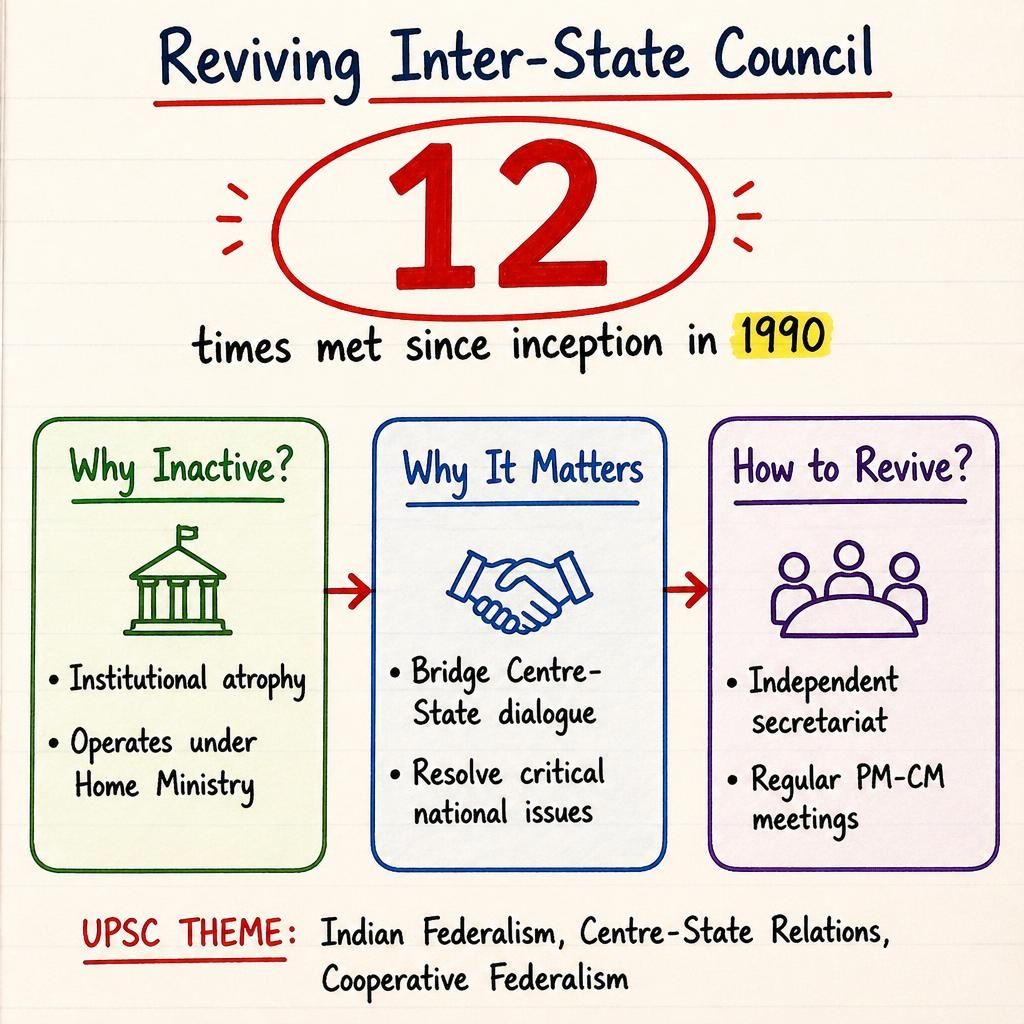
Inter-State Council.jpg
Detailed Insights:
- The Inter-State Council was envisioned by the Constitution's framers to harmonize disparate interests between the Union and states in India's diverse federal structure.
- The Sarkaria Commission (1983-1988) identified the dormant Council as a missing link in India's federal equilibrium and recommended its permanent establishment.
- Despite its potential, the Council has suffered from institutional atrophy, operating as an appendage of the Home Ministry rather than an autonomous body.
- Its subordination has prevented it from setting an unbiased national agenda or influencing legislative initiatives affecting states' rights and revenues.
- The infrequent meetings and lack of operational autonomy have eroded trust between central authorities and states, particularly those governed by opposition parties.
- An active Council would provide a platform for continuous deliberation on cross-jurisdictional policy challenges like economic reforms, public health, and internal security.
- Rebuilding the Council involves establishing an independent secretariat, institutionalizing regular meetings with the Prime Minister and Chief Ministers, and empowering it to negotiate major policy reforms.
- A revitalized Inter-State Council is crucial for transforming Centre-state relations into a cooperative partnership, giving substance to the principle of cooperative federalism.
Key Concepts Involved:
- Inter-State Council: A constitutional body established under Article 263 to facilitate coordination and consultation between the Union and states, and among states.
- Article 263: Constitutional provision empowering the President to establish an Inter-State Council to inquire into disputes, investigate common subjects, and make recommendations for policy coordination.
- Sarkaria Commission: A commission established in 1983 to examine Centre-state relations and recommend improvements, notably advocating for a permanent Inter-State Council.
- Delimitation: The process of fixing limits or boundaries of territorial constituencies for elections to ensure proportionate representation based on population changes.
- Cooperative Federalism: A concept where the central and state governments collaborate and work together to achieve common goals and address shared challenges.

SuperKalam is your personal mentor for UPSC preparation, guiding you at every step of the exam journey.
Download the App


STUDY RESOURCES
CONTACT US
ⓒ Snapstack Technologies Private Limited