GS 2: GovernanceGS 3: EconomyPrelimsGS 3: Changes in Industrial Policy and Effects on Industrial GrowthGS 3: Effects of Liberalization on the Economy
Growth holds, but don't lose sight of pain points, Pg16
Indian economy shows robust growth momentum with upgraded forecasts, yet faces critical challenges like weak private investment, FPI outflows, and rupee depreciation.
Practice MCQs
818 Students attempted
Key Highlights:
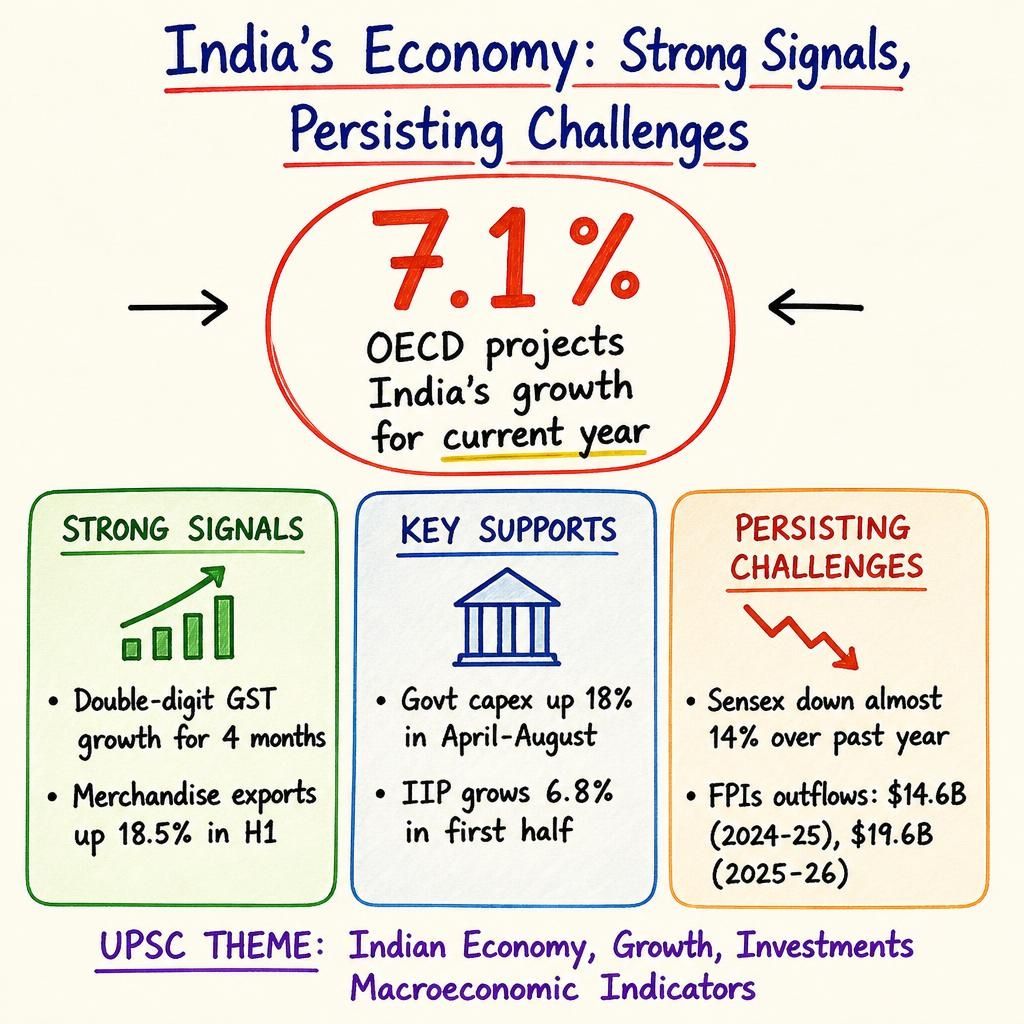
- Global agencies like ADB, Moody's, and OECD have upgraded India's growth estimates for the current year, with OECD projecting 7.1% growth.
- The Reserve Bank of India (RBI)'s latest 'State of the Economy' report indicates sustained economic strength based on high-frequency indicators.
- Positive economic indicators include double-digit GST collection growth for four consecutive months, robust electricity demand, healthy petrol consumption, and strong vehicle sales.
- Merchandise exports grew by 18.5% in the first half of the current fiscal year, supported by government capital expenditure which increased by 18% during April-August.
- Significant pain points persist, including a likely deficit monsoon impacting farm output, high input prices, weak private investment, and a nearly 14% fall in the Sensex over the past year.
- Foreign portfolio investors (FPIs) have recorded substantial outflows, totaling $14.6 billion in 2024-25, $19.6 billion in 2025-26, and $17.3 billion so far this year.
- The Indian Rupee has depreciated by approximately 5.5% this year, trading around 95.2 per dollar despite central bank interventions.
India's Growth.jpg
Detailed Insights:
- ADB and Moody's raised their growth forecasts for India to 7%, while OECD's projection stands at 7.1% for the current year.
- The RBI report highlights strong performance across both industrial and services sectors, contributing to the overall economic momentum.
- GST revenue from imports saw a significant increase of 25.9% in September, while domestic transactions grew by 10.1%.
- The Index of Industrial Production (IIP) recorded a growth of 6.8% in the first half of the year, signaling healthy industrial activity.
- Passenger vehicle sales show strong demand in both urban and rural areas, complemented by robust sales of two-wheelers and tractors in rural markets.
- The government's capital expenditure increased by 18% during April-August, reaching ₹5.10 trillion, indicating a focus on infrastructure development.
- The Sensex has fallen by almost 14% over the past year, reflecting visible weakness in the stock markets.
- FPIs have withdrawn a record ₹3.08 trillion ($32.73 billion) from Indian equities in the first nine months of calendar year 2026.
- The rupee's depreciation is attributed to factors like a strong US dollar, capital outflows, and inflation differentials.
- The article emphasizes the urgent need for wide-ranging reforms to lower trade barriers, improve the business environment, and attract both domestic and foreign private investment.
Key Concepts Involved:
- Goods and Services Tax (GST): An indirect tax used in India on the supply of goods and services, replacing multiple cascading taxes.
- Index of Industrial Production (IIP): A composite indicator measuring short-term changes in the volume of production of industrial products in India.
- Foreign Portfolio Investment (FPI): Investments made by foreign entities in financial assets like stocks and bonds in a country.
- Capital Expenditure (Capex): Funds used by a government or company to acquire, upgrade, and maintain physical assets such as property, industrial plants, or equipment.

SuperKalam is your personal mentor for UPSC preparation, guiding you at every step of the exam journey.
Download the App


STUDY RESOURCES
CONTACT US
ⓒ Snapstack Technologies Private Limited