GS 2: GovernanceGS 2: International RelationsGS 3: EconomyPrelimsGS 3: Indian Economy, Planning, Mobilization of Resources, Growth, Development and Employment
India-New Zealand trade ties set to scale new heights, Pg8
India-New Zealand Free Trade Agreement enters force, promising to significantly expand bilateral trade, investments, and services across key sectors.
Practice MCQs
818 Students attempted
Key Highlights:
- The India-New Zealand Free Trade Agreement (FTA) has officially entered into force, aiming to significantly boost bilateral trade and economic cooperation.
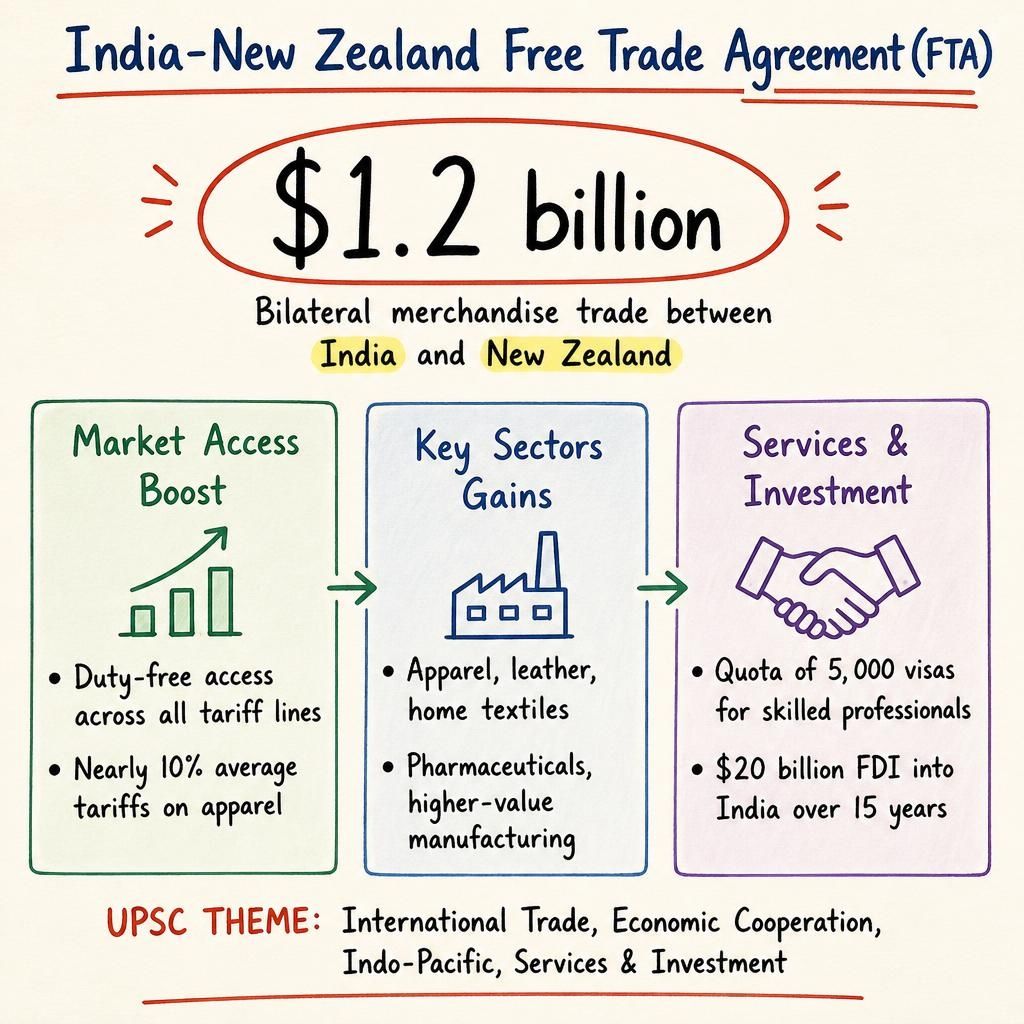
- Bilateral merchandise trade between India and New Zealand currently stands at $1.2 billion, with India accounting for only 1.9% of New Zealand’s merchandise imports.
- The FTA provides Indian exporters with duty-free access across all tariff lines, addressing a competitive disadvantage faced previously.
- Key sectors poised for immediate gains include labour-intensive industries like apparel, leather, and home textiles, as well as higher-value manufacturing and pharmaceuticals.
- The agreement also includes commitments across 118 services sectors and provisions for enhanced mobility for skilled professionals and students.
India-NZ FTA.jpg
Detailed Insights:
- The implementation of the India-New Zealand FTA is expected to strengthen India's economic engagement in the Indo-Pacific region.
- New Zealand's major suppliers, such as China, Australia, the U.S., South Korea, and Japan, previously enjoyed preferential access, disadvantaging Indian exporters.
- The elimination of nearly 10% average tariffs on apparel offers significant expansion opportunities for Indian manufacturers in New Zealand.
- India's market share in New Zealand's machinery ($7 billion) and vehicles ($5.2 billion) imports is currently around 1% or lower, indicating high growth potential.
- For pharmaceuticals, the FTA facilitates the use of regulatory evaluation reports, reducing duplicative compliance and improving market access.
- The agreement provides a quota of 5,000 visas for skilled professionals at any given time, allowing stays of up to three years.
- New Zealand has committed to facilitating $20 billion worth of Foreign Direct Investment (FDI) into India over a 15-year period.
- Effective utilization of the FTA requires targeted market intelligence, stronger distribution networks, and sustained engagement with New Zealand investors.
Key Concepts Involved:
- Free Trade Agreement (FTA): A pact between two or more countries to reduce barriers to imports and exports among them.
- Indo-Pacific: A geopolitical construct encompassing the Indian Ocean and the Pacific Ocean, crucial for trade and strategic interests.
- Foreign Direct Investment (FDI): An investment made by a firm or individual in one country into business interests located in another country.

SuperKalam is your personal mentor for UPSC preparation, guiding you at every step of the exam journey.
Download the App


STUDY RESOURCES
CONTACT US
ⓒ Snapstack Technologies Private Limited