GS 2: GovernanceGS 3: EconomyPrelimsGS 3: Changes in Industrial Policy and Effects on Industrial GrowthGS 3: Effects of Liberalization on the Economy
Disinvestment as key economic strategy, Pg9
India's disinvestment drive, including IDBI Bank sale, exceeds fiscal targets, signaling commitment to economic reforms and private sector role.
Practice MCQs
818 Students attempted
Key Highlights:
- Disinvestment and asset monetisation helped the government navigate a challenging fiscal year 2026-27 amidst global uncertainty and high energy prices.
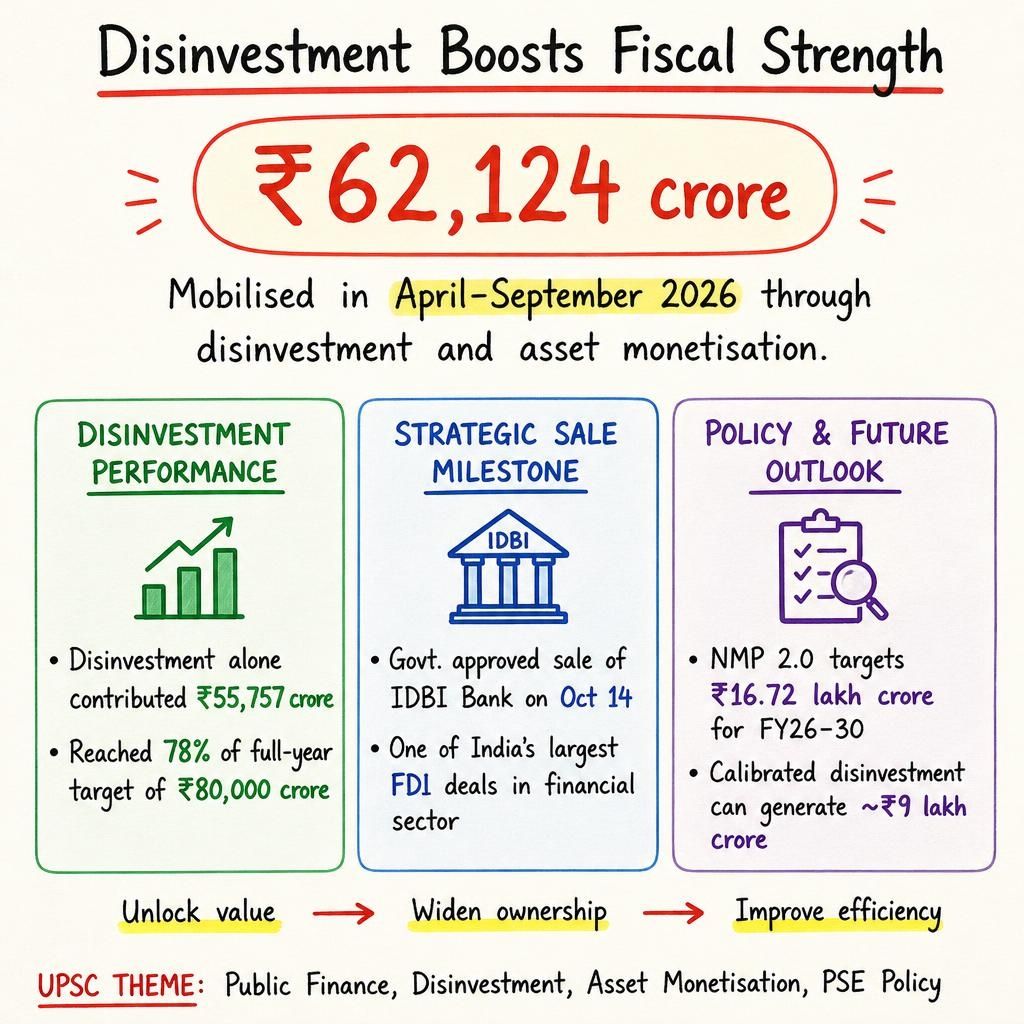
- In April-September 2026, the Centre mobilised ₹62,124 crore through disinvestment and asset monetisation.
- Disinvestment alone contributed ₹55,757 crore, reaching 78% of the full-year budget target of ₹80,000 crore.
- The government's approval of the sale of its share in IDBI Bank on October 14 is expected to exceed the disinvestment target.
- The IDBI Bank sale is considered one of India's largest Foreign Direct Investment (FDI) deals in the financial sector.
Disinvestment.jpg
Detailed Insights:
- The fiscal year 2026-27 was marked by modest growth in net tax and non-tax revenues, while capital expenditure increased by over 18%.
- The fiscal deficit reached 42% of budgeted levels, highlighting the need for diversified revenue sources.
- Disinvestment is viewed as a policy choice to unlock value from public assets, widen public ownership, and improve efficiency.
- The LIC IPO in 2022 is cited as an example of widening public ownership through disinvestment.
- The New Public Sector Enterprise (PSE) Policy 2021 aims for a "bare minimum presence" of PSEs in strategic sectors.
- The National Monetisation Pipeline (NMP), with NMP 2.0 targeting ₹16.72 lakh crore for FY26-30, focuses on re-engaging capital via mature public assets.
- The IDBI Bank strategic sale is the first significant one since Air India in 2022, signaling a 'Privatisation 2.0' framework.
- This new privatisation framework is intended to be investor-led, professionally managed, and time-bound.
- Suggestions for future disinvestments include a demand-based approach and a rolling three-year privatisation stream for better price discovery.
- Calibrated disinvestment, reducing government stake to 51% in 95 listed PSEs, could generate approximately ₹9 lakh crore.
Key Concepts Involved:
- Disinvestment: The process by which a government or an organization sells or liquidates an asset or subsidiary.
- Asset Monetisation: Creating new revenue streams by unlocking the value of underutilized public assets through various mechanisms.
- Fiscal Deficit: The difference between the government's total expenditure and its total revenue, excluding borrowings.
- Strategic Sale: The sale of a significant portion of government equity in a Public Sector Enterprise, often involving transfer of management control.

SuperKalam is your personal mentor for UPSC preparation, guiding you at every step of the exam journey.
Download the App


STUDY RESOURCES
CONTACT US
ⓒ Snapstack Technologies Private Limited