GS 2: GovernanceGS 1: Indian SocietyGS 2: Social JusticeGS 3: EconomyPrelims
Revisiting The Farmer Question, Pg7
Article revisits M.S. Swaminathan's NCF recommendations to address India's persistent farmer distress, advocating for economic viability and integrated policy framework.
Practice MCQs
811 Students attempted
Key Highlights:
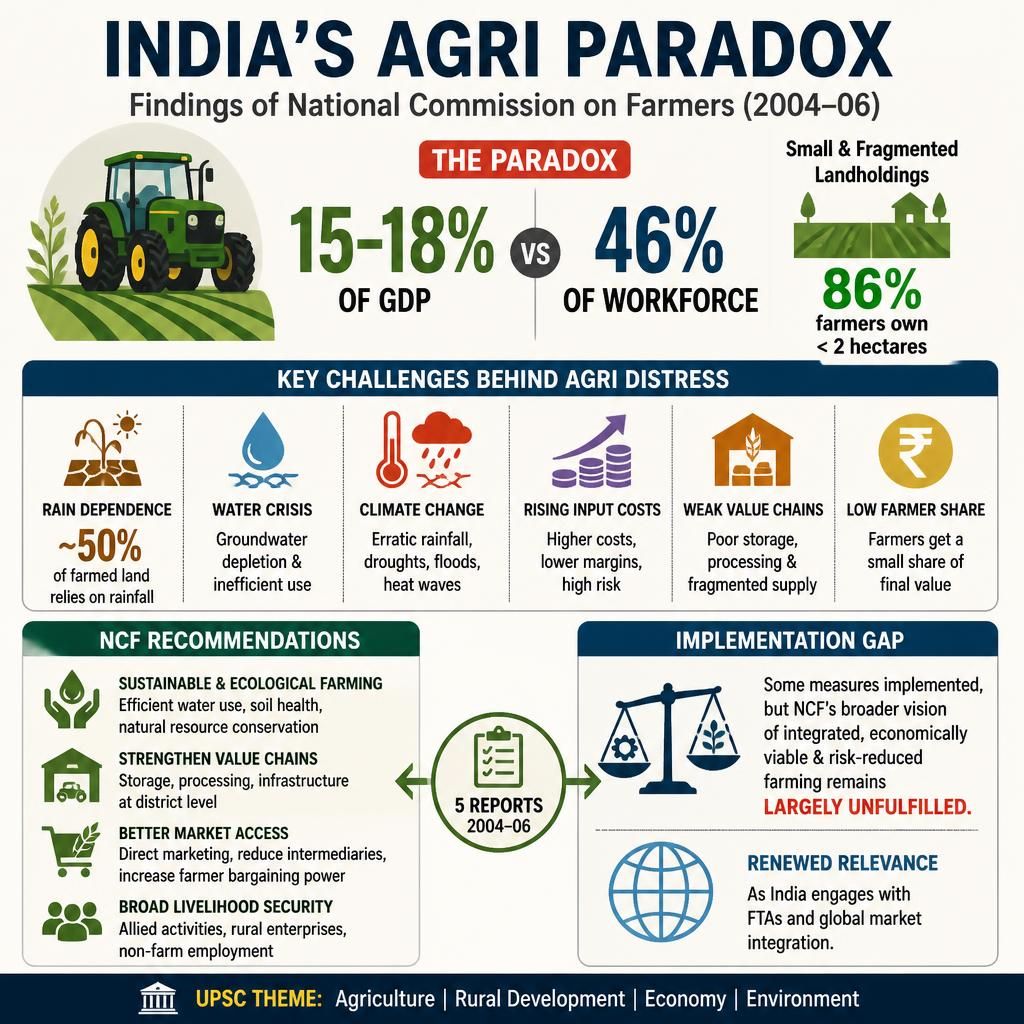
- India's agriculture sector contributes 15-18% to the GDP but employs around 46% of the workforce, highlighting a significant economic paradox.
- Approximately 86% of Indian farmers own less than two hectares of land, leading to challenges in achieving economies of scale and adopting modern practices.
- The National Commission on Farmers (NCF), chaired by M.S. Swaminathan, submitted five reports between 2004 and 2006 to address agrarian distress.
- The NCF identified agricultural distress primarily as an income and livelihood problem, rather than solely a productivity issue.
- Key challenges include small landholdings, water scarcity, climate change impacts, rising input costs, and weak agricultural value chains.
- While some NCF recommendations have been implemented, its broader vision for an integrated, economically viable, and risk-reduced farming sector remains largely unfulfilled.
Agri Paradox.jpg
Detailed Insights:
- Despite India's economic shift towards industry and services, a large portion of its rural population remains dependent on agriculture for livelihood.
- Structural constraints like fragmented landholdings hinder crop diversification and the adoption of new technologies.
- Around 50% of farmed land relies on unpredictable rainfall, making farmers vulnerable to droughts and erratic monsoons, while intensive irrigation causes groundwater depletion.
- Climate change exacerbates vulnerabilities through erratic rainfall, floods, droughts, and heat waves, leading to crop losses.
- Farmers often receive a minimal share of the final value of their produce due to weak storage, processing infrastructure, and fragmented supply chains.
- The NCF emphasized ecological sustainability, advocating for efficient water use, sustainable farming practices, and natural resource conservation.
- The Commission proposed strengthening farmers' bargaining power through district-level agricultural infrastructure, direct marketing, and better storage and processing facilities.
- The NCF also envisioned a broader livelihood-security framework, including allied activities, rural enterprises, and non-farm employment.
- The relevance of NCF recommendations is renewed as India navigates Free Trade Agreements (FTAs) and global market integration.
- The current approach to agricultural policy should combine remunerative prices, risk management, farmer aggregation, productivity enhancement, value addition, and carefully designed trade safeguards.
Key Concepts Involved:
- National Commission on Farmers (NCF): A commission constituted in 2004 under M.S. Swaminathan to address agrarian distress and recommend policies for farmers' welfare.
- Free Trade Agreements (FTAs): Treaties between countries to reduce or eliminate trade barriers, impacting agricultural exports and imports.
- Ecological Sustainability: Practices and policies aimed at maintaining environmental balance and natural resources for long-term agricultural productivity.
- Value Chain: The full range of activities required to bring a product or service from conception to delivery to final consumers.

SuperKalam is your personal mentor for UPSC preparation, guiding you at every step of the exam journey.
Download the App


STUDY RESOURCES
CONTACT US
ⓒ Snapstack Technologies Private Limited