GS 2: GovernanceGS 2: PolityGS 1: Indian SocietyPrelimsGS 2: Government policies and interventions for development in various sectors
A new governance model for Ladakh, Pg8
Ladakh's demand for Sixth Schedule status sparks debate, as government proposes Article 371-K for a unique governance model balancing autonomy and national security.
Practice MCQs
811 Students attempted
Key Highlights:
- Ladakh is demanding Sixth Schedule status for protection of its unique culture, land rights, and political representation.
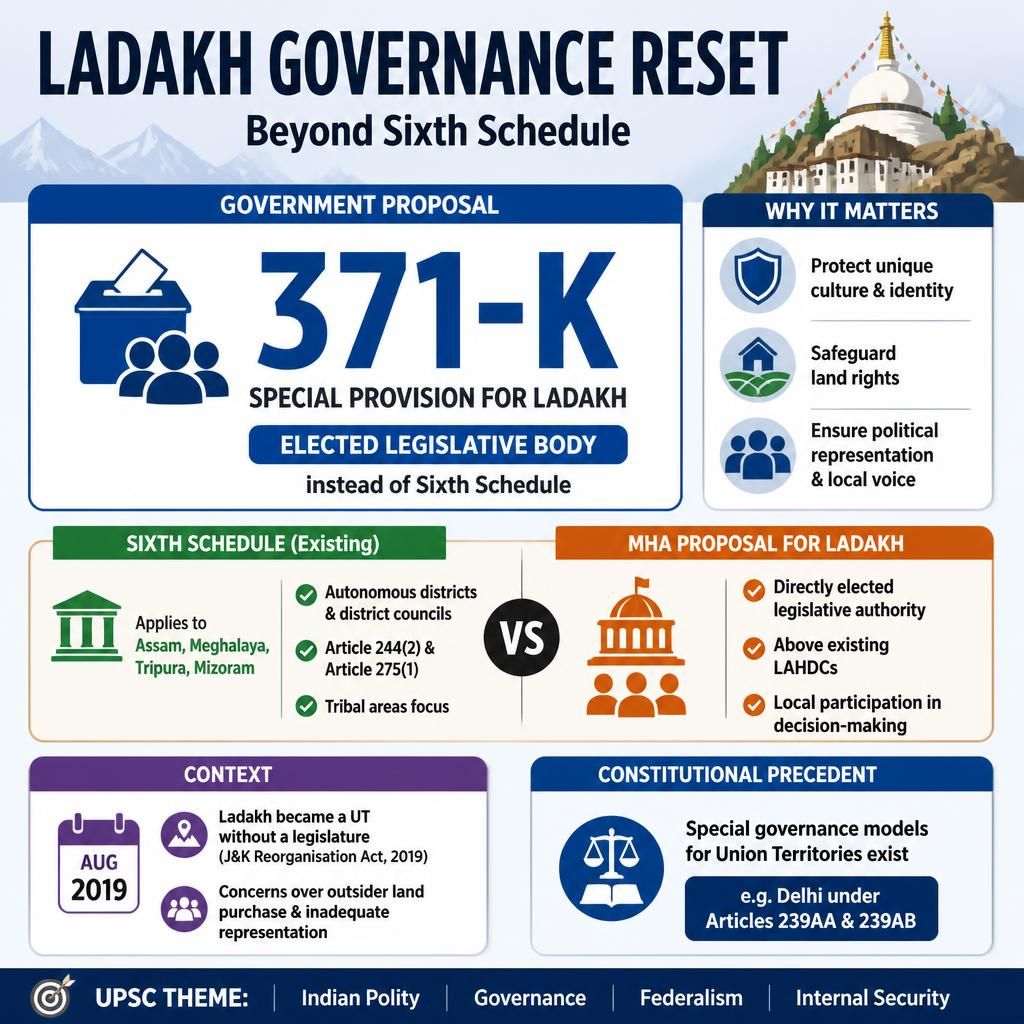
- The Ministry of Home Affairs (MHA) has proposed a directly elected legislative body for Ladakh instead of Sixth Schedule status.
- The government is considering inserting Article 371-K into the Constitution to provide a special governance model for Ladakh.
- This proposal aims to balance national security concerns with the need for local self-government in the strategically important region.
Ladakh Governance.jpg
Detailed Insights:
- Ladakh became a Union Territory without a legislative assembly under the Jammu and Kashmir Reorganisation Act, 2019.
- Local groups are concerned about outsiders acquiring land and the lack of adequate political representation in Ladakh.
- The Sixth Schedule currently applies to Assam, Meghalaya, Tripura, and Mizoram, granting significant autonomy to tribal areas.
- It is governed by Article 244(2) and Article 275(1), allowing for autonomous districts with district councils.
- The MHA's proposal for an elected legislative authority is seen as a way to ensure political representation and local participation in decision-making.
- This new structure might operate above the existing Ladakh Autonomous Hill Development Councils (LAHDCs).
- The constitutionality of granting special status to a Union Territory is supported by precedents like the National Capital Territory of Delhi under Articles 239 AA and 239 AB.
- Indian federalism is described as "Amphibian" by the Supreme Court in State of Rajasthan v. Union of India (1977), signifying a blend of federal and unitary characteristics.
Key Concepts Involved:
- Sixth Schedule: A constitutional provision under Article 244(2) and Article 275(1) granting administrative autonomy to tribal areas in four Northeastern states.
- Union Territory (UT): An administrative division in India directly governed by the Central Government.
- Federalism: A system of government where power is divided between a central authority and constituent political units.
- Article 371-K: A proposed constitutional article to provide special provisions for the governance of Ladakh.
- Doctrine of Proportionality: A legal principle ensuring that actions taken are appropriate and necessary to achieve a legitimate aim.

SuperKalam is your personal mentor for UPSC preparation, guiding you at every step of the exam journey.
Download the App


STUDY RESOURCES
CONTACT US
ⓒ Snapstack Technologies Private Limited