GS 2: GovernanceGS 3: EconomyPrelims
Cumulative cost overrun registered by infrastructure projects, Pg8
Government report reveals staggering ₹4.92 lakh crore cost overrun across 1,847 infrastructure projects by June 2026, impacting national development.
Practice MCQs
796 Students attempted
Key Highlights:
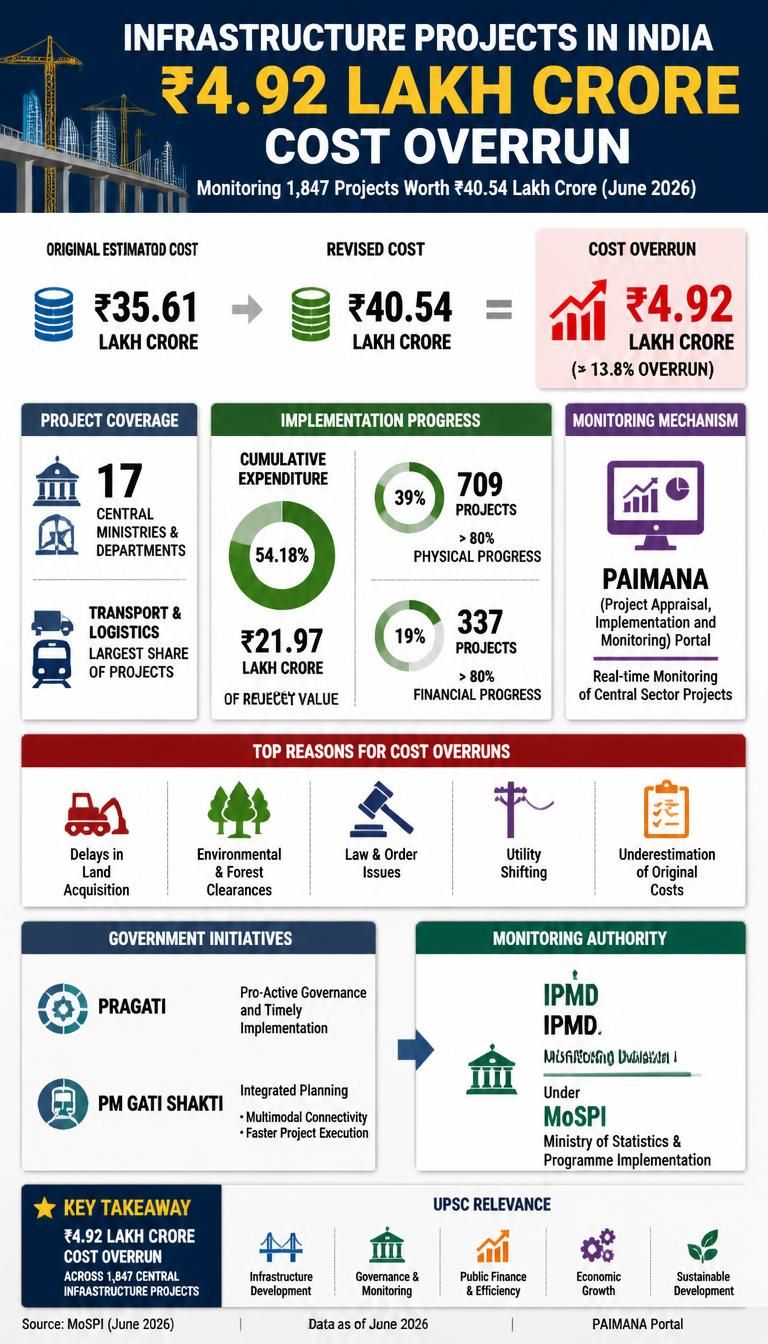
- Infrastructure projects in India, each valued at over ₹150 crore, have registered a cumulative cost overrun of approximately ₹4.92 lakh crore as of June 2026.
- The Ministry of Statistics and Programme Implementation (MoSPI) reported that 1,847 ongoing projects were monitored.
- The total revised cost for these projects stands at ₹40.54 lakh crore, significantly higher than their original estimated cost of ₹35.61 lakh crore.
- Monitoring is conducted through the PAIMANA (Project Appraisal, Implementation and Monitoring) portal.
Infrastructure cost overrun.jpg
Detailed Insights:
- The monitored projects span across 17 central ministries and departments, with the Transport and Logistics sector accounting for the largest share of projects.
- Cumulative expenditure on these projects has reached ₹21.97 lakh crore, representing 54.18% of the revised project value, indicating steady implementation progress.
- Approximately 39% (709 projects) of the monitored projects have achieved over 80% physical progress, while 19% (337 projects) have crossed 80% financial completion.
- Common reasons for cost overruns include delays in land acquisition, environmental and forest clearances, law and order issues, utility shifting, and underestimation of original costs.
- Government initiatives like PRAGATI (Pro-Active Governance and Timely Implementation) and PM Gati Shakti aim to resolve bottlenecks and expedite project implementation.
- The Infrastructure and Project Monitoring Division (IPMD) under MoSPI is responsible for monitoring these central sector projects.
Key Concepts Involved:
- Cost Overrun: When the actual cost of a project exceeds its initially estimated budget.
- Infrastructure Projects: Large-scale public works essential for economic development, such as roads, railways, ports, and power plants.
- Central Sector Projects: Development projects fully funded and implemented by the Central Government of India.
- PAIMANA: A web-based system used by MoSPI to monitor the progress of central sector infrastructure projects.

SuperKalam is your personal mentor for UPSC preparation, guiding you at every step of the exam journey.
Download the App


STUDY RESOURCES
CONTACT US
ⓒ Snapstack Technologies Private Limited