GS 2: International RelationsGS 3: Environment & EcologyPrelimsGS 2: Bilateral, Regional and Global Groupings and AgreementsGS 2: Important International Institutions, Agencies and Fora
UN Sea Level Declaration, Pg II
UN General Assembly approves landmark declaration ensuring statehood, sovereign rights, and maritime zones for low-lying nations threatened by sea-level rise.
Practice MCQs
804 Students attempted
Key Highlights:
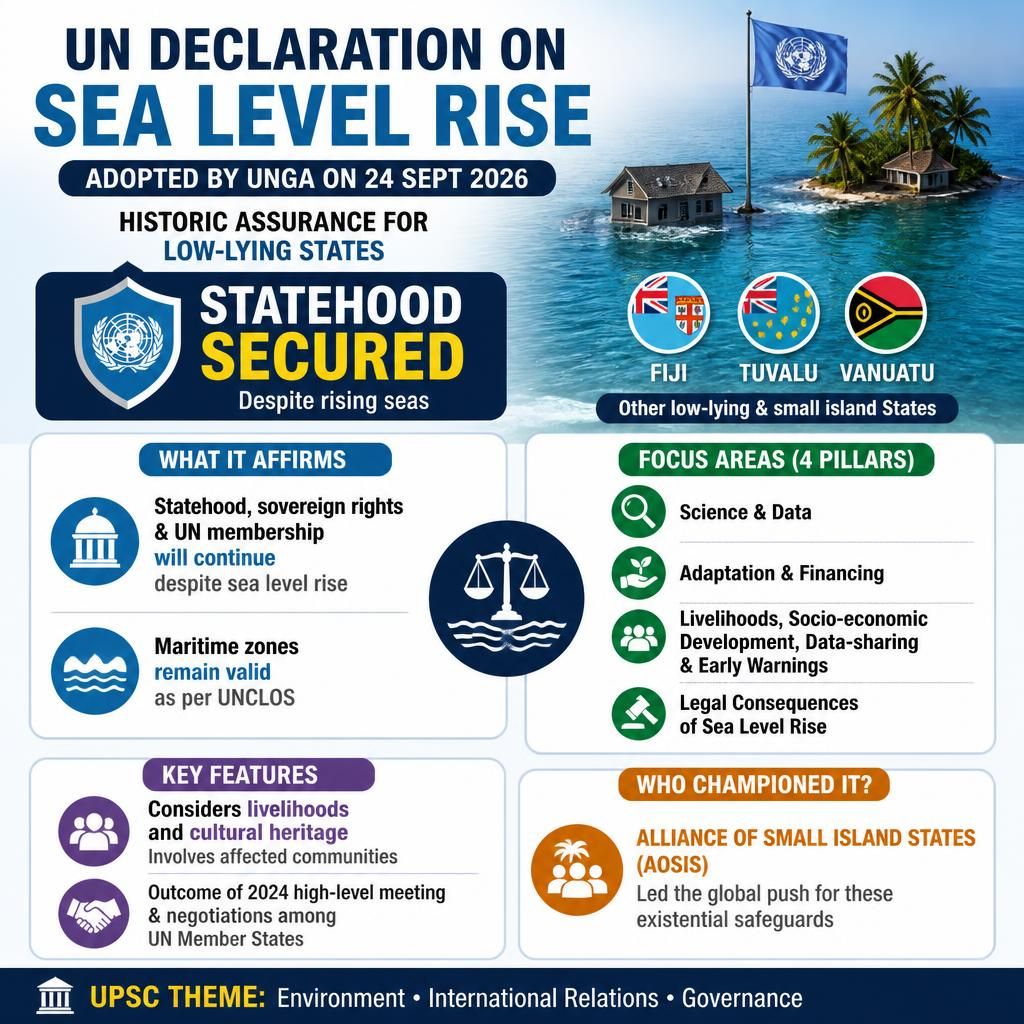
- The United Nations General Assembly approved the Declaration on Sea Level Rise by consensus on September 24, 2026.
- The Declaration affirms that low-lying countries, such as Fiji, Tuvalu, and Vanuatu, will retain their statehood, sovereign rights, and UN membership despite rising seas.
- It also stipulates that maritime zones will continue to be defined in line with the UN Convention on the Law of the Sea (UNCLOS), even if coastlines retreat.
Sea Level Rise.jpg
Detailed Insights:
- The Declaration emerged from a high-level meeting in 2024, followed by negotiations among member countries.
- It organizes action around four key areas: science and data, adaptation and financing, livelihoods/socio-economic development/data-sharing/early-warnings, and the legal consequences of sea-level rise.
- The Declaration calls on countries to address sea-level rise by considering livelihoods and cultural heritage, with the involvement of affected communities.
- The Alliance of Small Island States (AOSIS) played a crucial role in advocating for these assurances, as their territories face existential threats from rising sea levels.
- UN member countries are committed to continued engagement on sea-level rise issues, including a high-level meeting before the 84th session of the General Assembly concludes, which is scheduled to open on September 11, 2029.
Key Concepts Involved:
- UN General Assembly: The main deliberative, policymaking, and representative organ of the United Nations.
- UN Convention on the Law of the Sea (UNCLOS): An international treaty establishing a comprehensive legal framework for all marine and maritime activities.
- Alliance of Small Island States (AOSIS): An intergovernmental organization of low-lying coastal and small island countries, advocating on climate change and sea level rise.
- Statehood: The condition of being a recognized independent state, possessing sovereignty over its territory and population under international law.

SuperKalam is your personal mentor for UPSC preparation, guiding you at every step of the exam journey.
Download the App


STUDY RESOURCES
CONTACT US
ⓒ Snapstack Technologies Private Limited