GS 2: GovernanceGS 2: International RelationsGS 3: Environment & EcologyPrelimsGS 3: Conservation, Pollution and Degradation
COP31 hosts Australia and Türkiye face the fossil-fuel question, Pg II
COP31 hosts Australia and Türkiye, major fossil fuel users, face scrutiny over their climate agenda, omitting direct fossil fuel transition and loss and damage financing.
Practice MCQs
804 Students attempted
Key Highlights:
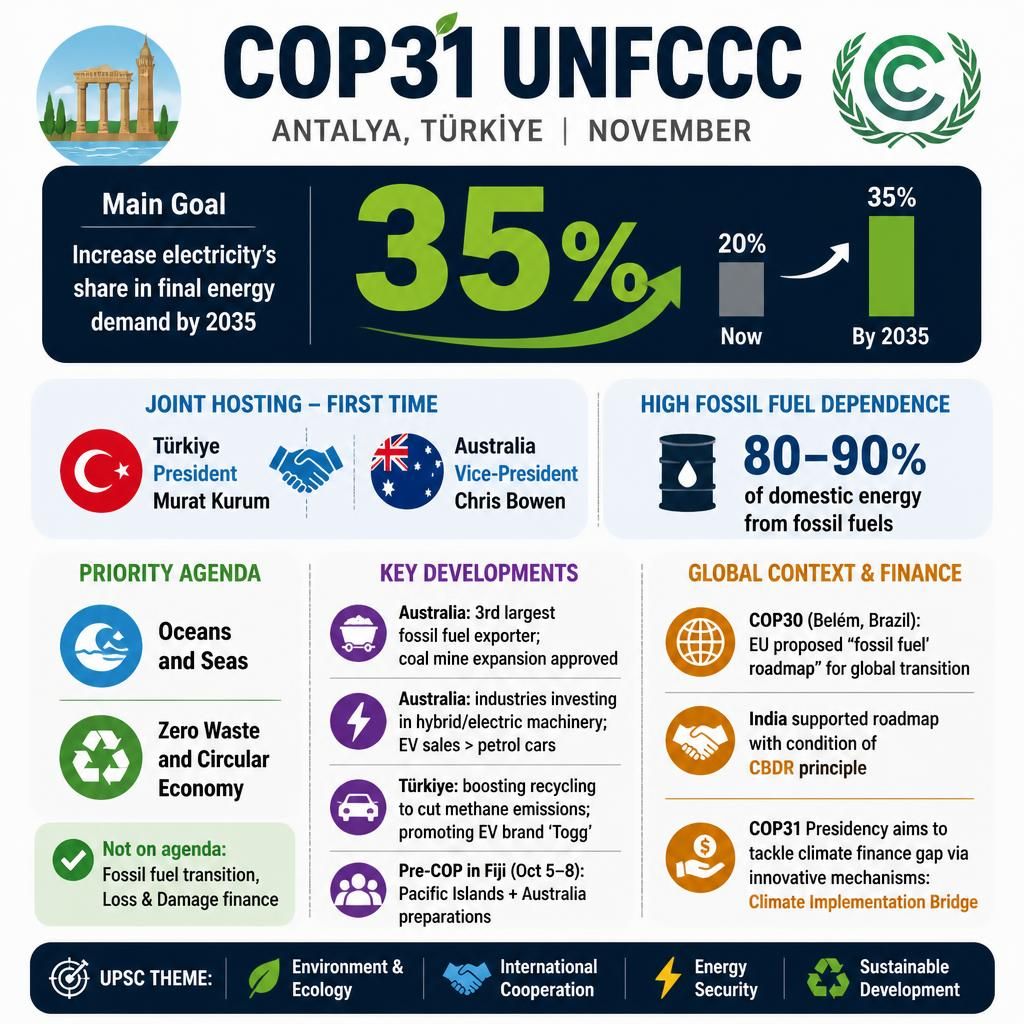
- The 31st Conference of the Parties (COP31) to the UNFCCC will be held in November in Antalya, Türkiye.
- Türkiye will host the event with its Minister of Environment, Murat Kurum, as President, while Australia will oversee negotiations with Chris Bowen as Vice-President.
- This joint hosting arrangement is novel, with both nations sharing crucial responsibilities for the climate summit.
- Both Türkiye and Australia are significant fossil fuel users, relying on them for 80-90% of their domestic energy needs.
- The primary goal for COP31 is to increase electricity's share in final energy demand from 20% to 35% by 2035.
- Priority agenda items include 'Oceans and Seas' and 'Zero Waste and a Circular Economy', but not direct fossil fuel transition or loss and damage financing.
COP 31 UNFCCC.jpg
Detailed Insights:
- A pre-COP event was held in Fiji from October 5-8, involving Pacific Island countries and Australia, to prepare for the main summit.
- Australia is the world’s third-largest fossil fuel exporter and recently approved a coal mine expansion, drawing criticism from climate groups.
- Australia's industries, like iron-ore mining, are investing in hybrid/electric machinery for decarbonization, and electric vehicle sales have surpassed petrol cars.
- Türkiye is focusing on augmenting recycling to reduce methane emissions and promoting its local EV brand, Togg.
- At COP30 in Belém, Brazil, the European Union proposed a "fossil fuel roadmap" for global transition.
- India supported the "fossil fuel roadmap" on the condition that it incorporates the principle of Common but Differentiated Responsibilities.
- The COP31 Presidency aims to address the climate finance gap through innovative mechanisms like the Climate Implementation Bridge.
- Recent catastrophic floods in Nepal are expected to increase pressure for stronger mitigation actions and Loss and Damage Financing at COP31.
- Countries can propose new agenda items during COP negotiations, as the EU did with the "fossil fuel roadmap" at COP30.
Key Concepts Involved:
- COP (Conference of the Parties): The supreme decision-making body of the United Nations Framework Convention on Climate Change (UNFCCC).
- UNFCCC (United Nations Framework Convention on Climate Change): An international environmental treaty adopted in 1992 to stabilize greenhouse gas concentrations in the atmosphere.
- Common but Differentiated Responsibilities (CBDR): A principle under UNFCCC acknowledging that all states have a shared responsibility to address climate change but with varying capabilities and historical contributions.
- Loss and Damage Financing: Financial support provided to developing countries to address unavoidable impacts of climate change that cannot be adapted to.
- Circular Economy: An economic system aimed at eliminating waste and the continual use of resources, contrasting with the traditional linear economy.

SuperKalam is your personal mentor for UPSC preparation, guiding you at every step of the exam journey.
Download the App


STUDY RESOURCES
CONTACT US
ⓒ Snapstack Technologies Private Limited