GS 2: GovernanceGS 2: PolityGS 2: Social JusticePrelimsGS 2: Government policies and interventions for development in various sectors
The Pitfalls Of Mandatory FIRs, Pg7
Supreme Court's mandatory FIR directive for all missing persons sparks debate over adult agency, potentially endangering consenting couples and increasing police burden.
Practice MCQs
804 Students attempted
Key Highlights:
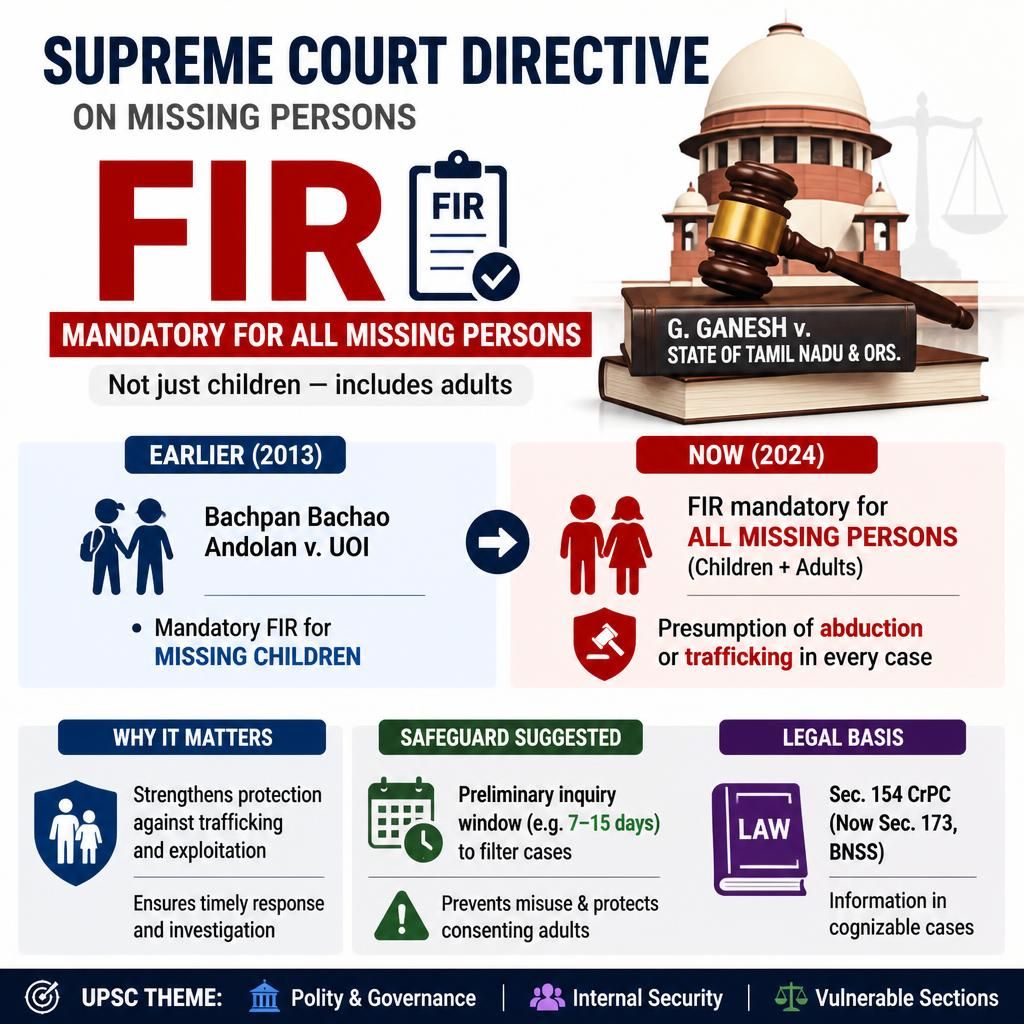
- The Supreme Court recently reiterated the mandatory registration of a First Information Report (FIR) for any missing 'person', not just children, in the case of G. Ganesh v. State of Tamil Nadu and Others.
- Earlier directions from the Supreme Court in May included establishing a special portal by the Ministry of Home Affairs (MHA) for human trafficking and activating Anti-Human Trafficking Units (AHTUs).
- This expands upon the 2013 Bachpan Bachao Andolan (BBA) versus Union of India and Others judgment, which mandated FIRs specifically for missing children.
- The court's directive implies a presumption of abduction or trafficking for all missing persons, including adults.
FIR on Missing Persons.jpg
Detailed Insights:
- The Supreme Court ruling in G. Ganesh originated from a child missing since 2011, highlighting issues with the implementation of existing guidelines.
- The 2013 Bachpan Bachao Andolan judgment also directed states to establish Special Juvenile Police Units at every police station.
- For missing children, a presumption of a cognizable offense (abduction or trafficking) was established in 2013, as a child's consent is legally irrelevant.
- The current blanket presumption for adults is problematic as adults have agency and may leave voluntarily, potentially leading to police intervention in consensual relationships.
- Mandatory FIRs for all missing adults could lead to police tracing individuals who left home willingly, potentially endangering them in cases like honor killings.
- The article suggests that a preliminary inquiry window (e.g., a week or fortnight) could help filter cases and prevent unnecessary police action against consenting adults.
- The ruling references Section 154 of the Code of Criminal Procedure (CrPC), which is now Section 173 of the Bharatiya Nagarik Suraksha Sanhita (BNSS), concerning information in cognizable cases.
- Section 63 of the Juvenile Justice (Care and Protection of Children) Act, 2000 mandates a specially trained police officer to be designated as a Juvenile Welfare Officer.
Key Concepts Involved:
- First Information Report (FIR): A written document recorded by the police upon receiving information about a cognizable offense.
- Cognizable Offence: An offense where police can arrest a person without a warrant and begin investigation without court permission.
- Anti-Human Trafficking Units (AHTUs): Specialized police units established to combat human trafficking.

SuperKalam is your personal mentor for UPSC preparation, guiding you at every step of the exam journey.
Download the App


STUDY RESOURCES
CONTACT US
ⓒ Snapstack Technologies Private Limited