GS 2: GovernanceGS 2: PolityGS 2: Social JusticePrelimsGS 2: Important Aspects of Governance, Transparency and Accountability
Should Voting Be a Fundamental Right?, Pg8
Unprecedented ECI rift and systemic voter exclusion reignite debate on elevating the 'right to vote' to a fundamental constitutional right.
Practice MCQs
804 Students attempted
Key Highlights:
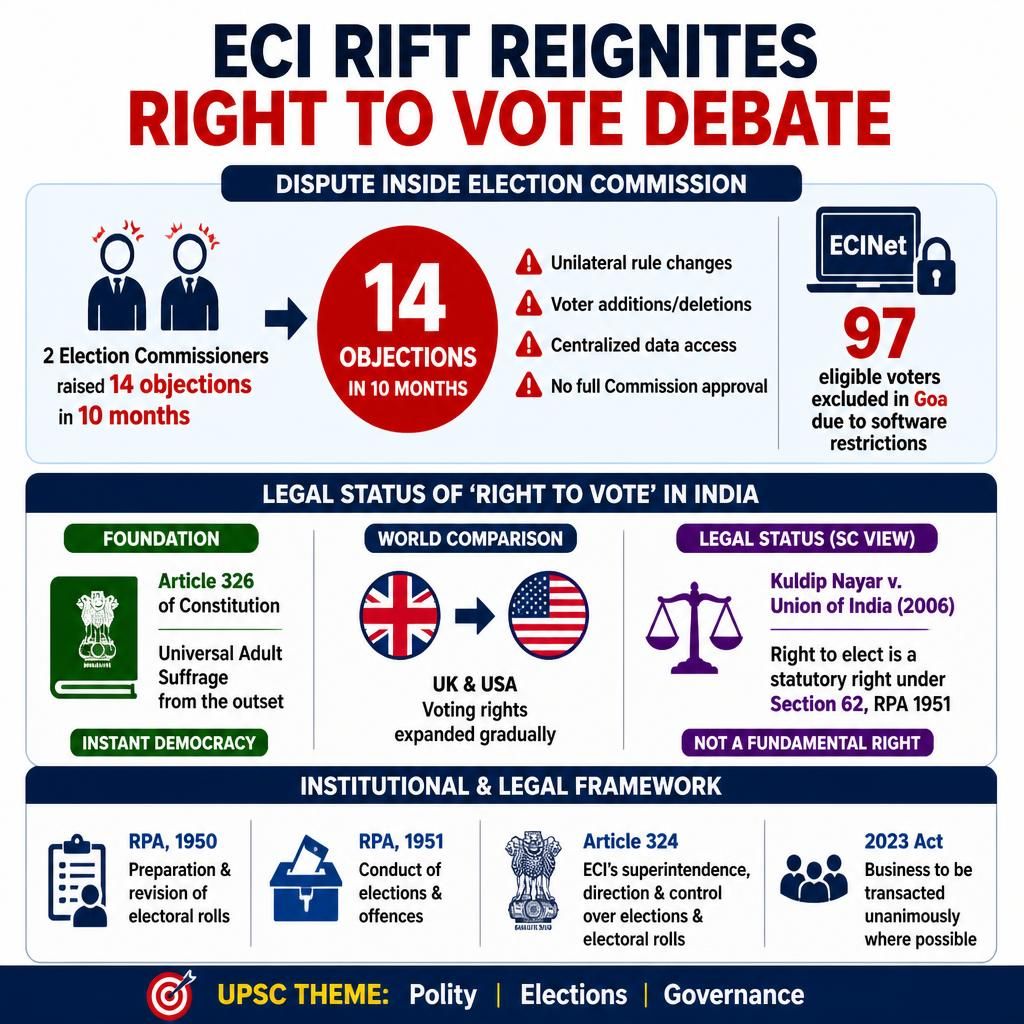
- An Indian Express investigation revealed a rift within the three-member Election Commission of India (ECI), with two Election Commissioners (ECs) raising 14 objections against the Chief Election Commissioner (CEC) over 10 months.
- The objections concerned alleged unilateral changes to rules, voter additions/deletions, and centralized data access without full Commission approval.
- The report highlighted the exclusion of 97 eligible voters in Goa from the electoral roll due to the ECINet software preventing ground-level corrections.
- This incident has reignited the debate on the legal status of the 'right to vote' in India, questioning if it should be a fundamental right.
- India adopted Universal Adult Suffrage (UAS) from the outset, enshrined in Article 326 of the Constitution, contrasting with the gradual expansion of voting rights in many Western democracies.
- The Supreme Court, in Kuldip Nayar v. Union of India (2006), affirmed the 'right to elect' as a statutory right under Section 62 of the Representation of the People Act, 1951, not a fundamental or constitutional right.
Right to Vote.jpg
Detailed Insights:
- The internal dissent within the ECI involved Commissioners Sukhbir Singh Sandhu and Vivek Joshi objecting to decisions made by CEC Gyanesh Kumar.
- The ECINet software's design reportedly prevented Electoral Registration Officers (EROs) from reversing erroneous deletions, leading to disenfranchisement in Goa.
- The exclusion of voters in Goa also impacted their eligibility for state schemes, such as the Goa Mediclaim Scheme, which uses electoral rolls for verification.
- India's commitment to Universal Adult Suffrage was a deliberate choice for immediate democratic equality, unlike the phased approach in countries like the U.K. and U.S.
- The Representation of the People Act, 1950, governs the preparation and revision of electoral rolls, while the Representation of the People Act, 1951, regulates election conduct and offences.
- Article 324 of the Constitution vests the ECI with superintendence, direction, and control over elections, including preparing accurate electoral rolls.
- The Chief Election Commissioner and Other Election Commissioners (Appointment, Conditions of Service and Term of Office) Act, 2023, outlines the procedure for the ECI to transact business, requiring unanimous decisions where possible.
- While the 'right to vote' is currently a statutory right, some scholars and a dissenting Supreme Court opinion argue for its elevation to a fundamental right to ensure stronger judicial review against potential legislative or administrative overreach.
Key Concepts Involved:
- Universal Adult Suffrage (UAS): The right of all adult citizens to vote, regardless of wealth, income, gender, social status, race, ethnicity, or any other restriction.
- Statutory Right: A right established by a statute or law passed by a legislature, which can be modified or repealed by the legislature.
- Fundamental Right: Rights guaranteed by the Constitution, considered essential for human dignity and development, and subject to strict judicial review.
- Basic Structure Doctrine: A principle established by the Supreme Court in Kesavananda Bharati v. State of Kerala (1973), stating that certain fundamental features of the Constitution cannot be altered by Parliament.
- Election Commission of India (ECI): An autonomous constitutional body responsible for administering election processes in India.

SuperKalam is your personal mentor for UPSC preparation, guiding you at every step of the exam journey.
Download the App


STUDY RESOURCES
CONTACT US
ⓒ Snapstack Technologies Private Limited