GS 3: EconomyPrelimsGS 3: Indian Economy, Planning, Mobilization of Resources, Growth, Development and EmploymentGS 3: Infrastructure: Energy, Ports, Roads, Airports, Railways etc.GS 2: Government policies and interventions for development in various sectors
S&P affirms 'BBB-' rating on India; cites infra push, policy stability, Pg13
S&P affirms India's 'BBB-' sovereign rating with stable outlook, citing robust infrastructure investment and policy stability despite global slowdown.
Practice MCQs
796 Students attempted
Key Highlights:
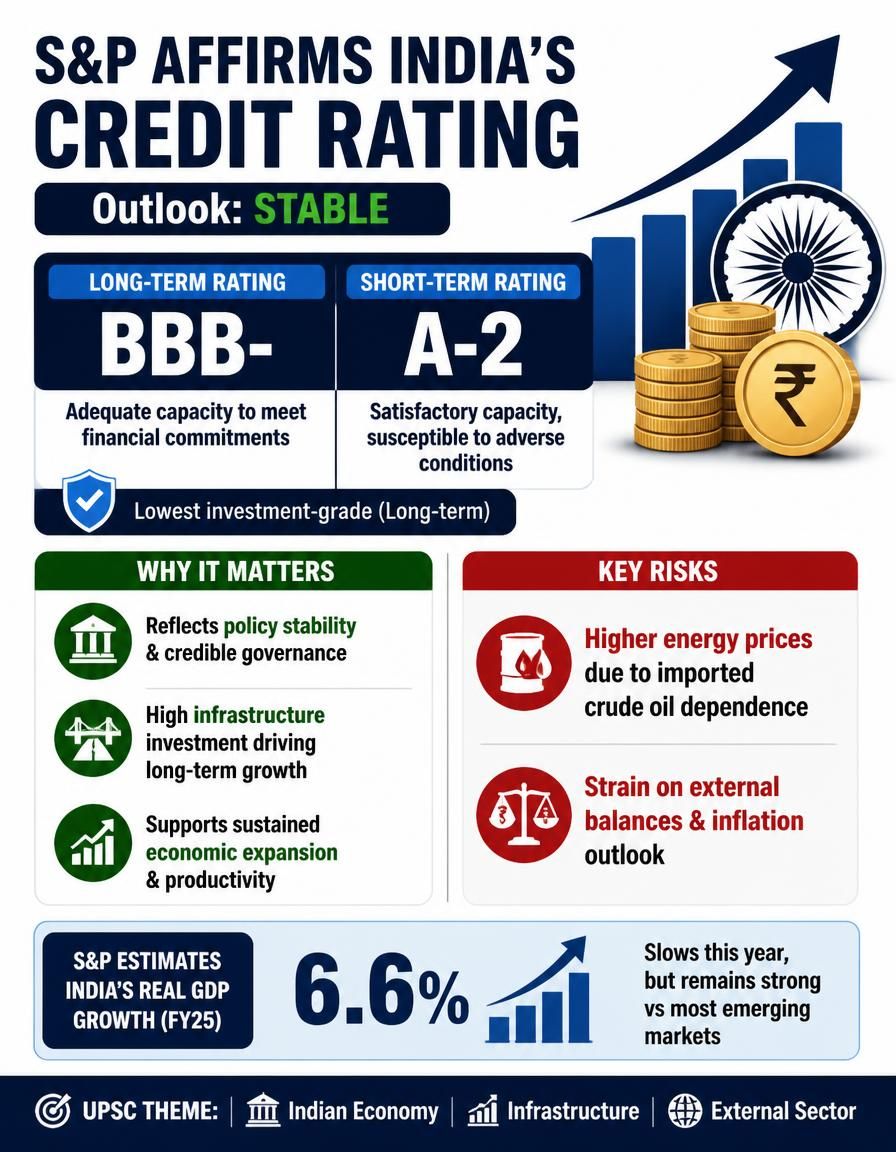
- Global ratings agency S&P affirmed India's sovereign credit ratings at 'BBB-/A-2' with a "stable" outlook.
- The affirmation is attributed to India's continued policy stability and high infrastructure investment, supporting long-term growth.
- S&P estimates India's Real GDP Growth to slow to 6.6% this year, which remains strong compared to most emerging markets.
- Risks highlighted include higher energy prices, potentially straining India's External Balances and Inflation outlook due to reliance on imported crude oil.
Credit Ratings.jpg
Detailed Insights:
- A 'BBB-' long-term rating signifies an adequate capacity to meet financial commitments, though it is the lowest investment-grade rating.
- The 'A-2' short-term rating indicates a satisfactory capacity to meet financial commitments, but it is susceptible to adverse economic conditions.
- The "stable" outlook suggests that S&P does not anticipate a change in India's rating in the near future.
- India's robust infrastructure push is seen as a key driver for sustained economic expansion and improved productivity.
- The assessment underscores India's resilience amidst a broad global economic slowdown.
- The reliance on imported crude oil makes India vulnerable to global energy price fluctuations, impacting its trade deficit and domestic prices.
Key Concepts Involved:
- Sovereign Rating: An assessment by credit rating agencies of a country's creditworthiness, indicating its ability and willingness to repay debt.
- Real GDP Growth: The increase in the value of goods and services produced by an economy, adjusted for inflation, reflecting actual output growth.
- External Balances: A country's equilibrium in its international trade and financial transactions, often reflected in its current account balance.
- Inflation: A general increase in the prices of goods and services over time, leading to a decrease in the purchasing power of currency.

SuperKalam is your personal mentor for UPSC preparation, guiding you at every step of the exam journey.
Download the App


STUDY RESOURCES
CONTACT US
ⓒ Snapstack Technologies Private Limited