GS 2: International RelationsPrelimsGS 2: Bilateral, Regional and Global Groupings and AgreementsGS 2: Effect of Policies and Politics of Developed and Developing Countries on India's Interests
Qatar PM Pursues Mediation In Iran As US Ramps Up ‘Economic War’, Pg14
Qatar's PM mediates in Tehran amidst US 'economic war' and sanctions against Iran, aiming to revive diplomacy and de-escalate regional tensions.
Practice MCQs
796 Students attempted
Key Highlights:
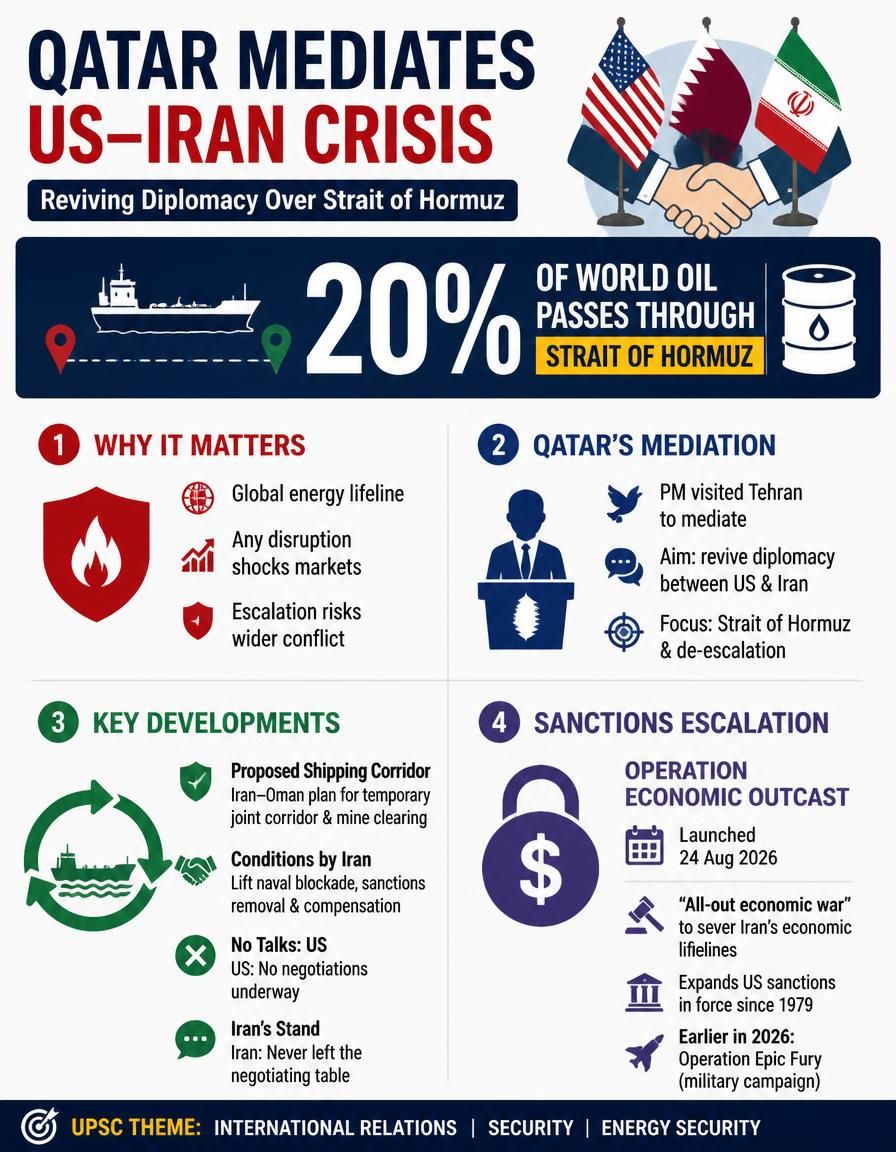
- Qatar's Prime Minister visited Tehran to mediate between the US and Iran amidst escalating tensions and new US sanctions.
- The visit aims to revive diplomacy as a conflict between the US and Iran nears its sixth month, with a focus on control of the Strait of Hormuz.
- The US launched Operation Economic Outcast on August 24, 2026, described as an "all-out economic war" to sever Iran's economic lifelines.
- Iran and Oman have a proposed phased framework for a temporary joint shipping corridor through the Strait of Hormuz, including mine clearing.
- The US stated no negotiations are currently underway, while Iran maintains it has never left the negotiating table.
Qatar Mediation.jpg
Detailed Insights:
- The Strait of Hormuz is a crucial maritime chokepoint connecting the Persian Gulf to the Gulf of Oman, vital for global oil trade.
- The current diplomatic efforts follow the breakdown of a June interim ceasefire (Memorandum of Understanding) between the US and Iran.
- The June agreement, mediated by Pakistan, included a 60-day ceasefire and conditions for reopening the Strait of Hormuz and lifting US sanctions.
- Iran insists on the US lifting its naval blockade on Iranian ports, providing compensation, and removing sanctions as conditions for implementing the new shipping corridor.
- Operation Economic Outcast expands on existing US sanctions against Iran, which have been in place in various forms since 1979.
- The US had previously conducted Operation Epic Fury, a military campaign earlier in 2026, to dismantle Iran's military capabilities.
Key Concepts Involved:
- Strait of Hormuz: A narrow, strategically vital waterway between the Persian Gulf and the Gulf of Oman, critical for global oil shipments.
- Economic Sanctions: Punitive measures imposed by one country on another to influence its policies, often involving trade restrictions and asset freezes.
- Mediation: Intervention in a dispute by a third party to help resolve it, often through negotiation and compromise.
Previous12/12

SuperKalam is your personal mentor for UPSC preparation, guiding you at every step of the exam journey.
Download the App


STUDY RESOURCES
CONTACT US
ⓒ Snapstack Technologies Private Limited