GS 2: GovernanceGS 2: PolityGS 1: Indian SocietyGS 1: Modern HistoryPrelims
Is English a foreign language in India?, Pg9
Supreme Court debates English's status in India amidst challenges to CBSE's three-language formula, sparking discussion on its indigenous nature and societal impact.
Practice MCQs
796 Students attempted
Key Highlights:
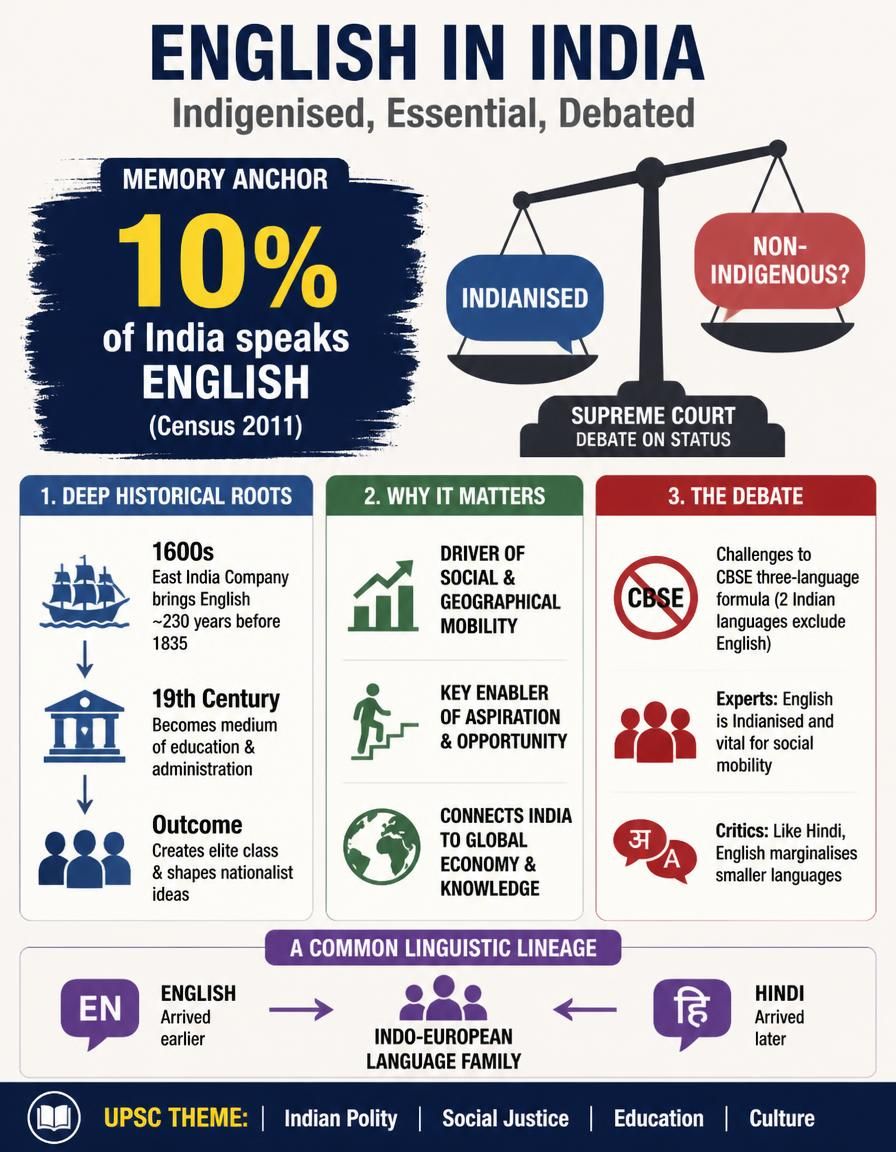
- The Supreme Court is currently debating whether English should be classified as a "non-indigenous" language in India, considering its long history and role as a link language.
- This discussion arises from challenges to the CBSE's three-language formula, which mandates two native Indian languages, thereby excluding English from that category.
- Experts Apoorvanand and Ganesh Devy contend that English, despite its foreign origin, has been "Indianised" and is crucial for social mobility and aspiration.
- Ganesh Devy highlights that both English and Hindi belong to the Indo-European language family, having arrived in India at different historical periods.
English Language Debate.jpg
Detailed Insights:
- English's presence in India predates Macaulay's Minute of 1835, with the East India Company beginning its use almost 230 years prior.
- The language transitioned from being a tool for traders and administration to a medium of education, influencing the formation of an elite class and nationalist ideas.
- English significantly contributes to social and geographical mobility, offering advantages that other Indian languages may not provide.
- The 2011 Census of India indicated that 10% of the population speaks English, though experts suggest this figure might be an underestimation due to data collection methodologies.
- Critics argue that Hindi, similar to English, has contributed to the marginalization of smaller languages by categorizing them as its subsets in the Census, reflecting a state-driven desire for linguistic unity.
- The continued prominence of English is also influenced by the commercial interests of English language publishers and educational institutions.
- Despite the widespread adoption of English and Hindi, Indian culture and regional languages have demonstrated resilience, integrating external influences rather than being entirely replaced.
Key Concepts Involved:
- Supreme Court: The apex judicial body in India, established under the Constitution, serving as the final court of appeal and guardian of fundamental rights.
- CBSE's three-language formula: A policy by the Central Board of Secondary Education recommending students learn three languages, with at least two being native Indian languages, to promote multilingualism.
- Macaulay's Minute: A document presented by Thomas Babington Macaulay in 1835, advocating for English as the medium of instruction in Indian education to create a class loyal to British interests.
- Indo-European language family: A large family of languages native to Eurasia, encompassing most European, Iranian, and Indo-Aryan languages like Hindi and English.
- Census of India: The official decennial population enumeration conducted by the Government of India, collecting comprehensive demographic, social, and economic data.

SuperKalam is your personal mentor for UPSC preparation, guiding you at every step of the exam journey.
Download the App


STUDY RESOURCES
CONTACT US
ⓒ Snapstack Technologies Private Limited