GS 2: GovernanceGS 3: Science & TechnologyGS 3: Internal SecurityGS 3: EconomyPrelims
Can India build a strategic fuel system?, Pg10
India considers a $42 billion strategic fuel program to build 41 MT of crude, LNG, and LPG reserves, bolstering energy security against disruptions.
Practice MCQs
796 Students attempted
Key Highlights:
- India's energy security is vulnerable due to limited strategic storage for crude oil, LNG, and LPG.
- A proposed decade-long strategic-fuel programme aims to add 28 MT of crude oil, 9 MT of LNG, and 4 MT of LPG storage.
- This expansion targets nearly two months of crude and LNG demand cover and about six weeks of LPG demand.
- India currently operates underground Strategic Petroleum Reserve for crude and two LPG caverns, but lacks natural gas storage.
- The proposed program, estimated at $42 billion, combines infrastructure CAPEX with the cost of purchasing and maintaining fuel inventories.
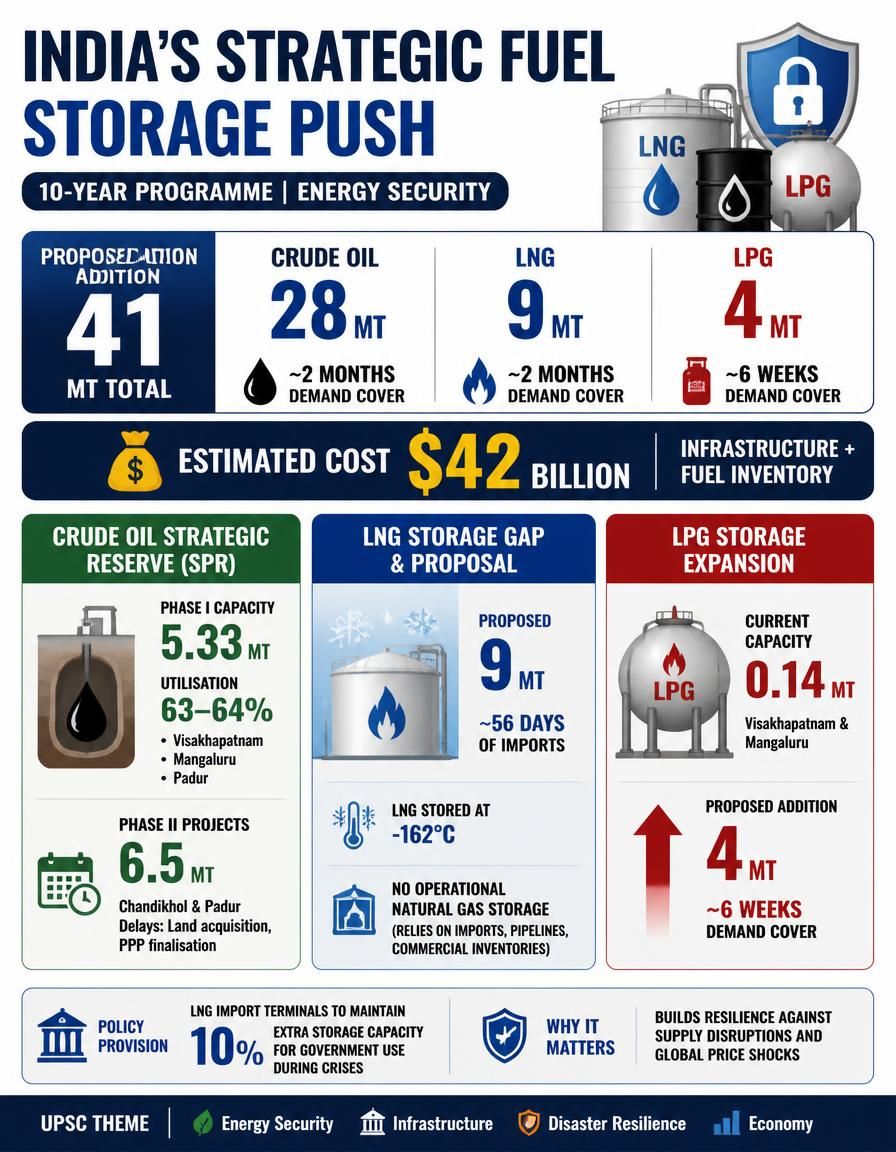
Fuel Storage.jpg
Detailed Insights:
- Phase I of the Strategic Petroleum Reserve provides 5.33 MT of underground crude capacity, with 63-64% utilization across Visakhapatnam, Mangaluru, and Padur.
- Phase II crude storage projects (6.5 MT) at Chandikhol and Padur face delays due to land acquisition and finalization of Public-Private Partnership (PPP) frameworks.
- India's current underground LPG capacity is 0.14 MT in Visakhapatnam and Mangaluru, making the 4 MT proposal a significant increase.
- Natural gas security relies on domestic production, LNG imports, terminals, commercial inventories, and pipelines, as there is no operational underground storage.
- The proposed 9 MT LNG storage aims to buffer India against prolonged import disruptions, representing about 56 days of imports.
- LNG is stored cryogenically at -162°C, while underground natural gas storage involves regasifying LNG and injecting it into depleted reservoirs or caverns.
- The Ministry of Petroleum and Natural Gas proposes LNG import terminals maintain 10% extra storage capacity for government use during crises.
- India is diversifying import sources and shipping capabilities, with State-run oil refiners and Shipping Corporation of India planning a $1.5-$2 billion joint venture for 59 ships.
- Indian Oil is expanding sourcing and exploring direct stakes in Very Large Gas Carriers to secure supply chains.
- The Petroleum and Natural Gas Regulatory Board (PNGRB) has authorized 1,800 km of new LPG pipelines to improve deliverability and reduce road dependence.
- An effective strategic reserve requires an integrated framework encompassing reserves, shipping, pipelines, and robust governance for emergency execution.
Key Concepts Involved:
- Strategic Petroleum Reserve (SPR): Government-maintained emergency stockpiles of crude oil to mitigate supply disruptions.
- Liquefied Natural Gas (LNG): Natural gas converted to liquid form for easier storage and transport at cryogenic temperatures.
- Public-Private Partnership (PPP): A funding model for public infrastructure projects involving collaboration between government and private sector.
- Energy Security: Uninterrupted availability of energy sources at an affordable price.

SuperKalam is your personal mentor for UPSC preparation, guiding you at every step of the exam journey.
Download the App


STUDY RESOURCES
CONTACT US
ⓒ Snapstack Technologies Private Limited