GS 2: International RelationsGS 3: EconomyPrelims
Forced labour farce, Pg8
US slaps 10% 'forced labor' tariffs on India, exposing a strategic ploy to force trade deals amid ongoing Section 301 investigations.
Practice MCQs
789 Students attempted
Key Highlights:
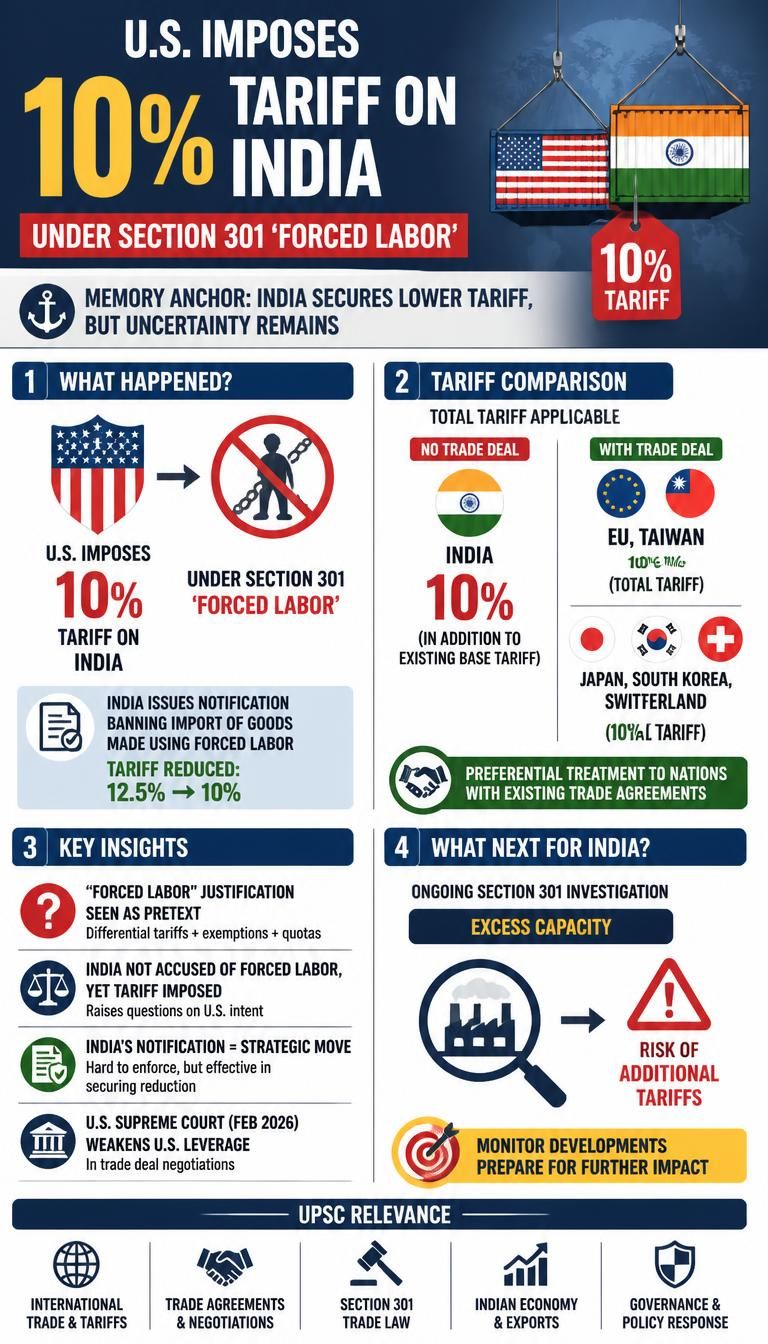
- The United States has imposed a 10% tariff on imports from India and several other countries, citing goods made using forced labor.
- This action is perceived as an effort to re-establish permanent tariffs and encourage new trade deals with the U.S.
- A U.S. Supreme Court decision in February 2026 reportedly diminished the U.S.'s leverage in trade deal negotiations.
- The new Section 301 'forced labor' tariffs are designed to be more permanent and provide preferential treatment to nations with existing trade agreements.
- India successfully negotiated a reduction in its proposed tariff from 12.5% to 10% by issuing a notification banning the import of goods made using forced labor.
US Tariffs.jpg
Detailed Insights:
- The 10% tariff applied to India is in addition to its existing base tariff, while countries like the European Union and Taiwan, with trade deals, face a total 10% tariff.
- Similar benefits were extended to Japan, South Korea, and Switzerland, all of whom have trade agreements with the U.S. at various stages of formalization.
- The article suggests that the "forced labor" justification is a pretext, given the differential application of tariffs and numerous product-wise exemptions and country-wise quotas.
- India faces these tariffs despite not being accused of using forced labor, raising questions about the U.S. penalizing countries for trade with third parties.
- India's notification banning forced labor imports, though potentially challenging to enforce, was a strategic move to secure a tariff reduction.
- Uncertainty persists for India due to another ongoing Section 301 investigation concerning excess capacity, which could result in further tariffs.
- The article advises India against hastily entering a trade deal, as the U.S. tariff landscape can undergo significant changes even after agreements are signed.
Key Concepts Involved:
- Section 301: A provision of the Trade Act of 1974 empowering the U.S. to impose tariffs or other trade restrictions against countries engaging in unfair trade practices.
- Tariff: A tax or duty levied by a government on imported or exported goods.
- Forced Labor: Work or service exacted from any person under the threat of penalty and for which the person has not voluntarily offered themselves.
- Trade Deal: A bilateral or multilateral agreement between countries aimed at reducing or eliminating trade barriers and fostering economic cooperation.

SuperKalam is your personal mentor for UPSC preparation, guiding you at every step of the exam journey.
Download the App


STUDY RESOURCES
CONTACT US
ⓒ Snapstack Technologies Private Limited