GS 2: International RelationsGS 3: EconomyPrelimsGS 3: Effects of Liberalization on the EconomyGS 2: Effect of Policies and Politics of Developed and Developing Countries on India's Interests
US Proposes 25% Tariff on Indian Exports Amid Trade Friction
Washington threatens India with a 25% tariff on pharmaceuticals and clean energy exports to force concessions in bilateral trade negotiations.
Source: The Hindu (Pg. 8)
Practice MCQs
811 Students attempted
Key Highlights:
- The Office of the United States Trade Representative proposed a 25% tariff on Indian exports, citing alleged strategic excess manufacturing capacity.
- The proposed duty can be reduced to 17% if India concludes a bilateral trade agreement with the United States.
- India received the second-highest tariff rate among 14 partner nations targeted under this trade measure.
- Key sectors singled out by Washington include generic pharmaceuticals, telecommunication equipment, and renewable energy goods.
- The United States previously instituted a 25% tariff in July 2025, alongside paused threats of 100% duties tied to Russian crude imports.
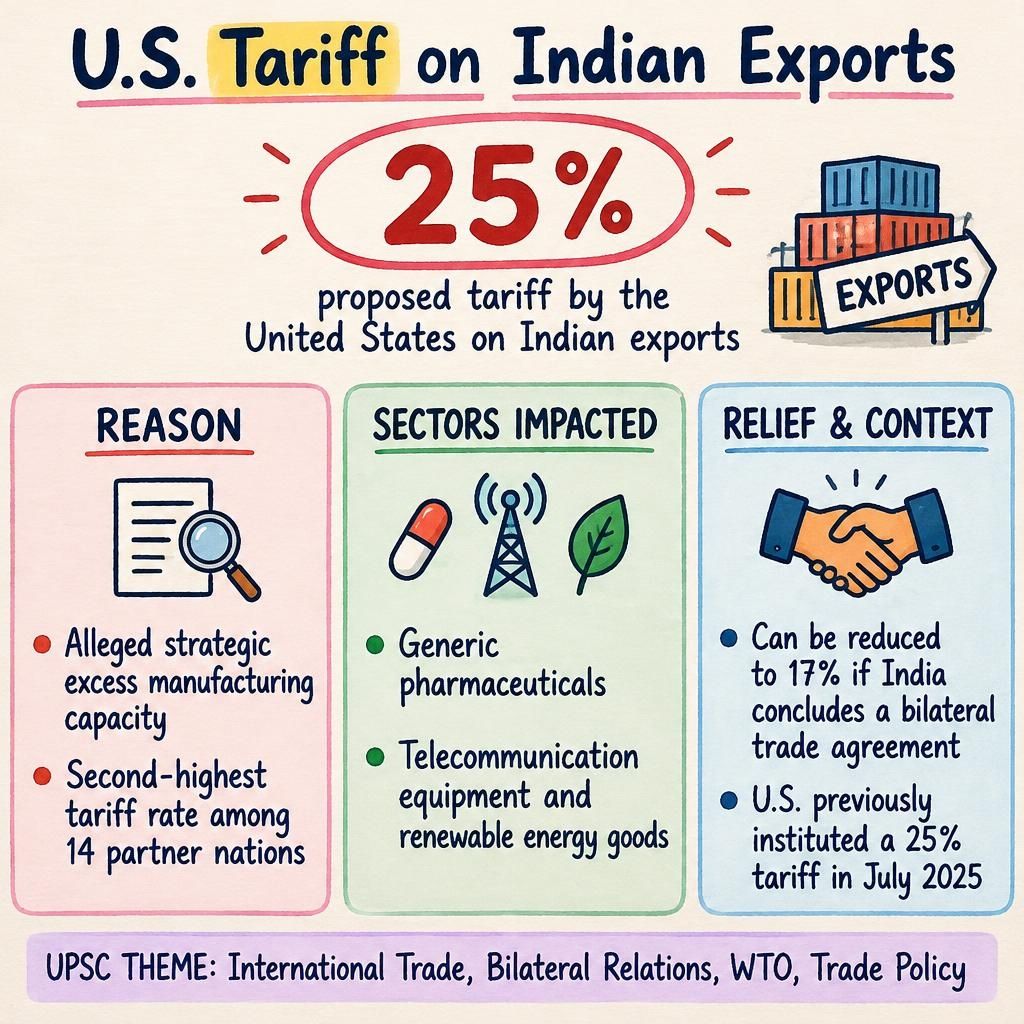
US Tariff
Detailed Insights:
- Unilateral tariff measures challenge the rule-based multilateral trading architecture governed by the World Trade Organization.
- Tariff escalation serves as economic leverage to compel concessions in stalled bilateral free trade negotiations.
- Washington frequently pursues unilateral enforcement through investigations under Section 301 of the Trade Act of 1974.
- Indian industrial output under the Production Linked Incentive scheme targets domestic import substitution rather than predatory export dumping.
- U.S. demand for Indian clean energy products expanded primarily due to supply chain diversification away from China.
- Secondary tariff threats linked to crude purchases reflect pressure strategies aligned with the Countering America's Adversaries Through Sanctions Act.
Key Concepts Involved:
- Strategic Excess Capacity: Industrial output systematically exceeding domestic consumption, subsidized to dominate foreign export markets.
- Reciprocal Tariffs: Import duties levied by a country to match identical tariff rates applied by trade partners.
- Countervailing Duties: Tariffs imposed on imported goods to offset foreign government subsidies and protect domestic manufacturers.
- Section 301: A U.S. statutory provision authorizing trade sanctions against foreign policies deemed burdensome to American commerce.

SuperKalam is your personal mentor for UPSC preparation, guiding you at every step of the exam journey.
Download the App


STUDY RESOURCES
CONTACT US
ⓒ Snapstack Technologies Private Limited