GS 3: EconomyPrelimsGS 3: Changes in Industrial Policy and Effects on Industrial GrowthGS 3: Inclusive GrowthGS 3: Indian Economy, Planning, Mobilization of Resources, Growth, Development and Employment
Corporate Investment, Wage Stagnation, and Employment Generation in India
Prime Minister Modi urges India Inc to boost capital expenditure and wages as 2019 corporate tax cuts fail to curb jobless growth.
Source: The Hindu (Pg. 9)
Practice MCQs
811 Students attempted
Key Highlights:
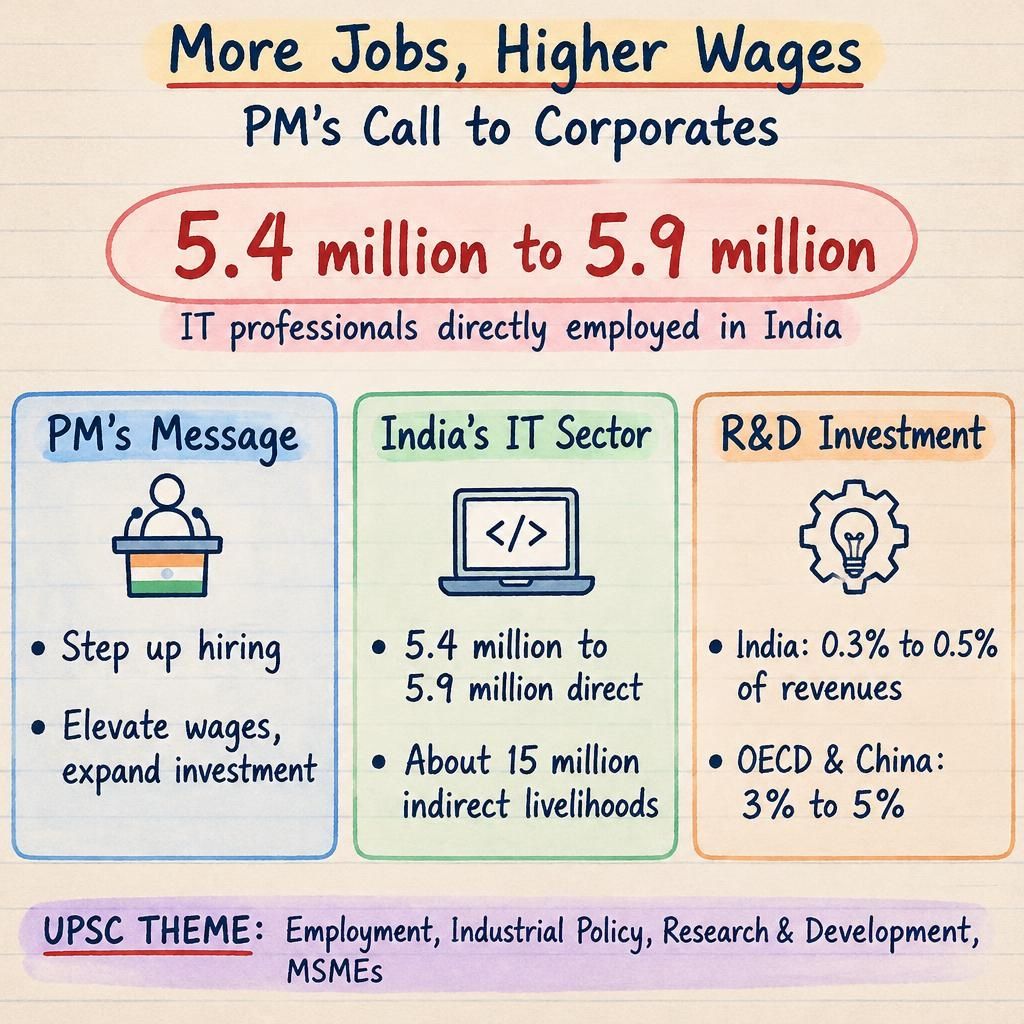
- Prime Minister Narendra Modi urged domestic corporations to step up hiring, elevate worker wages, and expand capital investments to support broader economic development.
- Despite major government concessions including the 2019 corporate tax rate reduction and Make in India, economic expansion has not adequately translated into high-quality, remunerative employment.
- India's information technology industry directly employs 5.4 million to 5.9 million professionals and supports approximately 15 million indirect livelihoods.
- Indian private firms invest between 0.3% and 0.5% of their revenues in research and development, compared to 3% to 5% across major OECD economies and China.
- Saudi Arabia's Nitaqat Scheme was cited as a policy benchmark where state concessions were conditioned on binding domestic employment targets.
Corporate Investment
Detailed Insights:
- Supply-side interventions like the Production Linked Incentive Scheme have expanded manufacturing capacity but struggled to revive aggregate consumer demand.
- Corporate profits have rebounded post-pandemic, yet private sector capital formation remains subdued, prolonging the trend of jobless economic growth.
- Historical incentives provided via Software Technology Parks of India demonstrate that strategic policy support can create robust employment multipliers in service sectors.
- Stalled implementation of the Code on Wages, 2019 across states has contributed to wage stagnation among contract workers and notified informal industries.
- Funding channelled through the Anusandhan National Research Foundation is viewed as necessary to help domestic firms shift from low-cost operations to high-value innovation.
- Reorienting fiscal policy toward enterprises governed under the Micro, Small and Medium Enterprises Development Act, 2006 offers higher labour absorption than large-scale corporate tax relief.
Key Concepts Involved:
- Jobless Growth: An economic phase where gross domestic product expands without a corresponding increase in net employment opportunities.
- Supply-side Economics: A macroeconomic strategy using tax cuts, deregulation, and industrial subsidies to spur corporate investment and output.
- Nitaqat Scheme: A regulatory labour quota system in Saudi Arabia mandating private companies to hire fixed percentages of domestic workers.
- Gross Expenditure on Research and Development: The total financial outlay committed by government and private entities toward systematic scientific and industrial innovation.

SuperKalam is your personal mentor for UPSC preparation, guiding you at every step of the exam journey.
Download the App


STUDY RESOURCES
CONTACT US
ⓒ Snapstack Technologies Private Limited