GS 1: Indian GeographyGS 1: Physical GeographyGS 3: Environment & EcologyPrelimsGS 3: Disaster and Disaster Management
'Godzilla' El Niño Effects To Be Felt Next Year Too: Decoding WMO Warning For India, Pg13
WMO warns 'Godzilla' El Niño, peaking this year with record-breaking temperatures, will cause extreme weather and food insecurity globally until 2027.
Practice MCQs
804 Students attempted
Key Highlights:
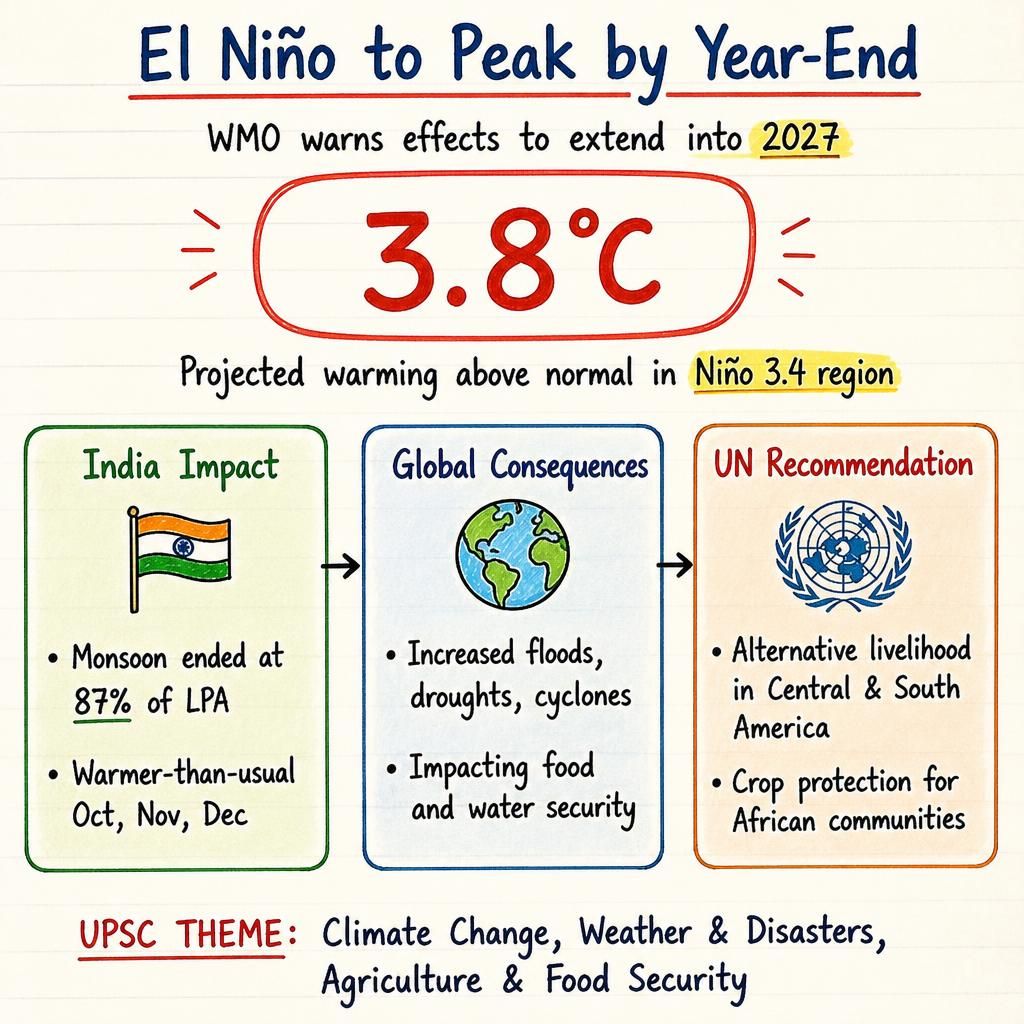
- The World Meteorological Organization (WMO) has warned that the prevailing El Niño conditions are set to peak by the end of the year, with effects extending into 2027.
- This El Niño is characterized by "off-the-charts warming," with sea surface temperatures in the Pacific Ocean expected to break previous records.
- India's southwest monsoon, which brings 70% of annual rainfall, ended at 87% of the long period average, making it the fourth driest since 2001.
- The current El Niño is projected to cause a warmer-than-usual winter in India, with above-normal temperatures forecast for October, November, and December.
- Globally, the phenomenon is expected to lead to increased floods, droughts, extreme temperatures, and cyclones, impacting food and water security.
El Nino.jpg
Detailed Insights:
- El Niño, an abnormal warming of surface waters in the Pacific Ocean, emerged in June this year, with its climatic effects felt in India after 40-45 days.
- The ongoing northeast monsoon is, however, expected to be normal over India’s southern peninsula.
- The El Niño Southern Oscillation (ENSO) describes the interaction over the Pacific, with El Niño being its warm phase, alongside neutral and La Niña (cool) phases.
- Scientists measure temperature anomalies in the Niño 3.4 region of the equatorial Pacific Ocean to determine the onset and strength of ENSO phases.
- The Relative Ocean Niño Index (RONI) for July-September recorded warming of 2 to 2.8 degrees Celsius, with projections reaching 3.8 degrees Celsius above normal.
- This temperature anomaly is unprecedented since ocean temperature monitoring began four decades ago, surpassing the previous high of 3 degrees Celsius.
- Regions like southern Europe, parts of Africa, the Arabian peninsula, the Indian subcontinent, and eastern Asia are likely to experience above-normal temperatures.
- The UN body handling humanitarian affairs has recommended alternative livelihood options for Central and South American populations and crop protection for African communities.
Scientific/Technical Concepts Involved:
- El Niño: Abnormal warming of surface waters in the Pacific Ocean, influencing global weather patterns.
- El Niño Southern Oscillation (ENSO): A large-scale ocean-atmosphere interaction over the Pacific with warm (El Niño), neutral, and cool (La Niña) phases.
- Niño 3.4 region: A specific area in the equatorial Pacific Ocean used to monitor sea surface temperature anomalies for ENSO declarations.
- Relative Ocean Niño Index (RONI): A measure of temperature deviation from the normal in the Niño 3.4 region, used to declare El Niño or La Niña.

SuperKalam is your personal mentor for UPSC preparation, guiding you at every step of the exam journey.
Download the App


STUDY RESOURCES
CONTACT US
ⓒ Snapstack Technologies Private Limited