GS 2: GovernanceGS 2: PolityPrelimsGS 2: Government policies and interventions for development in various sectorsGS 2: Indian Constitutional Evolution, Features, Amendments, Basic Structure Doctrine
Census duty: govt's powers and private citizens' rights, Pg13
Government amends Census Rules to clarify power to compel private citizens for duty, facing legal challenges from private institutions and courts.
Practice MCQs
804 Students attempted
Key Highlights:
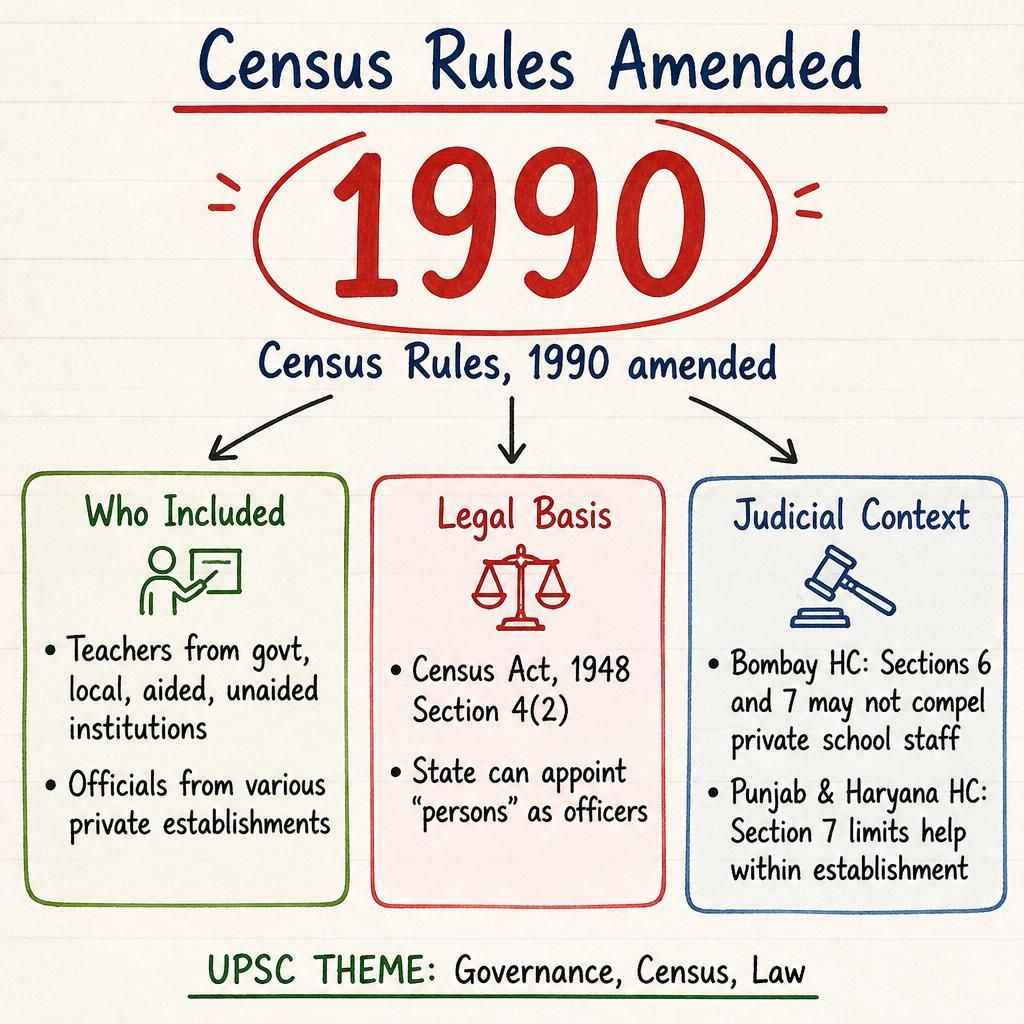
- The Centre recently amended the Census Rules, 1990, to explicitly include teachers from government, local authority, aided, and unaided private educational institutions, as well as officials from various private establishments, as potential Census enumerators.
- The amendment also retains a broader category of "any person" deemed suitable by state governments or Union Territory administrations for Census duties.
- This amendment follows interim protections granted by the Bombay High Court and a stay by the Punjab and Haryana High Court against compulsory requisition of private school teachers for Census duty.
- The Census Act, 1948, particularly Section 4(2), empowers state governments to appoint "persons" as Census officers who are "bound to serve accordingly."
Census Rules.jpg
Detailed Insights:
- The Ministry of Home Affairs (MHA) stated the amendment aims to remove ambiguity and ensure smooth conduct of the Census, which requires a large number of enumerators.
- The Bombay High Court, in May, observed that Sections 6 and 7 of the Census Act might not confer authority to compulsorily requisition staff from private unaided schools.
- The court rejected the government's interpretation that "any person" in the old Rule 3 broadly covered private teachers, noting it could extend to professionals like doctors or lawyers.
- The Punjab and Haryana High Court had previously quashed orders compelling LIC employees for general enumeration, citing that Section 7 only allows assistance within an establishment.
- During Census 2011, courts allowed deployment of private aided and unaided school teachers but with conditions, such as using their services outside school hours and exempting certain classes.
- Article 23(2) of the Indian Constitution permits the state to impose "compulsory service for public purposes," provided it does not discriminate.
- However, the article highlights that the Census Act lacks the elaborate statutory regime for compulsory service seen in acts like the National Service Act, 1972.
Key Concepts Involved:
- Census Act, 1948: The primary legislation governing the conduct of the Census in India, outlining powers and duties.
- Census Rules, 1990: Subordinate legislation detailing the procedures and personnel involved in conducting the Census.
- Article 23 of the Indian Constitution: Prohibits forced labor but allows the state to impose compulsory service for public purposes.
- Enumerators: Individuals appointed to collect demographic and other data from households during a Census operation.

SuperKalam is your personal mentor for UPSC preparation, guiding you at every step of the exam journey.
Download the App


STUDY RESOURCES
CONTACT US
ⓒ Snapstack Technologies Private Limited