GS 2: GovernanceGS 2: PolityGS 3: Science & TechnologyGS 2: Social JusticePrelims
Censorship, gag on investigations: Publishers move SC against privacy law, Pg1
News publishers challenge India's privacy law in Supreme Court, citing threats to press freedom, investigative journalism, and source protection.
Practice MCQs
804 Students attempted
Key Highlights:
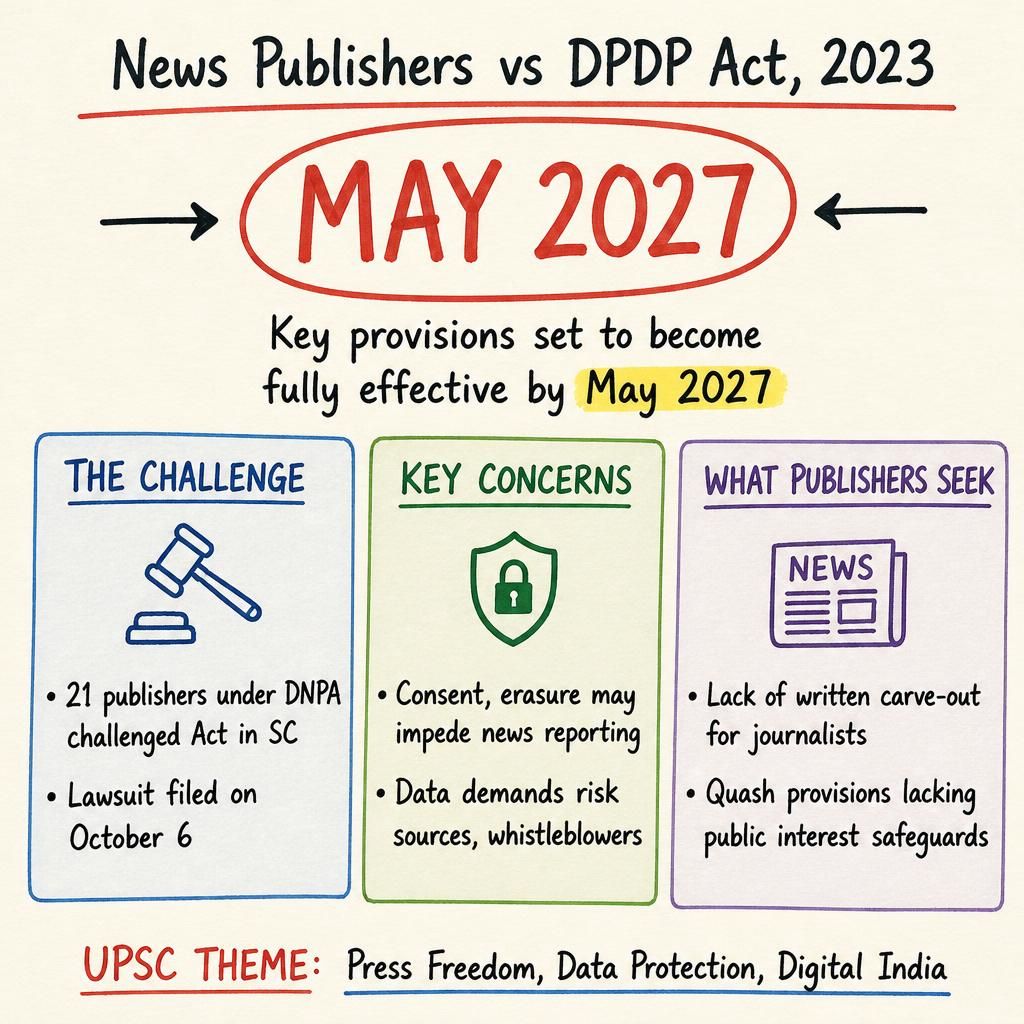
- A group of 21 news publishers, under the Digital News Publishers Association (DNPA), has challenged India's Digital Personal Data Protection Act, 2023 in the Supreme Court.
- The lawsuit, filed on October 6, argues that the privacy law infringes upon press freedom, investigative journalism, and the protection of journalists' sources.
- Publishers contend that the law lacks specific exemptions for journalistic activities, unlike data protection laws in the European Union, Singapore, and Britain.
- Key contentious provisions, which are set to become fully effective by May 2027, are sought to be quashed by the publishers.
- The DNPA argues that requiring prior consent from investigation subjects and allowing data erasure without public interest safeguards could severely impede news reporting.
DPDP Act.jpg
Detailed Insights:
- The Digital Personal Data Protection Act, 2023, enacted in August 2023, aims to protect individuals' digital personal data while allowing its processing for lawful purposes.
- The law's phased implementation began in November 2025, with most substantive obligations, including consent requirements, becoming effective by May 2027.
- Publishers fear that the law could force them to seek consent from individuals they are investigating, potentially allowing subjects to destroy evidence or intimidate witnesses.
- Concerns also include the power granted to a federal authority to demand information, which could expose confidential sources and deter whistleblowers.
- The DNPA highlights that the law grants broad exemptions to the state but fails to extend corresponding protections to the press, creating an imbalance.
- The absence of a written carve-out for journalists, despite government assurances, is a major point of alarm for media organizations.
- The lawsuit emphasizes that provisions allowing individuals to withdraw consent and demand data erasure without public interest safeguards could lead to factual news reports being unpublished or heavily redacted.
Key Concepts Involved:
- Digital Personal Data Protection Act, 2023: India's comprehensive law regulating the processing of digital personal data to protect individual privacy.
- Press Freedom: The constitutional right to circulate opinions and information without censorship or government interference, crucial for a democratic society.
- Investigative Journalism: A form of journalism where reporters deeply investigate a single topic, often involving crime, political corruption, or corporate wrongdoing.
- Data Fiduciary: An entity that determines the purpose and means of processing personal data under the Digital Personal Data Protection Act, 2023.

SuperKalam is your personal mentor for UPSC preparation, guiding you at every step of the exam journey.
Download the App


STUDY RESOURCES
CONTACT US
ⓒ Snapstack Technologies Private Limited