GS 2: GovernanceGS 3: Science & TechnologyGS 3: EconomyPrelimsGS 2: Government policies and interventions for development in various sectors
Why India’s R&D system needs a map of where funds really go, Pg II
NITI Aayog report reveals R&D funding inefficiencies, proposing a Unified Project Management System with PIDs to track grants and prevent duplication.
Practice MCQs
789 Students attempted
Key Highlights:
- A recent NITI Aayog report, 'Ease of Doing R&D in India', highlighted significant issues in the country's research and development ecosystem.
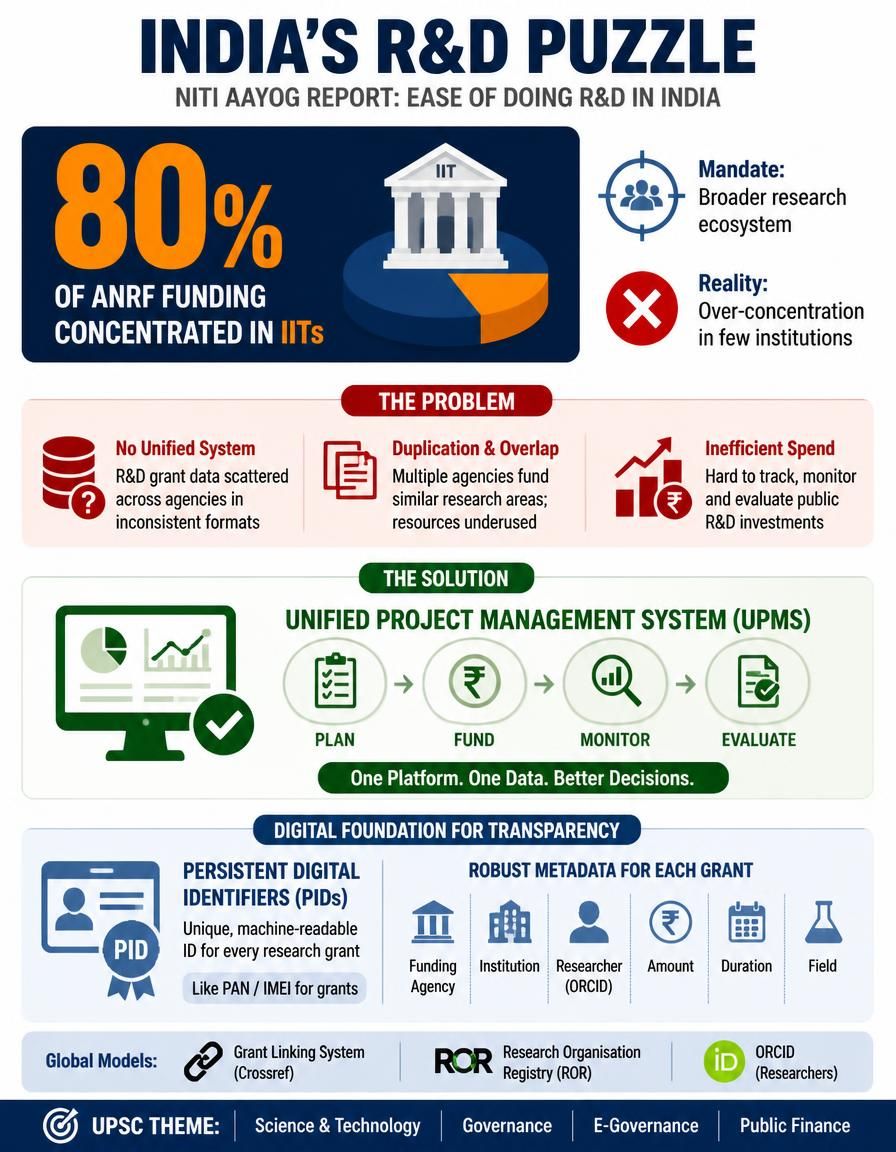
- The report revealed that nearly 80% of funding from the Anusandhan National Research Foundation (ANRF) is concentrated in IITs.
- India lacks a unified system to track R&D funding, leading to potential overlaps and inefficient use of public money.
- NITI Aayog has proposed the Unified Project Management System (UPMS) to streamline the planning, funding, monitoring, and evaluation of public R&D projects.
- The report emphasizes the critical need for Persistent Digital Identifiers (PIDs) and a robust metadata infrastructure for all research grants.
R&D Puzzle.jpg
Detailed Insights:
- The NITI Aayog report was based on inputs from over 400 institutional leaders and 850 scientists.
- The concentration of ANRF funding in IITs goes against its mandate to support a broader base of research institutions.
- Multiple Central agencies funding similar research areas results in duplication and suboptimal utilization of resources.
- PIDs are unique, machine-readable identifiers for research grants, akin to a PAN or IMEI number.
- Metadata would provide structured details for each grant, including funding agency, institution, researcher, amount, duration, and field.
- Currently, grant information is scattered across various agency databases in inconsistent formats, making comprehensive analysis difficult.
- Global solutions like the Grant Linking System by Crossref and the Research Organisation Registry (ROR) already exist to address these issues.
- Key global identifiers include funder IDs, ROR IDs for institutions, and ORCID for individual researchers.
- Crossref also provides a grant DOI (Digital Object Identifier) to permanently identify grants and link them to research outputs.
- Such systems enable tracking of duplicate proposals, identification of funding concentration, and evaluation of research outcomes.
- India can adopt a hybrid model, using a national portal like UPMS to generate Crossref-compatible grant DOIs and link to ROR and ORCID.
Key Concepts Involved:
- NITI Aayog: The premier public policy think tank of the Government of India, providing strategic and technical advice.
- Anusandhan National Research Foundation (ANRF): A flagship body established to provide high-level strategic direction for research and development in India.
- Unified Project Management System (UPMS): A proposed system by NITI Aayog to centralize and streamline the management of R&D projects across government entities.
- Persistent Digital Identifier (PID): A long-lasting, unique reference to a digital object or entity, ensuring its discoverability and accessibility over time.
- Metadata: Data that provides information about other data, describing the content, quality, condition, and other characteristics of data.
- Crossref: A non-profit organization that provides services for scholarly communication, including a Grant Linking System for research funding.
- Research Organisation Registry (ROR): A global, community-led registry of open, sustainable, and unique identifiers for research organizations.
- ORCID: An open, non-profit, community-driven effort to create and maintain a registry of unique researcher identifiers.

SuperKalam is your personal mentor for UPSC preparation, guiding you at every step of the exam journey.
Download the App


STUDY RESOURCES
CONTACT US
ⓒ Snapstack Technologies Private Limited