GS 3: Environment & EcologyPrelimsGS 3: Conservation, Pollution and DegradationGS 1: Changes in Critical Geographical Features, Water Bodies, Ice Caps, Flora and FaunaGS 1: Salient Features of World's Physical Geography
Arctic ‘jungles’ offer critical insights into climate studies, Pg II
Rapid Arctic warming is transforming the tundra's miniature plant life, causing "shrubification" that accelerates climate change and alters fragile ecosystems.
Practice MCQs
789 Students attempted
Key Highlights:
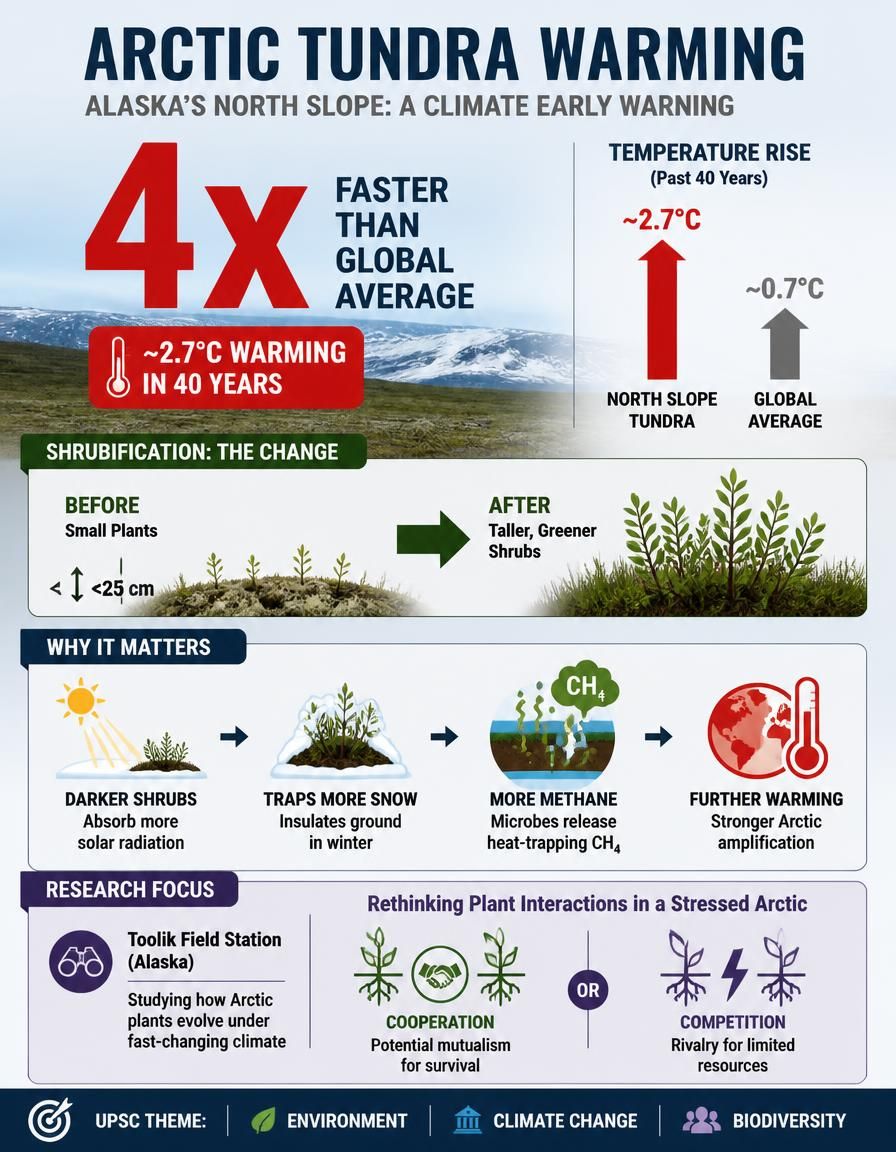
- The Arctic, particularly Alaska's North Slope tundra, is warming four times faster than the global average, offering critical climate insights.
- This rapid warming is causing traditionally small Arctic plants to grow taller and greener, a process termed shrubification.
- Shrubification contributes to further warming by increasing heat absorption and trapping more snow, which leads to greater methane release.
- Researchers at Toolik Field Station are investigating how Arctic plants evolve to either compete or cooperate under these changing conditions.
- The article suggests a re-evaluation of plant interactions, highlighting potential mutualism among species for survival in stressed Arctic ecosystems.
Arctic Tundra.jpg
Detailed Insights:
- The North Slope tundra in Alaska, characterized by its low-growing vegetation, provides a unique natural laboratory for climate change studies.
- Historically, extreme cold and shallow permafrost restricted Arctic plant growth to small sizes, typically under 25 centimeters.
- The region has experienced a warming of approximately 2.7 degrees Celsius over the past four decades, largely attributed to the burning of fossil fuels.
- Taller, darker shrubs absorb more solar radiation than reflective snow, contributing significantly to Arctic amplification.
- Increased snow trapped by shrubs insulates the ground, allowing microbes to release more heat-trapping methane during winter.
- While the added greenery from taller plants may absorb more carbon dioxide, its warming effects are a major concern.
- Scientists from the Woodwell Climate Research Center are conducting multi-year studies on ecosystem adaptation and genetic evolution in response to climate stress.
- The concept of mutualism, where plant species cooperate, is being explored as a potential survival strategy for Arctic flora.
Scientific/Technical Concepts Involved:
- Tundra: A treeless biome characterized by permafrost, low-growing vegetation, and extremely cold temperatures.
- Permafrost: Ground (soil, rock, or sediment) that remains frozen for two or more consecutive years.
- Shrubification: The increase in the density and height of shrubs in an ecosystem, often linked to climate change.
- Arctic amplification: The phenomenon where the Arctic region warms at a faster rate than the rest of the planet.

SuperKalam is your personal mentor for UPSC preparation, guiding you at every step of the exam journey.
Download the App


STUDY RESOURCES
CONTACT US
ⓒ Snapstack Technologies Private Limited