GS 1: Indian GeographyGS 3: Disaster ManagementGS 3: Environment & EcologyPrelimsGS 3: Disaster and Disaster Management
Why Assam is experiencing unprecedented flooding this year, Pg11
Unprecedented Assam floods claim 66 lives, displace 7 lakh, as extreme rainfall, climate change, and deforestation overwhelm river systems.
Practice MCQs
782 Students attempted
Key Highlights:
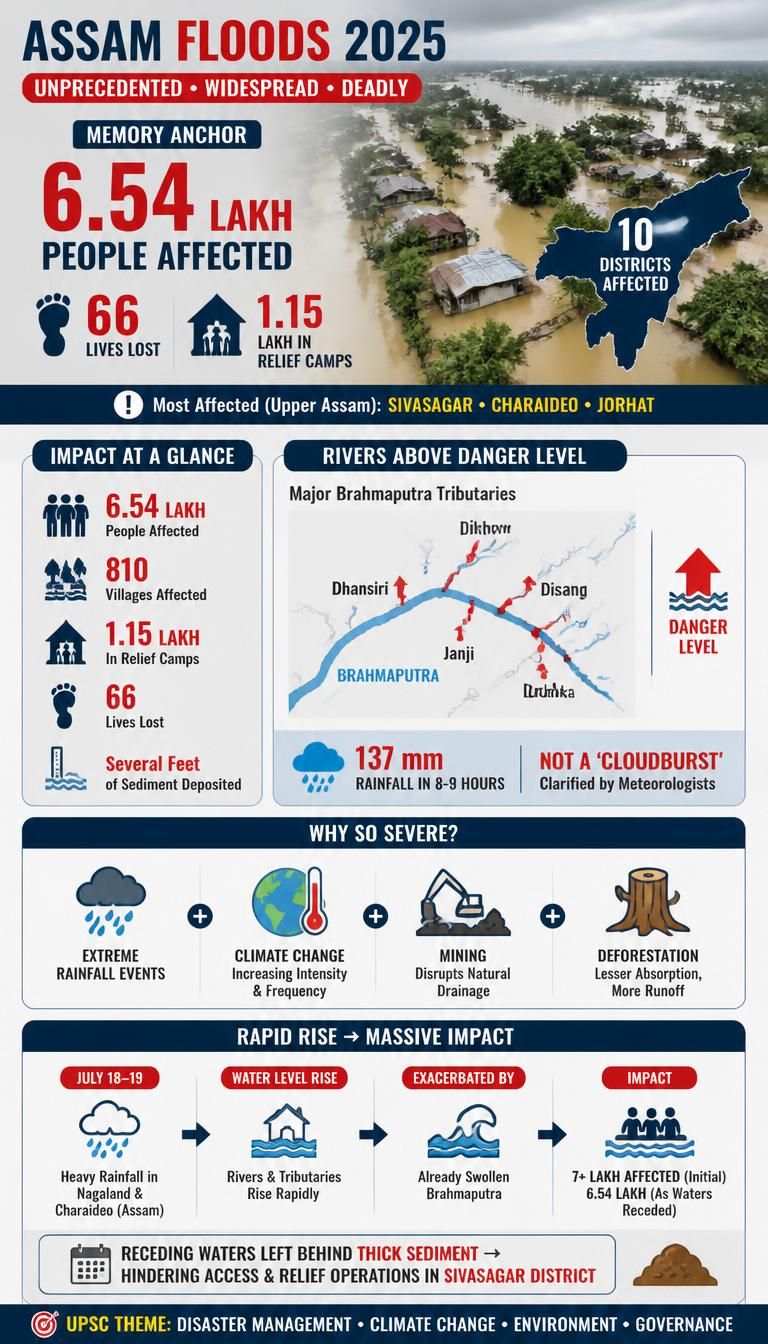
- Assam is experiencing unprecedented floods, affecting over 6.54 lakh people across 10 districts and claiming at least 66 lives.
- The Upper Assam districts of Sivasagar, Charaideo, and Jorhat are among the most severely impacted.
- Initial government attribution to a "cloudburst" in Nagaland was clarified by meteorologists as heavy rainfall (137 mm over 8-9 hours).
- Major rivers like Dikhow, Dhansiri, Disang, Janji, and Darika, all Brahmaputra tributaries, flowed above danger levels.
- Experts attribute the severity to a combination of extreme weather events, climate change, and anthropogenic factors like mining and deforestation.
Assam Floods.jpg
Detailed Insights:
- Floodwaters reached critical levels on July 19, leading to over 7 lakh people initially affected and 1.15 lakh moving to relief camps.
- The Assam State Disaster Management Authority (ASDMA) reported 6.54 lakh people affected across 810 villages as waters receded.
- Receding floodwaters left behind several feet of sediment, hindering government access to parts of Sivasagar district.
- Heavy rainfall in Nagaland and Assam's Charaideo district on July 18-19 caused rapid water level rises, exacerbated by the already swollen Brahmaputra.
- Climate change is increasing the frequency of high-intensity rainfall events (over 50 or 100 mm in a day) that cause floods.
- Excessive excavation, likely due to mining, on river valley sides contributes to mud flow, reducing river carrying capacity.
- Deforestation in watershed areas leads to rapid runoff and increased siltation, raising riverbeds and further reducing carrying capacity.
Key Concepts Involved:
- Cloudburst: A sudden, localized, and intense rainfall event, typically exceeding 100 mm per hour over a small area.
- River Carrying Capacity: The maximum volume of water and sediment a river channel can transport without overflowing its banks.
- Watershed Areas: Regions of land where all water drains into a common outlet, such as a river, lake, or ocean.
- Anthropogenic Factors: Environmental changes or pollutants caused or influenced by human activities.

SuperKalam is your personal mentor for UPSC preparation, guiding you at every step of the exam journey.
Download the App


STUDY RESOURCES
CONTACT US
ⓒ Snapstack Technologies Private Limited