GS 2: GovernanceGS 3: Science & TechnologyGS 2: Social JusticePrelimsGS 3: Economics of Animal Rearing
For antibiotics, the right dose is restraint, Pg12
Global study exposes India's alarming antibiotic overuse, with 'watch' drugs fueling antimicrobial resistance, demanding urgent policy and healthcare reforms.
Practice MCQs
782 Students attempted
Key Highlights:
- A global study published in The Lancet Public Health revealed India's over-reliance on "watch" antibiotics and underuse of "access" antibiotics.
- The World Health Organisation (WHO) classifies antibiotics into "access," "watch," and "reserve" categories based on their resistance potential.
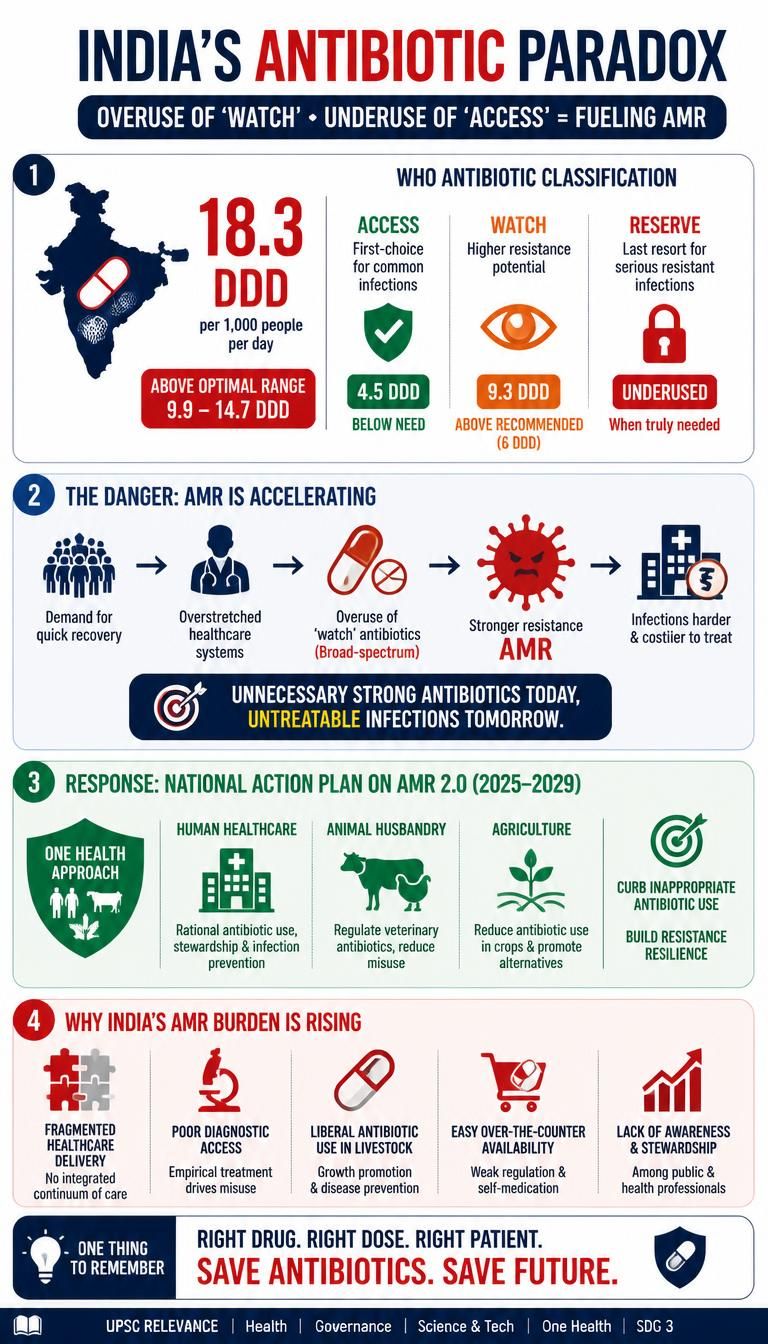
- India's actual antibiotic use stands at 18.3 Defined Daily Doses (DDD) per 1,000 people per day, exceeding the optimal range of 9.9 to 14.7 DDD.
- "Watch" antibiotics are used at 9.3 DDD against a recommended 6 DDD, while "access" antibiotics are at 4.5 DDD, falling short of needs.
- The National Action Plan on Antimicrobial Resistance 2.0 (2025-2029) aims to curb inappropriate antibiotic usage across human healthcare, animal husbandry, and agriculture.
Antibiotic.jpg
Detailed Insights:
- The preference for broad-spectrum "watch" drugs is driven by patient demand for quick recovery and doctors operating in overstretched healthcare systems.
- Unnecessary use of stronger antibiotics accelerates Antimicrobial Resistance (AMR), making future infections harder and more expensive to treat.
- The underuse of "reserve" antibiotics for genuinely resistant cases indicates systemic failures in ensuring the right medicine reaches the right patient.
- Factors contributing to India's rising AMR burden include fragmented healthcare delivery, poor diagnostic access, and liberal antibiotic use in livestock and agriculture.
- The National Action Plan on Antimicrobial Resistance 2.0 (2025-2029), launched on November 18, 2025, is a five-year roadmap to combat AMR through a One Health approach.
- The plan emphasizes antimicrobial stewardship and calls for stricter compliance across the pharmaceutical supply chain to curb indiscriminate over-the-counter sales and irrational fixed-dose combinations.
Key Concepts Involved:
- Antimicrobial Resistance (AMR): When microorganisms evolve to withstand drugs designed to kill them, making infections difficult or impossible to treat.
- Antimicrobial Stewardship: Coordinated efforts to promote the optimal use of antimicrobial agents to preserve their effectiveness and reduce resistance.
- Defined Daily Doses (DDD): A statistical measure representing the assumed average maintenance dose per day for a drug used for its main indication in adults.
- WHO AWaRe classification: A framework categorizing antibiotics into Access (first-line), Watch (broader-spectrum, reserved for specific situations), and Reserve (last-line for highly resistant infections) groups.

SuperKalam is your personal mentor for UPSC preparation, guiding you at every step of the exam journey.
Download the App


STUDY RESOURCES
CONTACT US
ⓒ Snapstack Technologies Private Limited