GS 2: International RelationsGS 3: EconomyPrelimsGS 3: Changes in Industrial Policy and Effects on Industrial GrowthGS 3: Effects of Liberalization on the Economy
Trump's tariff threat on generics: Why it matters for Indian pharma firms, Pg15
Trump threatens 200% tariffs on generic drugs, forcing Indian pharma giants to boost US investments and secure market access.
Practice MCQs
782 Students attempted
Key Highlights:
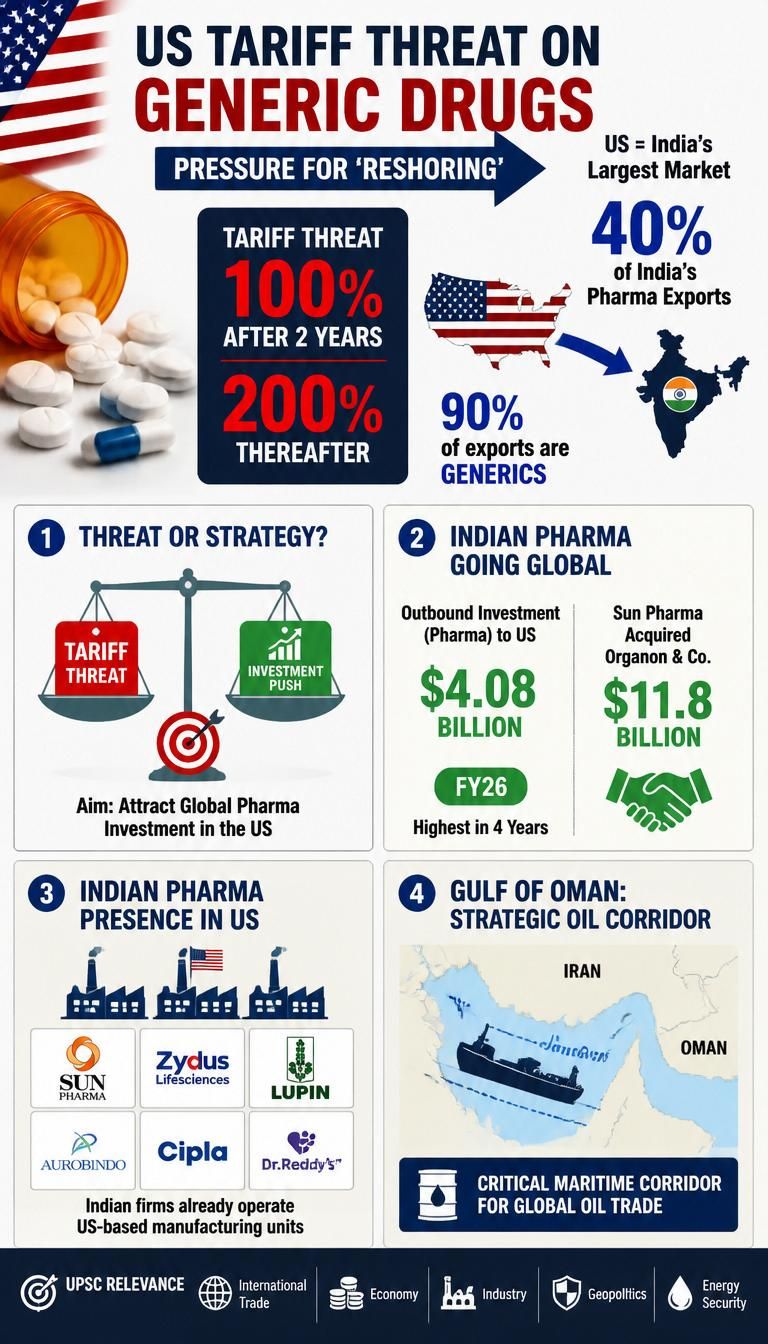
- US President Donald Trump announced a threat to impose 100% tariffs on generic drugs after two years, escalating to 200% thereafter, to promote "reshoring" of pharmaceutical production to the US.
- The US is India’s largest market for pharmaceutical exports, accounting for nearly 40% of India's total pharma exports, with 90% of these being generics.
- Indian pharmaceutical companies are increasing outbound investments in the US, with Sun Pharmaceutical Industries acquiring Organon & Co. for $11.8 billion.
- Outbound investment from India to the US in the pharma sector reached $4.08 billion in FY26, the highest in four years.
US tariff on generic drugs.jpg
Detailed Insights:
- Trump's tariff threats are largely seen by experts as a strategy to encourage global pharma giants to boost investments in the US rather than to actually implement tariffs.
- Previous un-implemented tariff threats included 100% on specified branded medicines under Section 232 of the Trade Expansion Act of 1962 and on imported branded and patented medicines.
- Several leading Indian drug makers, including Sun Pharma, Zydus Lifesciences, Lupin, Aurobindo Pharma, Cipla, and Dr Reddy’s Laboratories, already operate US-based manufacturing facilities.
- The Gulf of Oman is a critical maritime corridor for global oil trade.
- The US imported $213 billion worth of pharmaceutical products in 2025, with $94.1 billion being finished medicines, a category that includes generics.
- Cipla is expanding production at its plants in Massachusetts and New York, while Dr Reddy’s Laboratories is open to increasing US manufacturing if commercially viable.
Key Concepts Involved:
- Tariffs: Taxes imposed by a government on imported goods and services.
- Generic Drugs: Pharmaceutical products that are bioequivalent to a brand-name drug but are typically sold at a lower price.
- Reshoring: The process of returning the manufacturing of goods to the company's country of origin.
- Section 232 of the Trade Expansion Act of 1962: A US law allowing the President to impose tariffs on imports if they are deemed a threat to national security.

SuperKalam is your personal mentor for UPSC preparation, guiding you at every step of the exam journey.
Download the App


STUDY RESOURCES
CONTACT US
ⓒ Snapstack Technologies Private Limited