GS 2: GovernanceGS 2: PolityPrelimsGS 2: Indian Constitutional Evolution, Features, Amendments, Basic Structure Doctrine
Constitution Day: Tracing the Evolution and Enduring Compass of India's Founding Document
India marks Constitution Day on November 26, reaffirming key amendments and democratic milestones from Ambedkar to the historic women’s reservation act.
Source: Indian Express (Pg. 11)
Practice MCQs
804 Students attempted
Key Highlights:
- India marks Constitution Day on November 26, commemorating the formal adoption of the Constitution by the Constituent Assembly in 1949.
- The observance was instituted by the Ministry of Social Justice and Empowerment via a gazette notification on November 19, 2015, marking B. R. Ambedkar's 125th birth anniversary.
- National per capita income increased from ₹79,118 in FY 2013-14 to approximately ₹2.085 lakh in FY 2025-26.
- The Constitution (One Hundred and Second Amendment) Act, 2018 granted constitutional status to the National Commission for Backward Classes.
- The Constitution (One Hundred and Sixth Amendment) Act, 2023, also known as the Nari Shakti Vandan Adhiniyam, provides 33 percent reservation for women in legislative assemblies and Parliament.
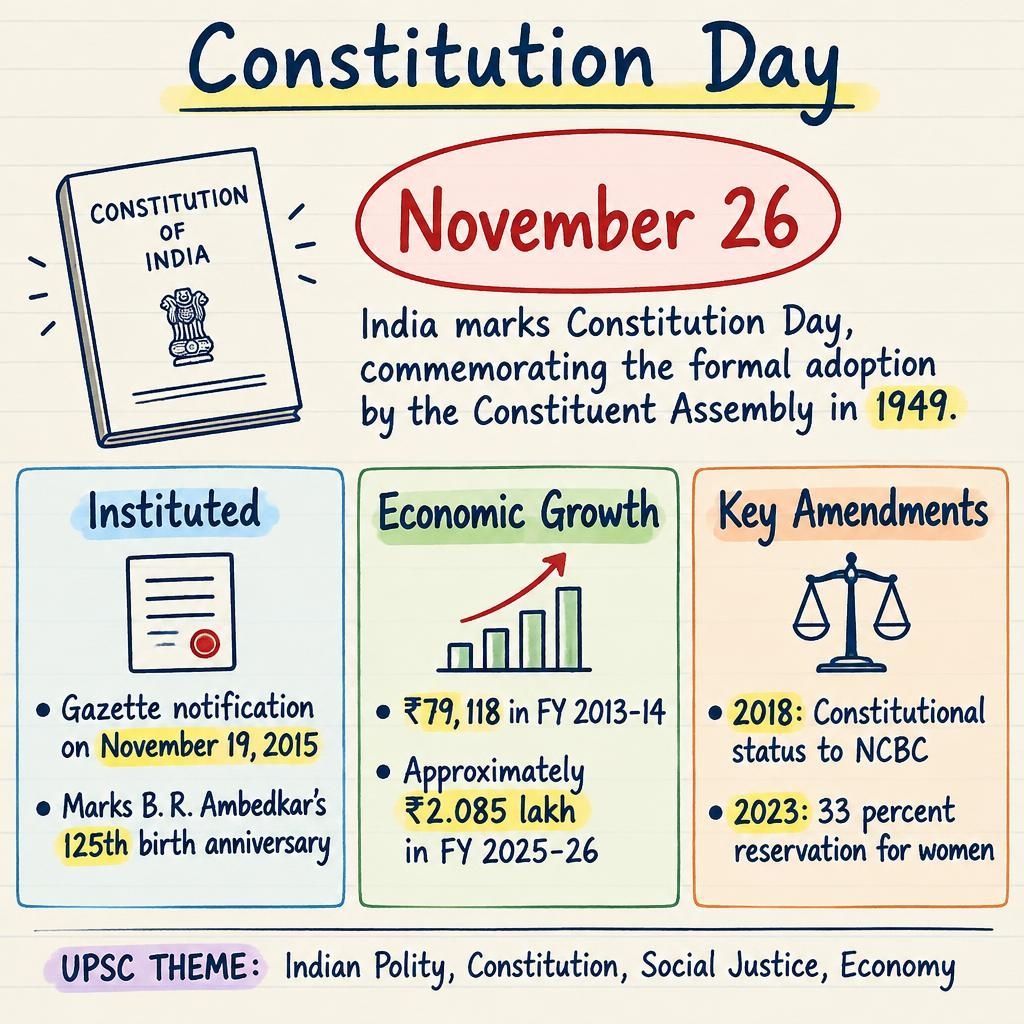
Constitution Day.jpg
Detailed Insights:
- The Constitution (Twenty-Fourth Amendment) Act, 1971 was enacted to overturn the Golaknath Case ruling regarding parliamentary power over Fundamental Rights.
- Judicial review over amending powers was decisively established through the Basic Structure Doctrine articulated in the Kesavananda Bharati Case.
- The Constitution (One Hundred and Third Amendment) Act, 2019 introduced a 10 percent reservation quota for Economically Weaker Sections under Article 15 and Article 16.
- The Constitution (One Hundred and Fifth Amendment) Act, 2021 restored the power of state governments to identify Socially and Educationally Backward Classes.
- The Election Commission of India maintains electoral integrity through revision drives governed by the Representation of the People Act, 1950.
Key Concepts Involved:
- Grammar of Anarchy: Ambedkar's warning against unconstitutional agitations and satyagraha once legal, democratic remedies become available.
- Basic Structure Doctrine: A judicial principle holding that Parliament cannot alter core features of the Constitution under Article 368.
- Constitutional Morality: The principled commitment to uphold democratic conventions, institutional checks, and rule of law over arbitrary power.

SuperKalam is your personal mentor for UPSC preparation, guiding you at every step of the exam journey.
Download the App


STUDY RESOURCES
CONTACT US
ⓒ Snapstack Technologies Private Limited