GS 3: Science & TechnologyGS 3: Internal SecurityGS 2: International RelationsPrelimsGS 2: Government policies and interventions for development in various sectors
Revisiting India’s nuclear doctrine without revising it, Pg8
India's two-decade-old nuclear doctrine, with NFU and credible minimum deterrence, faces scrutiny amid evolving security challenges and disruptive technologies.
Practice MCQs
789 Students attempted
Key Highlights:
- India's nuclear doctrine, operationalized in 2003, has remained largely unchanged for over two decades.
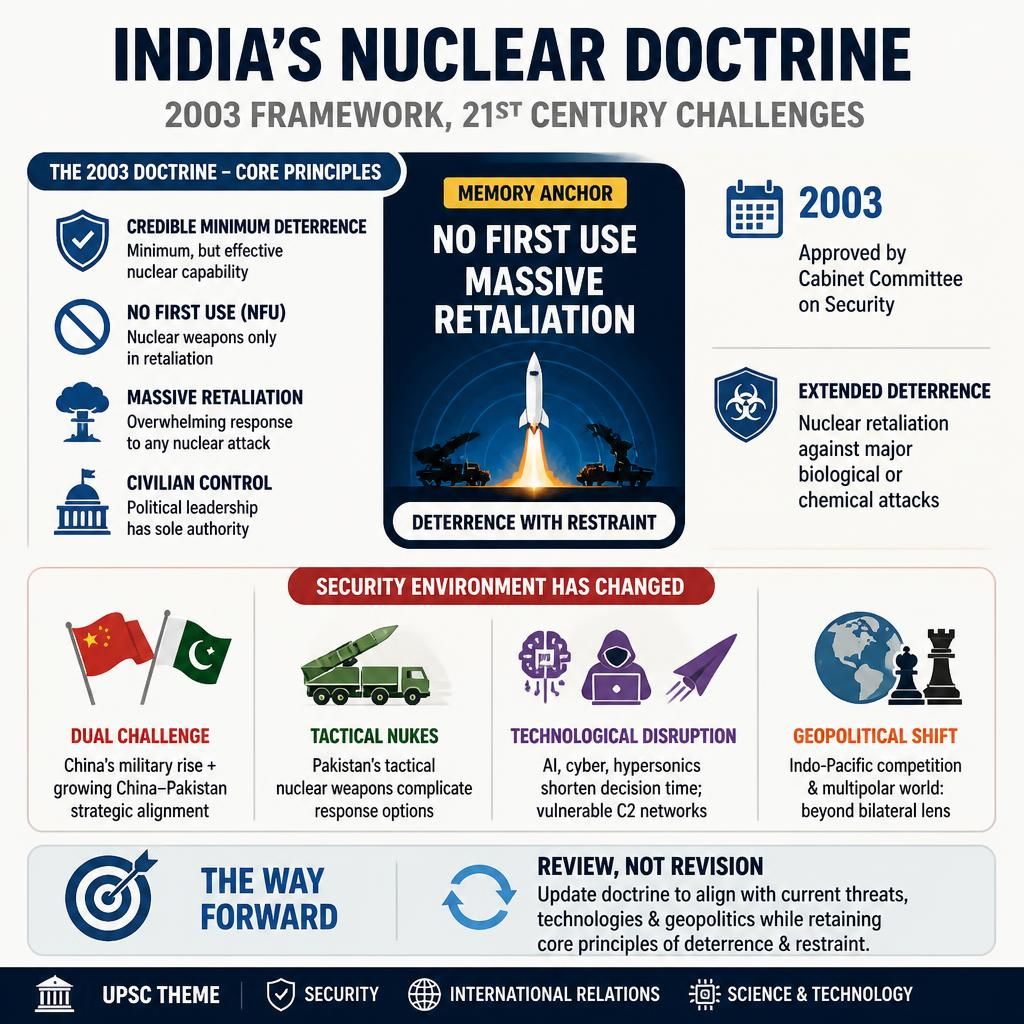
- Its core principles include Credible Minimum Deterrence and a No First Use (NFU) posture, with a provision for nuclear retaliation against major biological or chemical attacks.
- The doctrine was formulated after the 1998 Pokhran-II tests and the 1999 Kargil War, aiming to balance deterrence with restraint.
- Significant shifts in the security environment, including China's military modernization, Pakistan's development of tactical nuclear weapons, and technological advancements, challenge the doctrine's assumptions.
- The article suggests a review of the doctrine to align with current security challenges, rather than a complete revision.
India's Nuclear Doctrine.jpg
Detailed Insights:
- The 2003 doctrine, approved by the Cabinet Committee on Security, established a posture of massive retaliation to a nuclear attack, supported by a survivable second-strike capability and firm civilian control.
- China and Pakistan's growing strategic alignment means India must now consider interconnected challenges from two nuclear-armed neighbors.
- Pakistan's tactical nuclear weapons are designed to offset India's conventional advantage, complicating India's response options.
- Emerging technologies like AI, cyber capabilities, and hypersonic weapons are shortening decision-making timelines and increasing the vulnerability of command-and-control networks.
- The geopolitical landscape, marked by great-power competition in the Indo-Pacific and a more multipolar world, means nuclear doctrine can no longer be viewed solely through bilateral deterrence.
- A review could examine command-and-control resilience, second-strike capabilities, and the relevance of existing concepts like massive retaliation, without necessarily altering core principles.
- Maintaining the NFU policy reinforces India's image as a responsible nuclear power and avoids creating uncertainty for adversaries.
- Strengthening operational capabilities, modernizing delivery systems, and improving command-and-control resilience are prioritized over reopening declaratory policy.
- Any doctrinal assessment should also evaluate survivability, intelligence, early warning, cyber resilience, and the nuclear triad to ensure credible capabilities.
Key Concepts Involved:
- Credible Minimum Deterrence: India's nuclear strategy of maintaining a sufficient but not excessive nuclear arsenal to deter adversaries by ensuring the ability to inflict unacceptable damage in retaliation.
- No First Use (NFU): A commitment by a nuclear power not to initiate the use of nuclear weapons, only employing them in retaliation to a nuclear attack on its territory or forces.
- Tactical Nuclear Weapons: Smaller, lower-yield nuclear weapons designed for battlefield use against specific military targets, as opposed to strategic weapons targeting cities or large areas.
- Nuclear Triad: The capability of delivering nuclear weapons from three distinct platforms: land-based missiles, submarine-launched missiles, and strategic aircraft, ensuring a survivable second-strike capability.

SuperKalam is your personal mentor for UPSC preparation, guiding you at every step of the exam journey.
Download the App


STUDY RESOURCES
CONTACT US
ⓒ Snapstack Technologies Private Limited