GS 2: GovernanceGS 2: International RelationsPrelimsGS 4: Ethical Issues in International Relations and FundingGS 2: Bilateral, Regional and Global Groupings and Agreements
Overweight And Weak, Pg8
UNGA's 81st session highlights a weakened, unrepresentative UN amidst global crises, conflicts, and superpower polarization, urging urgent reforms and a new UNSG.
Practice MCQs
789 Students attempted
Key Highlights:
- The 81st session of the United Nations General Assembly (UNGA) is marked by urgency due to global crises and UN Secretary-General (UNSG) António Guterres's final term.
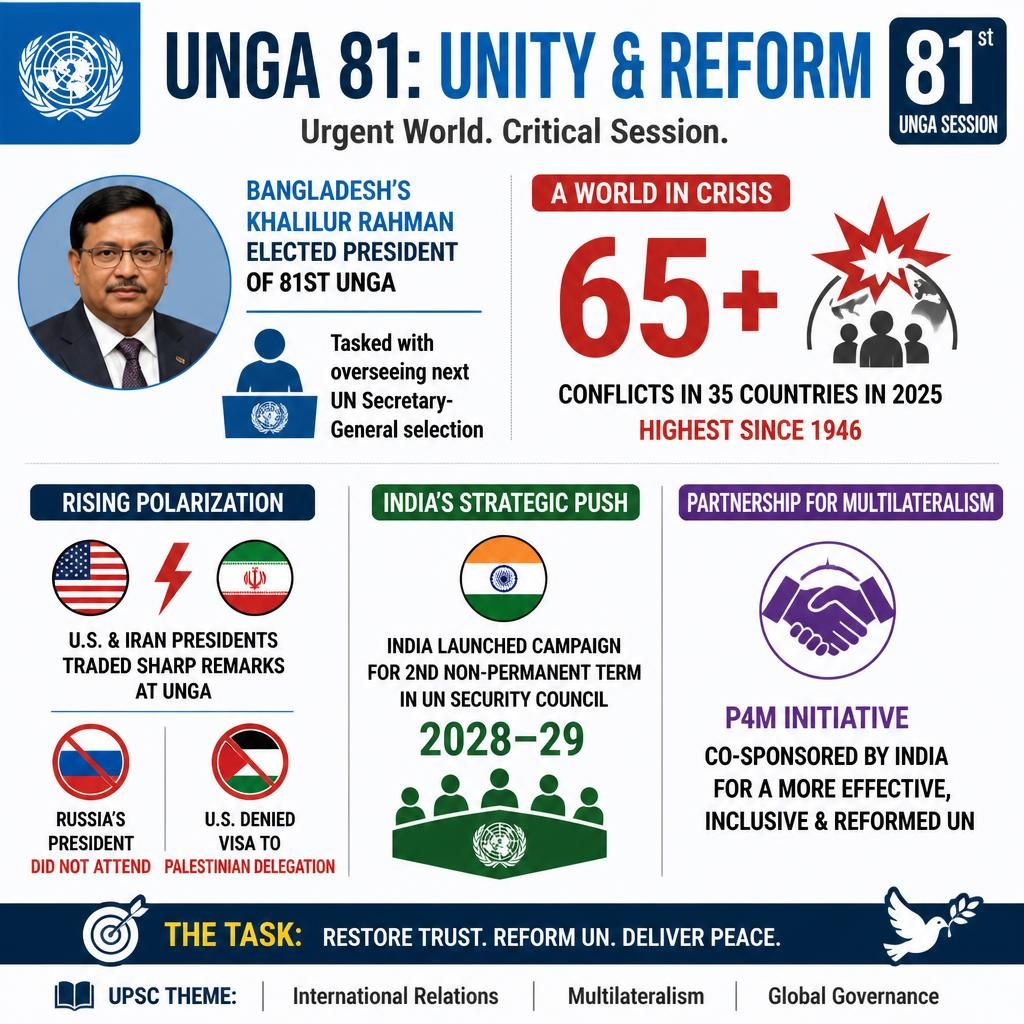
- Bangladesh's Foreign Minister Khalilur Rahman was elected President of the 81st UNGA, tasked with overseeing the next UNSG selection.
- The United Nations (UN) is perceived as weakened by a record number of global conflicts, increasing polarization, and superpower actions.
- India launched a campaign for a second two-year non-permanent term in the UN Security Council (UNSC) for 2028-29.
- An initiative for a Partnership for Multilateralism (P4M), co-sponsored by India, was discussed amidst the session's rancor.
UNGA 81.jpg
Detailed Insights:
- The 81st UNGA session is considered crucial for global unity and for initiating reforms within the UN.
- A study indicated over 65 conflicts across 35 countries in 2025, marking the highest number since 1946.
- Major global leaders, including the U.S. and Iranian Presidents, engaged in confrontational rhetoric during their speeches.
- The Russian President did not attend the session, and the U.S. denied visas to the Palestinian delegation.
- India's Prime Minister Narendra Modi notably skipped the UNGA speech despite India's active campaign for a UNSC seat.
- India advocates for a rules-based international order founded on the UN Charter, diplomacy, and dialogue.
Key Concepts Involved:
- United Nations General Assembly (UNGA): The main deliberative, policymaking, and representative organ of the United Nations.
- United Nations Secretary-General (UNSG): The chief administrative officer of the United Nations and its chief diplomat.
- United Nations Security Council (UNSC): The primary UN organ responsible for maintaining international peace and security.
- Multilateralism: Cooperation among several countries in pursuit of common goals and interests.
- UN Charter: The foundational treaty of the United Nations, outlining its purposes, principles, and structure.

SuperKalam is your personal mentor for UPSC preparation, guiding you at every step of the exam journey.
Download the App


STUDY RESOURCES
CONTACT US
ⓒ Snapstack Technologies Private Limited