GS 2: GovernanceGS 3: Environment & EcologyGS 3: EconomyPrelimsGS 3: Major Crops, Cropping Patterns and Irrigation Systems
India’s rice fields rank among world’s top methane sources, Pg13
New study reveals India's rice fields are global methane hotspots, doubling GHG emissions since 1960s, urging urgent climate-resilient agricultural reforms.
Practice MCQs
775 Students attempted
Key Highlights:
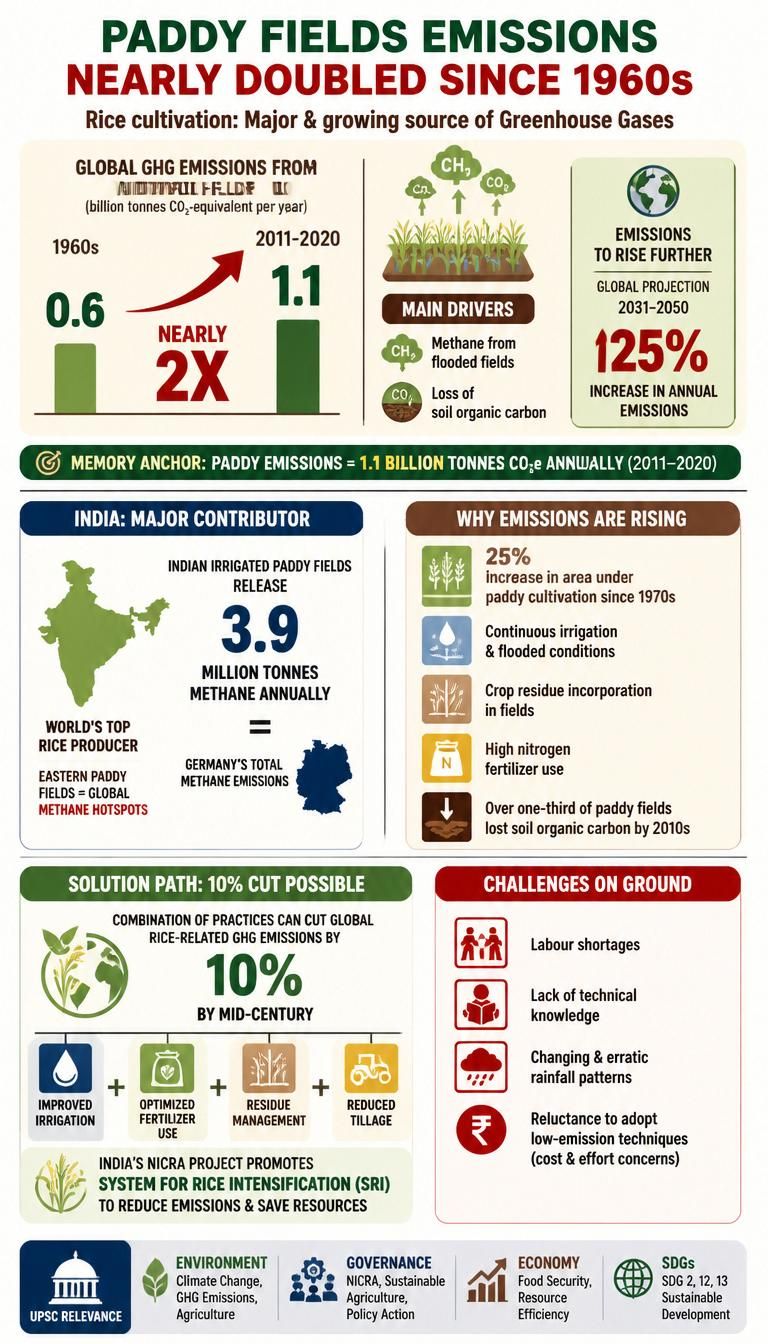
- Global greenhouse gas emissions from paddy fields have nearly doubled since the 1960s, reaching 1.1 billion tonnes of CO2-equivalent annually in 2011-2020.
- A study published in Nature Food identified methane from flooded fields and the loss of soil organic carbon as primary drivers of this increase.
- India, the world's top rice producer, contributes significantly, with its eastern paddy fields identified as global methane hotspots.
- Indian irrigated paddy fields release 3.9 million tonnes of methane annually, comparable to Germany's total methane emissions.
- The National Innovations in Climate Resilient Agriculture (NICRA) project promotes the 'System for Rice Intensification' (SRI) technique to reduce emissions.
Paddy Fields.jpg
Detailed Insights:
- The increase in emissions is partly due to the loss of soil organic carbon, with over a third of paddy fields worldwide losing carbon by the 2010s.
- Factors like increased area under cultivation (25% since 1970s), continuous irrigation, residue incorporation, and nitrogen fertilizer use contribute to India's high emissions.
- Projections indicate a 25% increase in annual emissions globally between 2031 and 2050, driven by global warming and erratic rainfall.
- Researchers suggest a combination of improved irrigation, optimized fertilizer use, residue management, and reduced tillage could cut global rice-related GHG emissions by 10% by mid-century.
- Farmers face reluctance in adopting low-emission techniques due to labor shortages, lack of technical knowledge, and changing rainfall patterns.
- The International Rice Research Institute (IRRI) advocates for a regional approach considering topography, soil, irrigation, and farmer needs.
- The KERA-AWD project in Kerala is establishing processes for low-emission rice systems in specific regions like Thrissur kole lands.
- Experts emphasize crop diversification and integrated interventions, including extension services and procurement support, to reduce reliance on paddy cultivation.
Key Concepts Involved:
- Carbon Dioxide Equivalent (CO2-e): A metric used to compare the emissions from various greenhouse gases based on their global warming potential.
- System for Rice Intensification (SRI): An agro-ecological methodology for increasing the productivity of irrigated rice by changing the management of plants, soil, water, and nutrients.
- Crop Diversification: The practice of growing a variety of crops in the same area to reduce risks and improve soil health and environmental sustainability.
- Soil Organic Carbon: The carbon component of organic matter in soil, crucial for soil health, fertility, and carbon sequestration.

SuperKalam is your personal mentor for UPSC preparation, guiding you at every step of the exam journey.
Download the App


STUDY RESOURCES
CONTACT US
ⓒ Snapstack Technologies Private Limited