GS 3: Science & TechnologyPrelimsGS 3: Space Technology
First moon found beyond solar system is as big as a planet, Pg13
Astronomers discover first exomoon, 90% Jupiter-sized, orbiting a brown dwarf, blurring planet-moon definitions using radial velocity method.
Practice MCQs
775 Students attempted
Key Highlights:
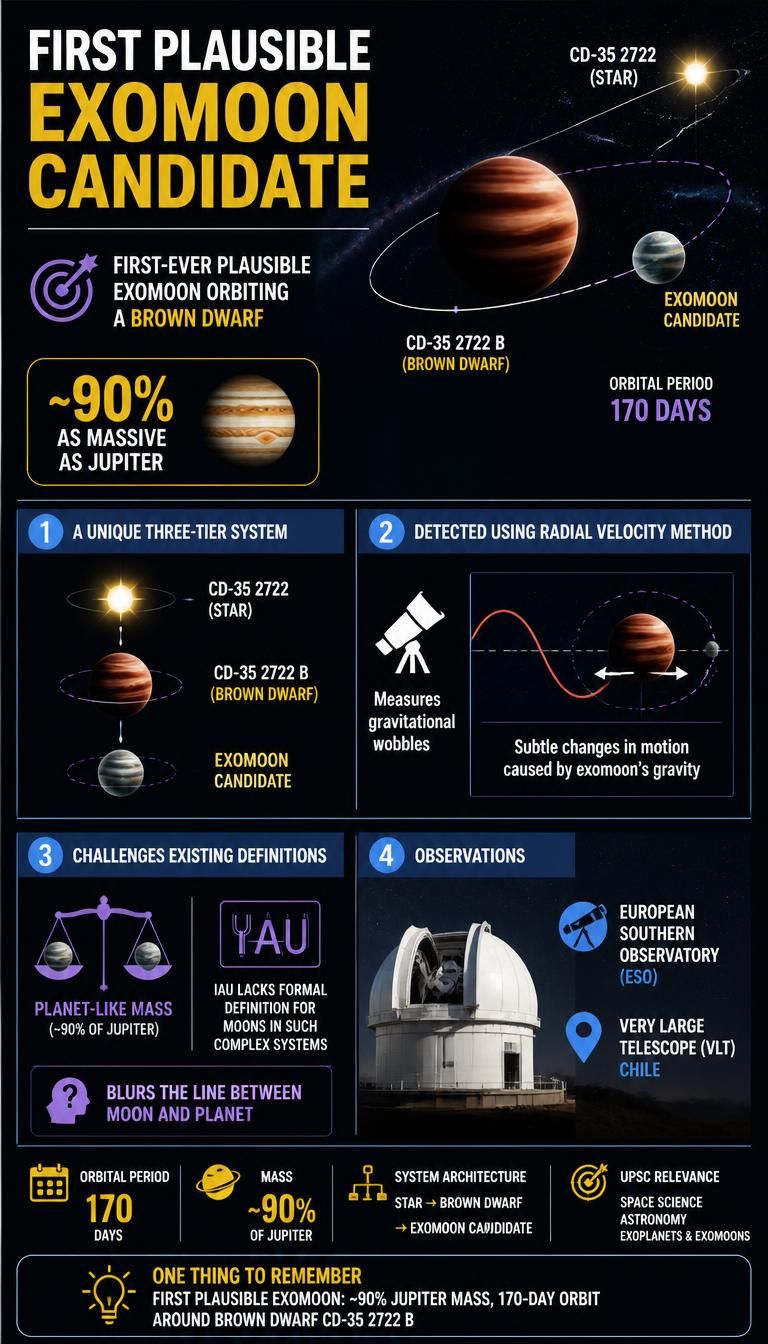
- Astronomers have identified the first plausible exomoon candidate, orbiting a brown dwarf outside our solar system.
- The newly discovered object is estimated to be approximately 90% as massive as Jupiter.
- This exomoon candidate orbits its host, the brown dwarf CD-35 2722 B, every 170 days.
- The detection was achieved using the Radial Velocity Method, a technique that measures gravitational wobbles.
Exomoon.jpg
Detailed Insights:
- The exomoon candidate is part of a unique three-tiered hierarchical system, orbiting CD-35 2722 B, which itself orbits a star named CD-35 2722.
- Its planet-like mass challenges existing astronomical definitions, blurring the distinction between a moon and a planet.
- The International Astronomical Union (IAU) currently lacks a formal definition for moons in such complex systems, highlighting a gap in celestial classification.
- The discovery was made by observing subtle changes in the brown dwarf's motion, caused by the gravitational pull of the orbiting body.
- Observations were conducted using the European Southern Observatory's Very Large Telescope (VLT) in Chile.
Scientific/Technical Concepts Involved:
- Radial Velocity Method: An indirect method to detect exoplanets or exomoons by observing Doppler shifts in the spectrum of a star or brown dwarf, caused by its gravitational wobble.
- Brown Dwarf: A celestial object with a mass between that of a large planet (like Jupiter) and a small star, capable of fusing deuterium but not hydrogen.
- Exomoon: A natural satellite orbiting an exoplanet or other non-stellar extrasolar body beyond our solar system.

SuperKalam is your personal mentor for UPSC preparation, guiding you at every step of the exam journey.
Download the App


STUDY RESOURCES
CONTACT US
ⓒ Snapstack Technologies Private Limited