GS 3: Science & TechnologyPrelimsGS 3: Space Technology
ISRO Prepares for Maiden Operational Launch of Small Satellite Launch Vehicle
ISRO prepares its maiden operational Small Satellite Launch Vehicle flight to boost commercial access for 500 kg payloads via NSIL.
Source: Indian Express (Pg. 14)
Practice MCQs
796 Students attempted
Key Highlights:
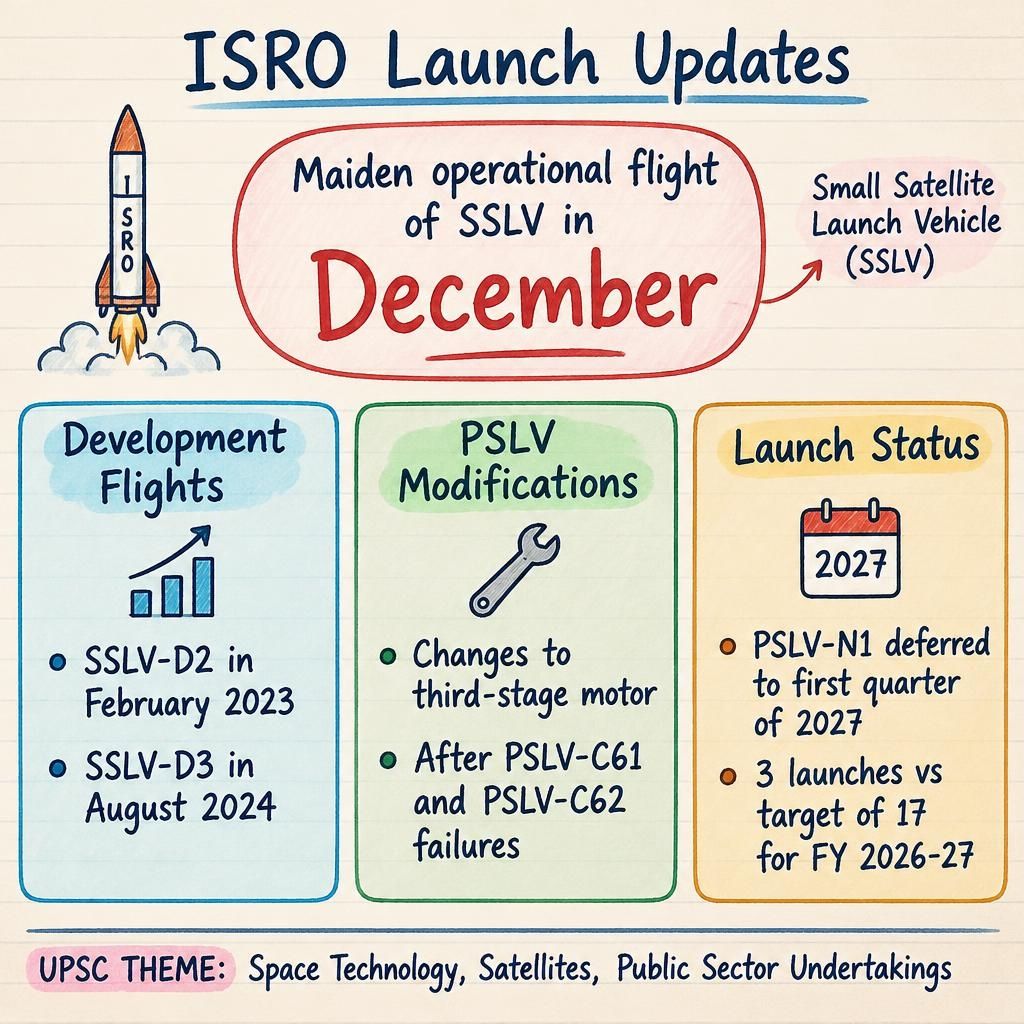
- The Indian Space Research Organisation is scheduled to conduct the maiden operational flight of the Small Satellite Launch Vehicle in December.
- The transition to operational status follows two consecutive successful development flights, SSLV-D2 in February 2023 and SSLV-D3 in August 2024.
- Modifications were made to the third-stage motor of the Polar Satellite Launch Vehicle following back-to-back mission failures of PSLV-C61 and PSLV-C62.
- The maiden launch of the first privately manufactured rocket, PSLV-N1, has been deferred to the first quarter of 2027.
- Against an annual target of 17 launches for FY 2026–27, the space agency achieved three launches, including deploying the EOS-05 and NVS-03 satellites.
ISRO SSLV.jpg
Detailed Insights:
- Operationalizing the launch vehicle allows full technology transfer to private industry consortia led by NewSpace India Limited.
- The vehicle provides dedicated, on-demand launch capability for small satellites weighing up to 500 kilograms into low Earth orbit.
- Failure reviews of the upper solid rocket stage led to redesigned nozzle configurations and enhanced raw material quality acceptance norms.
- Resuming regular flight schedules is vital to expanding India's footprint in the expanding commercial small-satellite launch market.
- The successful launch of the NVS-03 payload restored space segment capabilities for the Navigation with Indian Constellation network.
Scientific/Technical Concepts Involved:
- Velocity Trimming Module: A liquid-propellant upper stage designed to execute precise velocity adjustments and satellite orbital injections.
- Sun-Synchronous Orbit: A polar orbit maintaining a consistent angle relative to the Sun, ensuring uniform ground illumination for earth observation.
- Solid Rocket Motor: A chemical propulsion system using premixed solid fuel and oxidizer, offering rapid ignition and high thrust capabilities.

SuperKalam is your personal mentor for UPSC preparation, guiding you at every step of the exam journey.
Download the App


STUDY RESOURCES
CONTACT US
ⓒ Snapstack Technologies Private Limited