GS 3: EconomyPrelimsGS 3: Indian Economy, Planning, Mobilization of Resources, Growth, Development and Employment
Bank Loan Write-Offs Surpass Rs 18 Lakh Crore Over Past Decade
Indian banks write off over Rs 18 lakh crore in bad loans over ten years as gross non-performing assets decline steadily.
Source: Indian Express (Pg. 17)
Practice MCQs
796 Students attempted
Key Highlights:
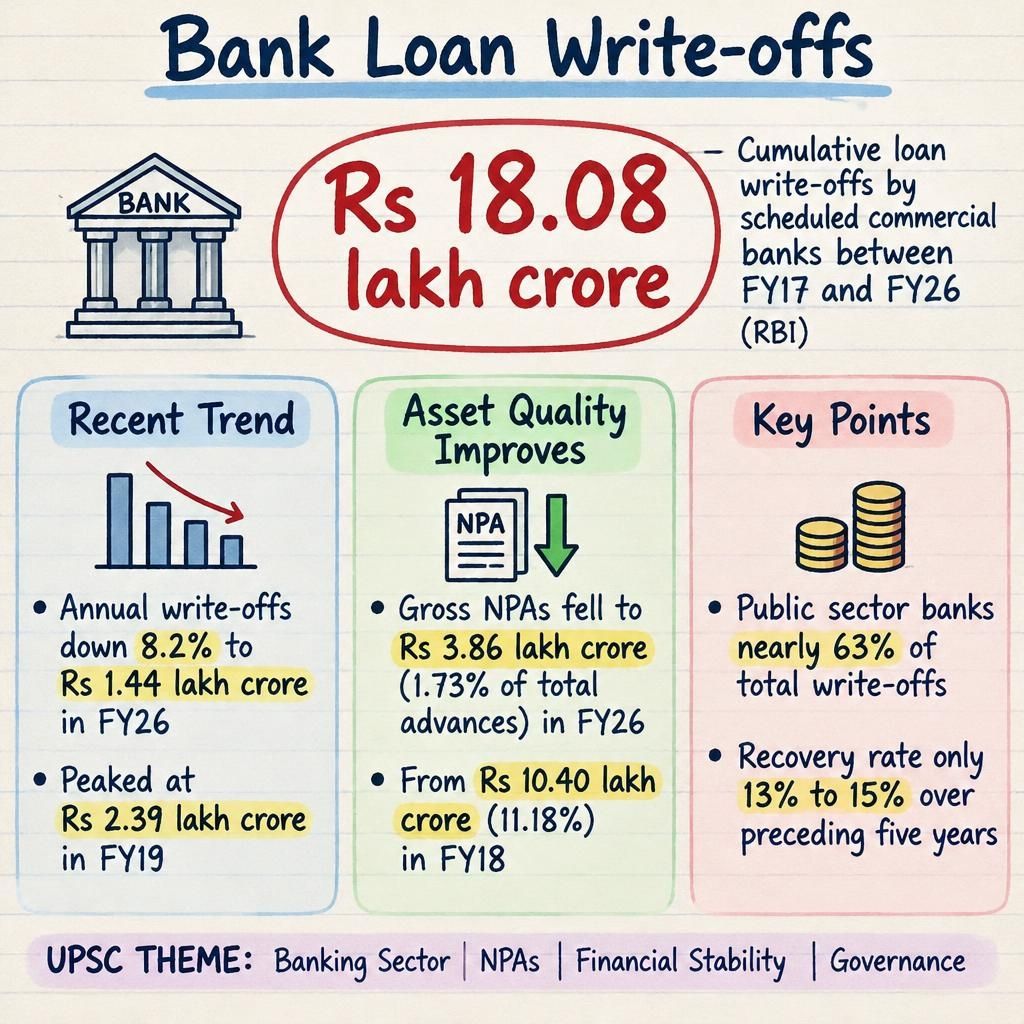
- Cumulative loan write-offs by scheduled commercial banks reached Rs 18.08 lakh crore between FY17 and FY26, according to the Reserve Bank of India.
- Annual write-offs decreased by 8.2% to Rs 1.44 lakh crore in FY26, declining steadily after peaking at Rs 2.39 lakh crore in FY19.
- Gross non-performing assets in the banking system fell to Rs 3.86 lakh crore (1.73% of total advances) in FY26 from Rs 10.40 lakh crore (11.18%) in FY18.
- Public sector banks accounted for nearly 63% of total write-offs, with State Bank of India recording the highest cumulative write-off at Rs 3.03 lakh crore.
- The recovery rate remained subdued, with lenders recovering only 13% to 15% of loans written off over the preceding five years.
Bank Loan Write-off.jpg
Detailed Insights:
- Banks utilize technical write-offs primarily to cleanse balance sheets, gain tax deductions, and fulfill capital adequacy mandates under Basel III norms.
- A write-off does not forgive debt; lenders pursue recovery using the Insolvency and Bankruptcy Code, 2016 and the SARFAESI Act, 2002.
- To expedite bad debt resolution, the central government set up the National Asset Reconstruction Company Limited to aggregate and resolve stressed loans.
- Debt resolution protocols are guided by the Reserve Bank of India under the Prudential Framework for Resolution of Stressed Assets.
- The disproportionate share of corporate defaults among write-offs highlights systemic governance gaps and weak initial risk appraisal in commercial lending.
Key Concepts Involved:
- Non-Performing Asset: A loan or advance where principal or interest payment remains overdue for 90 days.
- Technical Write-Off: An accounting removal of bad loans from balance sheets without extinguishing the borrower's legal liability.
- Provision Coverage Ratio: The proportion of bad assets backed by dedicated capital reserves to absorb potential credit losses.

SuperKalam is your personal mentor for UPSC preparation, guiding you at every step of the exam journey.
Download the App


STUDY RESOURCES
CONTACT US
ⓒ Snapstack Technologies Private Limited