GS 2: International RelationsGS 3: EconomyPrelimsGS 2: Bilateral, Regional and Global Groupings and AgreementsGS 2: Effect of Policies and Politics of Developed and Developing Countries on India's Interests
U.S. announces permanent tariffs; India rate still 10%, Pg1
U.S. imposes permanent 10% tariffs on India and 59 nations over forced labor probe.
Practice MCQs
767 Students attempted
Key Highlights:
- The U.S. has announced permanent tariffs of 10% or 12.5% on imports from 60 trading partners, effective July 24, 2026.
- These new tariffs replace temporary 10% tariffs that expired on the same date.
- The tariffs are imposed under Section 301 of the Trade Act of 1974, citing a probe into forced labor practices in these countries.
- India's tariff rate remains at 10%, having been moved from an initially proposed 12.5% after consultations.
- The affected countries account for approximately 99.4% of U.S. imports.
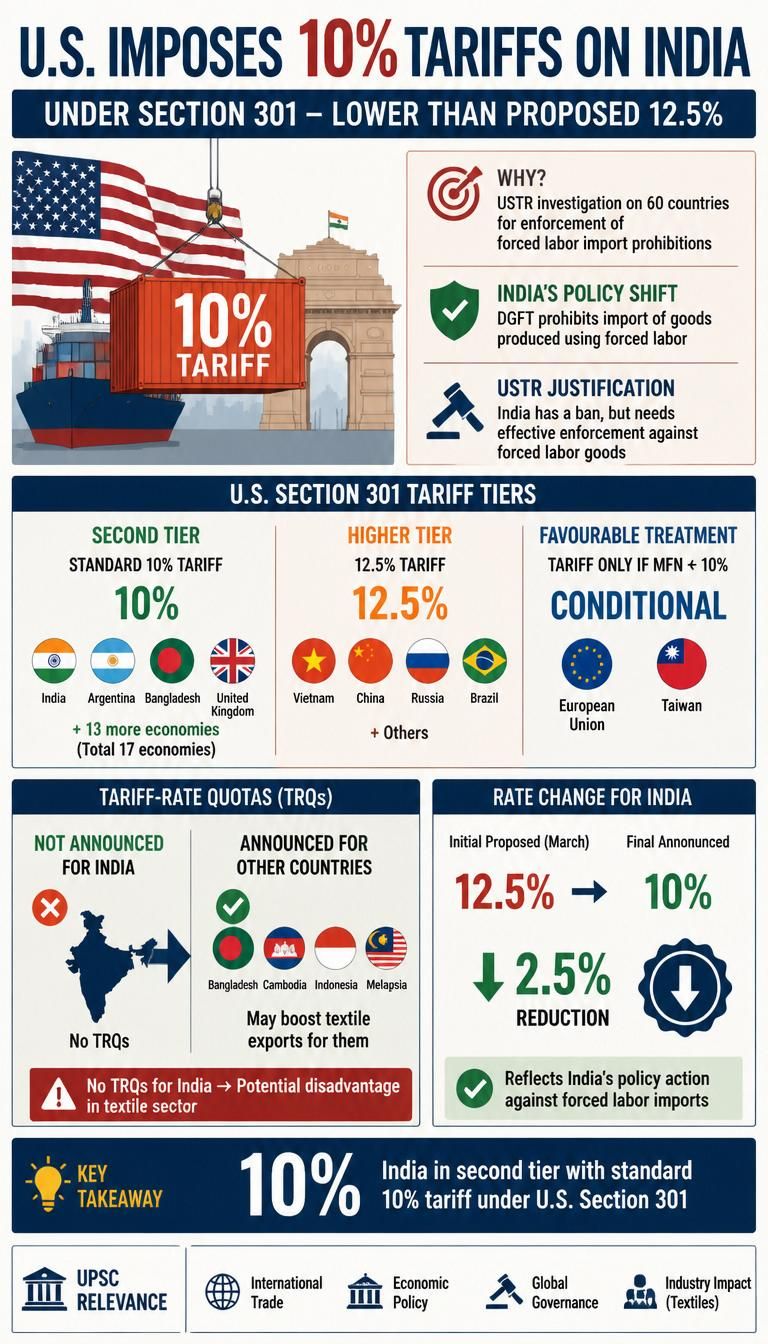
US Tariff.jpg
Detailed Insights:
- The temporary 10% tariffs, which expired on July 24, 2026, were imposed for 150 days under Section 122 of the Trade Act of 1974 following a Supreme Court decision that invalidated earlier "Liberation Day" tariffs.
- The U.S. administration, led by President Donald Trump, justifies the new tariffs by stating that affected countries have failed to impose and effectively enforce prohibitions on goods produced with forced labor.
- Countries that have made commitments to enforce forced labor import prohibitions, such as India, Canada, Mexico, and the European Union, face a 10% tariff.
- Other nations, including China, Japan, and Australia, which the U.S. claims lack or do not enforce such laws, face a higher 12.5% tariff.
- Exemptions from these new tariffs include certain products like oil and gas, fertilizer, and goods covered by the U.S.-Mexico-Canada Agreement (USMCA).
- Critics argue that the forced labor rationale is a pretext for broader protectionist trade policies aimed at reducing U.S. reliance on imports and could lead to increased prices for American consumers.
- The U.S. Customs and Border Protection (CBP) enforces Section 307 of the Tariff Act of 1930, which prohibits the importation of goods made wholly or in part with forced labor.
Key Concepts Involved:
- Tariffs: Taxes imposed by a government on imported goods and services.
- Forced Labor: All work or service exacted from any person under the menace of any penalty for its non-performance and for which the worker does not offer themselves voluntarily.
- Section 301 of the Trade Act of 1974: A U.S. trade law that allows the President to impose tariffs and other sanctions against countries engaging in unfair trade practices.
- Section 122 of the Trade Act of 1974: A U.S. trade law that permits the President to impose temporary tariffs to address balance of payments issues.

SuperKalam is your personal mentor for UPSC preparation, guiding you at every step of the exam journey.
Download the App


STUDY RESOURCES
CONTACT US
ⓒ Snapstack Technologies Private Limited