GS 3: Science & TechnologyGS 2: International RelationsGS 3: EconomyPrelimsGS 3: Infrastructure: Energy, Ports, Roads, Airports, Railways etc.
Trump's Saudi nuclear gambit marks a shift, Pg13
US-Saudi civil nuclear pact ignites Middle East geopolitical shift, raising proliferation fears and linking to Israel recognition for regional stability.
Practice MCQs
767 Students attempted
Key Highlights:
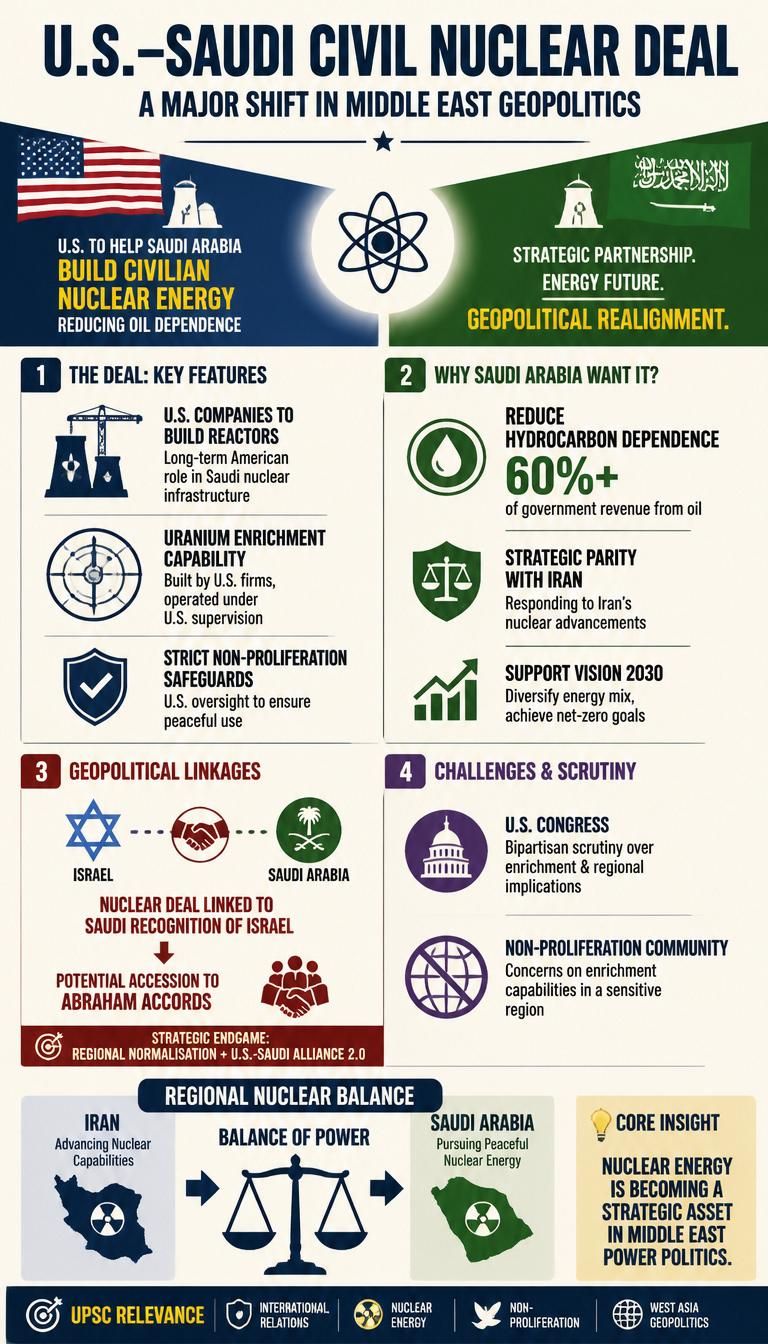
- The United States is pursuing a civil nuclear cooperation agreement with Saudi Arabia, marking a significant shift in Middle East geopolitics.
- The agreement aims to help Saudi Arabia develop a civilian nuclear energy program, reducing its dependence on hydrocarbons.
- The deal faces scrutiny from the U.S. Congress and opposition from the non-proliferation community.
- A central aspect of the agreement involves the potential for Saudi Arabia to develop uranium enrichment capabilities, to be built by American companies and operate under U.S. supervision.
- The U.S. is linking the nuclear deal to Saudi recognition of Israel and its potential accession to the Abraham Accords.
US-Saudi.jpg
Detailed Insights:
- This agreement highlights the increasing role of advanced technologies in the regional power balance, particularly in response to the growth of Iranian nuclear capabilities.
- Saudi Arabia's pursuit of nuclear energy is partly motivated by a desire for strategic parity with Tehran and to address regional nuclear balance concerns.
- The proposed arrangement for U.S. companies to build Saudi reactors aims to secure a long-term American position in the kingdom's nuclear infrastructure.
- The nuclear agreement could become part of a broader triangular negotiation involving Washington, Riyadh, and Tel Aviv, encompassing regional security, Palestinian statehood, and Arab-Israel relations.
- India is largely absent from the emerging nuclear industrial competition in the Middle East, with the article suggesting the implementation of the SHANTI Act to prepare Indian industry for nuclear technology export.
- Politically, India is encouraged to support the U.S.-Saudi agreement, provided it includes robust non-proliferation safeguards, and to offer assistance to Riyadh's civilian nuclear program.
Key Concepts Involved:
- Civil Nuclear Cooperation Agreement: A bilateral pact allowing the transfer of nuclear technology and materials for peaceful purposes, typically under international safeguards.
- Uranium Enrichment: A process that increases the concentration of uranium-235, making it suitable for use as nuclear fuel or in nuclear weapons.
- Non-proliferation: International efforts and treaties aimed at preventing the spread of nuclear weapons and related technologies.
- Abraham Accords: A series of normalization agreements signed in 2020 between Israel and several Arab nations, mediated by the United States.
- SHANTI Act: The Sustainable Harnessing and Advancement of Nuclear Energy for Transforming India Bill, a recent Indian legislation aimed at modernizing the country's nuclear legal framework, strengthening regulatory institutions, and enabling private participation.

SuperKalam is your personal mentor for UPSC preparation, guiding you at every step of the exam journey.
Download the App


STUDY RESOURCES
CONTACT US
ⓒ Snapstack Technologies Private Limited