GS 2: International RelationsPrelimsGS 2: Important International Institutions, Agencies and ForaGS 2: India and its Neighbourhood Relations
ICJ Holds Myanmar Responsible for Rohingya Genocide in Landmark Ruling
International Court of Justice finds Myanmar guilty of Rohingya genocide, ordering reparations and safe return for 1.2 million refugees.
Source: The Hindu (Pg. 8)
Practice MCQs
789 Students attempted
Key Highlights:
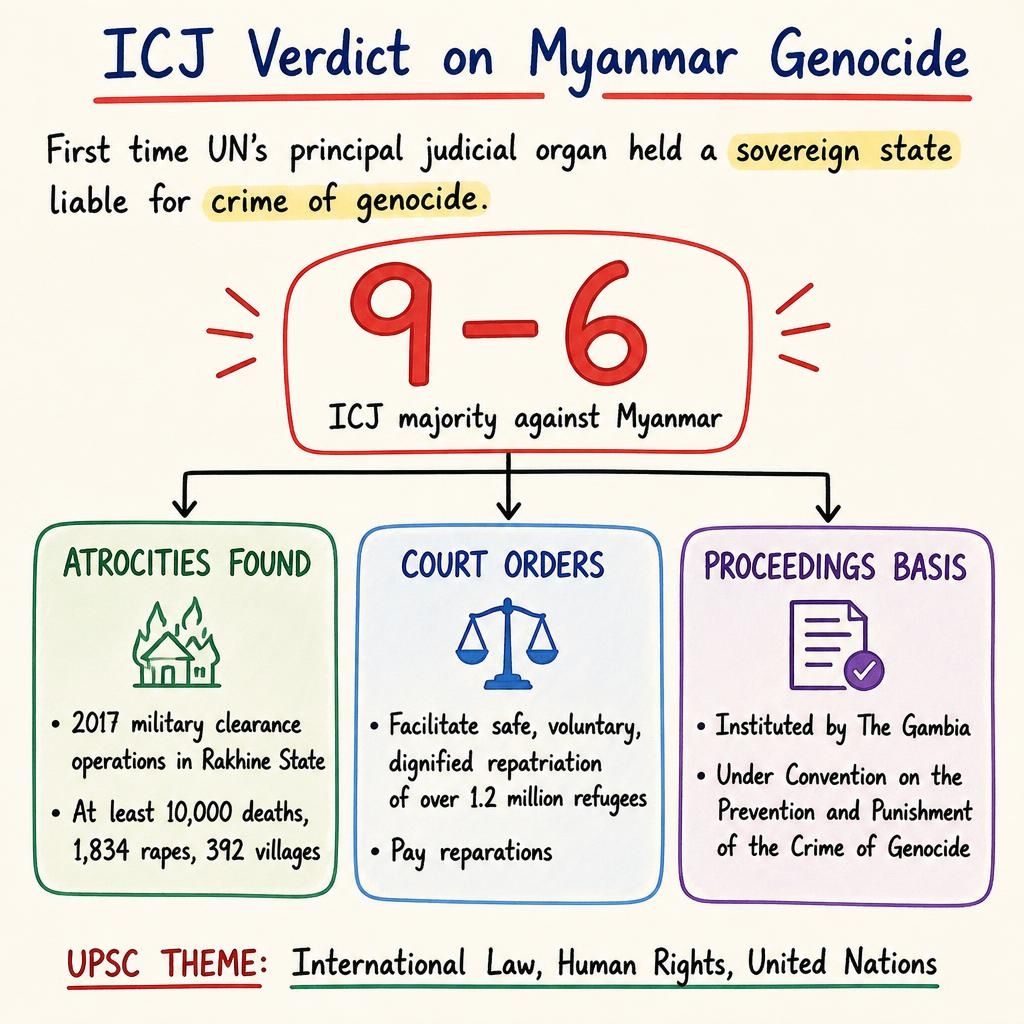
- The International Court of Justice ruled by a 9-6 majority that Myanmar committed genocide against the Rohingya minority in Rakhine State.
- This marks the first time the principal judicial organ of the United Nations has held a sovereign state liable for the crime of genocide.
- The verdict adjudicated the 2017 military clearance operations that resulted in at least 10,000 deaths, 1,834 documented rapes, and 392 razed villages.
- The court ordered Myanmar to facilitate the safe, voluntary, and dignified repatriation of over 1.2 million refugees currently sheltered in Bangladesh and pay reparations.
- The landmark proceedings were originally instituted by The Gambia under the Convention on the Prevention and Punishment of the Crime of Genocide.
ICJ Verdict on Myanmar.jpg
Detailed Insights:
- Proving state-level genocide required demonstrating dolus specialis (specific intent), which the court deduced as the sole reasonable inference from the scale of atrocities.
- Systematic exclusion stems from the Burma Citizenship Law of 1982, which stripped Rohingya of citizenship by omitting them from recognized national indigenous races.
- Execution of the judgment relies on Article 94 of the Charter of the United Nations, leaving binding enforcement vulnerable to a United Nations Security Council veto.
- Practical repatriation faces complex conflict dynamics within Myanmar, where the ethnic armed organisation Arakan Army has captured substantial territory in Rakhine State.
- Strategic and commercial imperatives lead regional powers to maintain diplomatic engagement with the ruling State Administration Council despite global judicial censure.
Key Concepts Involved:
- Genocide Convention of 1948: An international human rights treaty outlawing actions committed with specific intent to destroy a national, ethnic, racial, or religious group.
- Obligations Erga Omnes Partes: Legal duties owed by a state to all state parties of a multilateral treaty, granting non-injured states universal standing.
- Dolus Specialis: The heightened, specific mental intent necessary to distinguish the crime of genocide from other crimes against humanity.
- Principle of Non-Refoulement: A core rule of international law forbidding the expulsion of refugees to territories where they face life-threatening persecution.

SuperKalam is your personal mentor for UPSC preparation, guiding you at every step of the exam journey.
Download the App


STUDY RESOURCES
CONTACT US
ⓒ Snapstack Technologies Private Limited