GS 2: International RelationsPrelimsGS 2: Bilateral, Regional and Global Groupings and Agreements
Building a Global Nuclear Risk Reduction Framework as New START Expires
Major nuclear powers face dangerous escalation as New START expires, urging the US, Russia, and China to establish urgent risk-reduction mechanisms.
Source: The Hindu (Pg. 8)
Practice MCQs
789 Students attempted
Key Highlights:
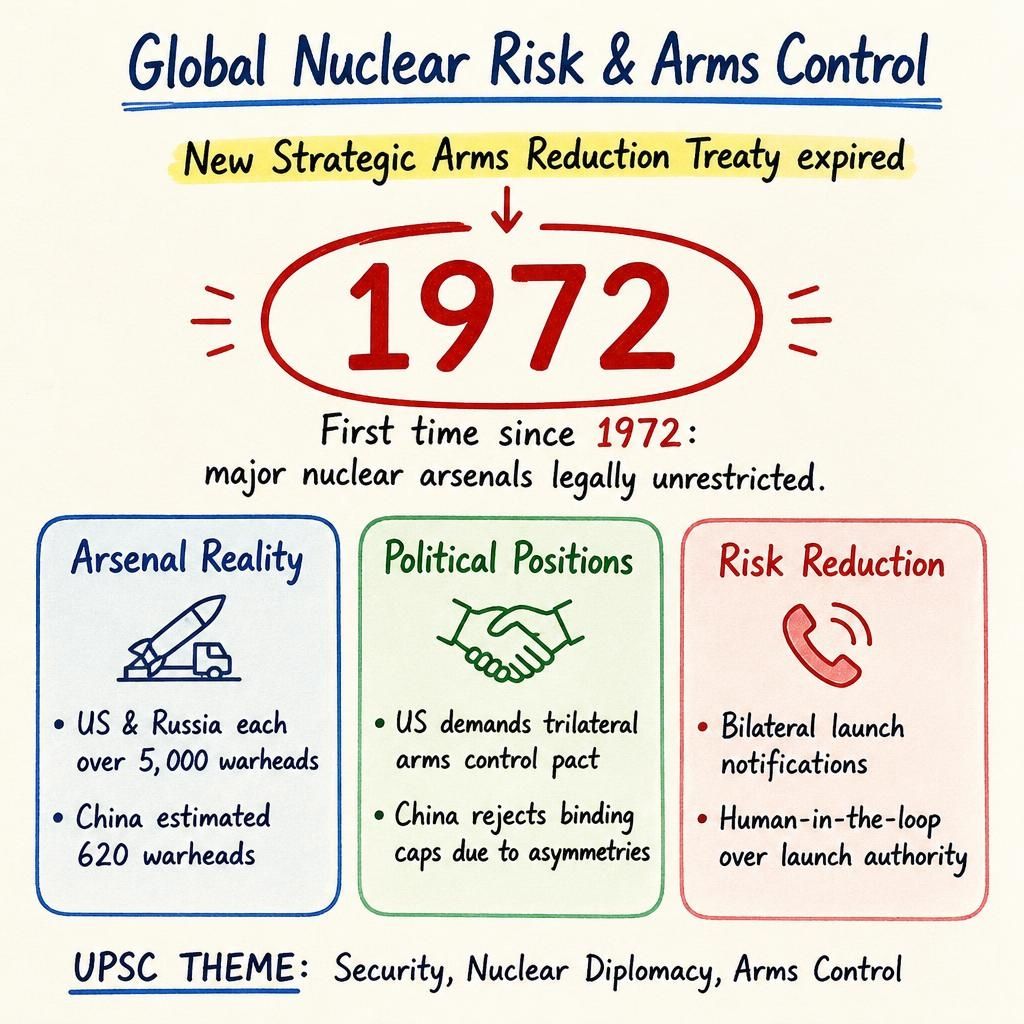
- The New Strategic Arms Reduction Treaty expired without an operational successor, leaving major nuclear arsenals legally unrestricted for the first time since 1972.
- Leaders of the United States, Russia, and China issued a joint declaration on nuclear risk reduction at the Asia-Pacific Economic Cooperation summit.
- The United States and Russia each possess over 5,000 nuclear warheads, compared to an estimated 620 warheads held by China.
- Russia previously suspended bilateral verification inspections and formally revoked its ratification of the Comprehensive Nuclear-Test-Ban Treaty.
- Washington demands a trilateral arms control pact, whereas Beijing rejects binding caps due to severe asymmetries in warhead stockpiles.
Global Nuclear Risk.jpg
Detailed Insights:
- The treaty lapse terminates the strategic arms limitation framework initiated during the 1972 Strategic Arms Limitation Talks.
- Russia demands that any multilateral disarmament regime must formally incorporate nuclear arsenals belonging to the North Atlantic Treaty Organization.
- China relies on strategic ambiguity and its No First Use doctrine to preserve credible second-strike deterrence against missile defense systems.
- Deploying artificial intelligence within nuclear command, control, and communications networks heightens risks of miscalculation and automated escalation.
- Proposed risk-reduction mechanisms prioritize bilateral launch notifications, crisis hotlines, and preserving human-in-the-loop control over launch authority.
Key Concepts Involved:
- New START: Bilateral pact capping deployed strategic warheads and intercontinental delivery systems between the United States and Russia.
- No First Use: Nuclear doctrine pledging to employ atomic weapons strictly in retaliation against an adversary's nuclear strike.
- Confidence-Building Measures: Diplomatic and military procedures designed to avert miscalculation, reduce friction, and establish strategic transparency.

SuperKalam is your personal mentor for UPSC preparation, guiding you at every step of the exam journey.
Download the App


STUDY RESOURCES
CONTACT US
ⓒ Snapstack Technologies Private Limited