GS 2: GovernanceGS 3: Science & TechnologyGS 3: Environment & EcologyGS 3: EconomyPrelims
On IT, India Had Early Advantage. It Hasn't Caught Up With AI Era, Pg12
India's IT advantage wanes as AI era demands frontier models, exposing low R&D and policy gaps, risking economic impact.
Practice MCQs
782 Students attempted
Key Highlights:
- India, despite its early advantage in IT services, has not adequately prepared for the Frontier AI era, unlike the US and China.
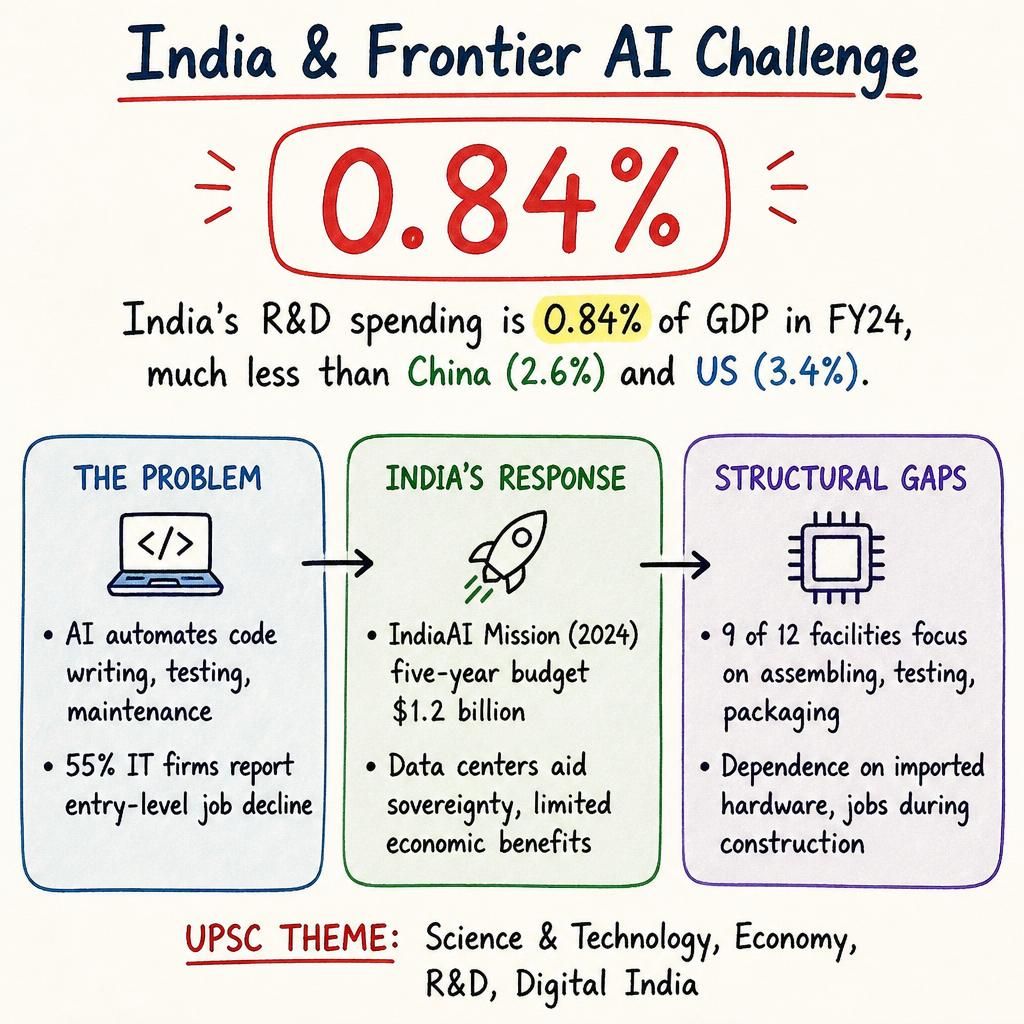
- India's R&D spending is low at around 0.84% of GDP in FY24, significantly less than China (2.6%) and the US (3.4%).
- The traditional IT services model, reliant on labor advantage, is becoming unsustainable as AI can automate code writing, testing, and maintenance.
- The IndiaAI Mission, launched in 2024 with a five-year budget of approximately $1.2 billion (₹10,372 crore), aims to develop the country's AI ecosystem. [7, 8, 9, 10]
- A survey by ICRIER (November 2025-January 2026) found 55% of IT firms reported a decline in entry-level employment due to AI, while senior-level jobs remained stable.
- India's focus on attracting data centers, while essential for data sovereignty, may offer minimal net economic benefits if foreign-owned models run on them.
- Of the 12 approved semiconductor facilities, nine focus on assembling, testing, and packaging pre-fabricated chips, not producing leading-edge AI chips.
Frontier AI Challenge.jpg
Detailed Insights:
- The episode involving Anthropic's models highlighted that control over Frontier AI access rests with countries developing these models.
- India's low R&D investment has hindered the development of indigenous Frontier AI capabilities.
- The shift in the IT sector is evident, with Global Capability Centers (GCCs) booming, yet job losses are concentrated in support and entry-level roles.
- The IndiaAI Mission's budget is considerably smaller than the projected annual training and inference costs of leading private AI firms like OpenAI and Anthropic.
- While data centers are crucial for domestic AI model training and data sovereignty, their economic benefits are limited if hardware is imported and jobs are primarily during construction.
- Meeting the round-the-clock electricity demand of data centers with intermittent renewables poses challenges, potentially increasing costs and reliance on coal.
- India's current semiconductor push primarily involves assembly and packaging, indicating a significant gap in advanced AI chip manufacturing.
- To maximize benefits from its "landlord role" in data centers, India needs to secure compute-access guarantees, sovereign cloud capacity, and local linkages in hardware and services.
Key Concepts Involved:
- Frontier AI: The most advanced and capable AI systems at any given time, pushing the boundaries of what AI can achieve across multiple domains. [12, 13, 14, 15, 16]
- R&D Spending: The investment made by a country in research and development activities, crucial for technological advancement and innovation.
- Global Capability Centers (GCCs): Wholly-owned offshore units established by multinational corporations in other countries to perform strategic business functions. [17, 18, 19, 20, 21]
- Data Sovereignty: The principle that data is subject to the laws and governance structures of the nation in which it is collected or stored. [1, 2, 3, 4, 5]

SuperKalam is your personal mentor for UPSC preparation, guiding you at every step of the exam journey.
Download the App


STUDY RESOURCES
CONTACT US
ⓒ Snapstack Technologies Private Limited