GS 2: GovernanceGS 2: Social JusticeGS 3: EconomyPrelimsGS 3: Buffer Stocks and Food Security
Study Flags 13.2 Percent Inclusion Error in PM Garib Kalyan Anna Yojana
Government study reveals 13.2 percent inclusion error under PM Garib Kalyan Anna Yojana, inflating India's 2.28 lakh crore rupee food subsidy bill.
Source: Indian Express (Pg. 5)
Practice MCQs
782 Students attempted
Key Highlights:
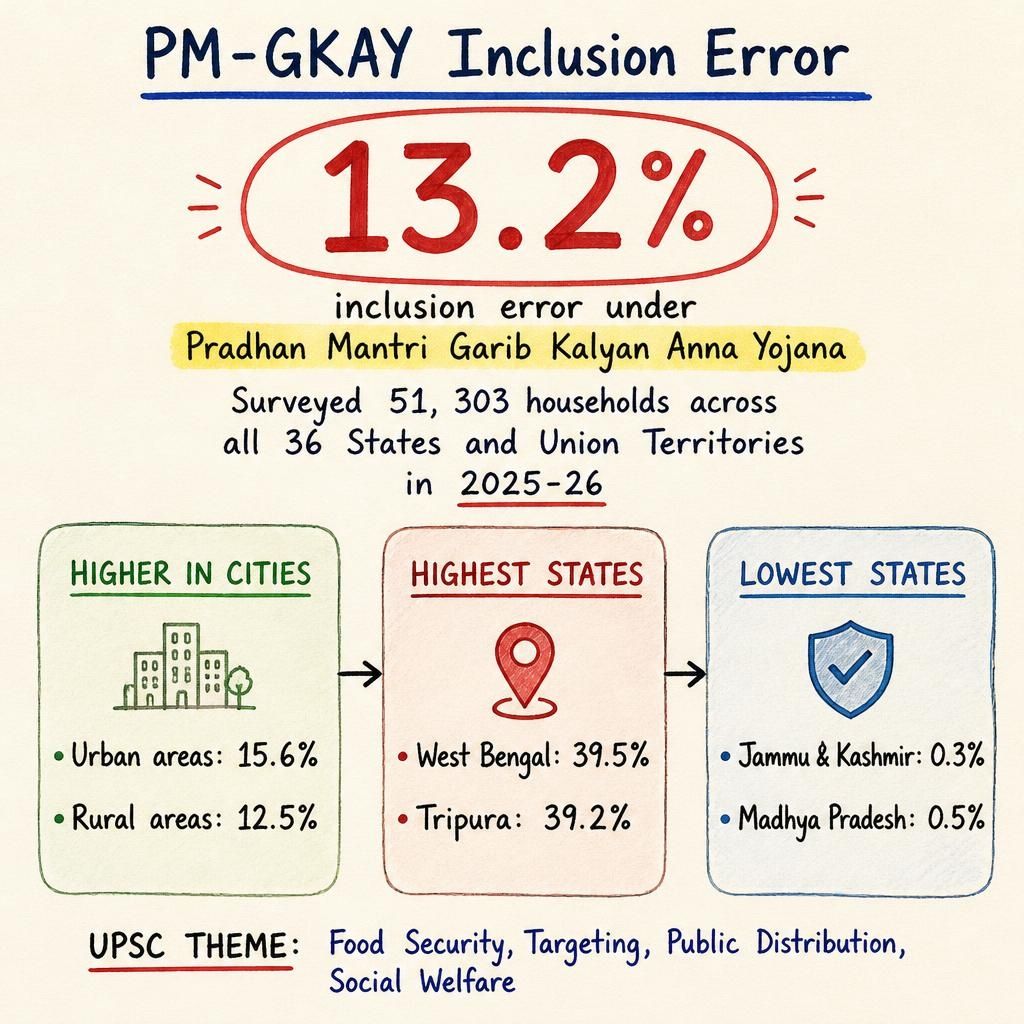
- An evaluation study by the Department of Food and Public Distribution revealed a 13.2% inclusion error under the Pradhan Mantri Garib Kalyan Anna Yojana.
- The study surveyed 51,303 beneficiary households across all 36 States and Union Territories during the financial year 2025-26.
- Inclusion error rates were found to be higher in urban areas at 15.6% compared to rural areas at 12.5%.
- West Bengal recorded the highest inclusion error at 39.5%, followed by Tripura at 39.2% and Tamil Nadu at 38.7%.
- Jammu & Kashmir recorded the lowest error rate at 0.3%, followed by Madhya Pradesh at 0.5% and Haryana at 1.0%.
- Ineligible beneficiaries were found possessing government jobs, four-wheelers, air conditioners, and pucca houses with three or more rooms.
- The national food subsidy bill stood at Rs 2.28 lakh crore, accounting for nearly half of the total central subsidy expenditure in 2025-26.
PM-GKAY Inclusion.jpg
Detailed Insights:
- Under Section 9 of the National Food Security Act, 2013, the Centre determines overall coverage, while Section 10 delegates identification to states.
- Varying state-level exclusion filters, outdated income thresholds, and infrequent database updates have led to substantial interstate targeting disparities.
- Eastern and northeastern states displayed elevated error rates, reflecting weaker administrative capacity and gaps in dynamic beneficiary verification.
- Northern and western states maintained negligible inclusion errors by leveraging digitised ration cards, automated exclusion filters, and comprehensive Aadhaar seeding.
- High inclusion errors divert subsidized resources from genuinely impoverished households and substantially inflate the Centre's annual food subsidy expenditure.
- The findings underscore the urgent need to integrate the Targeted Public Distribution System with real-time tax and asset databases.
Key Concepts Involved:
- Inclusion Error: Erroneous inclusion of ineligible persons or non-poor households into a targeted welfare scheme's beneficiary list.
- Priority Households: Category under the National Food Security Act, 2013 entitled to receive 5 kg of foodgrains per person monthly.
- Antyodaya Anna Yojana: Targeted welfare initiative identifying the poorest of the poor, entitled to 35 kg of foodgrains per household monthly.
- Targeted Public Distribution System: Subsidised foodgrain delivery network managed jointly by the Union and states to ensure household food security.

SuperKalam is your personal mentor for UPSC preparation, guiding you at every step of the exam journey.
Download the App


STUDY RESOURCES
CONTACT US
ⓒ Snapstack Technologies Private Limited