GS 2: International RelationsGS 3: Environment & EcologyPrelimsGS 3: Conservation, Pollution and DegradationGS 2: Bilateral, Regional and Global Groupings and Agreements
On climate, a long road back to Paris, Pg16
UNEP report warns 1.5°C Paris Pact goal unattainable near-term, demanding 18% global GHG emission cuts by 2030 to return by century-end.
Practice MCQs
775 Students attempted
Key Highlights:
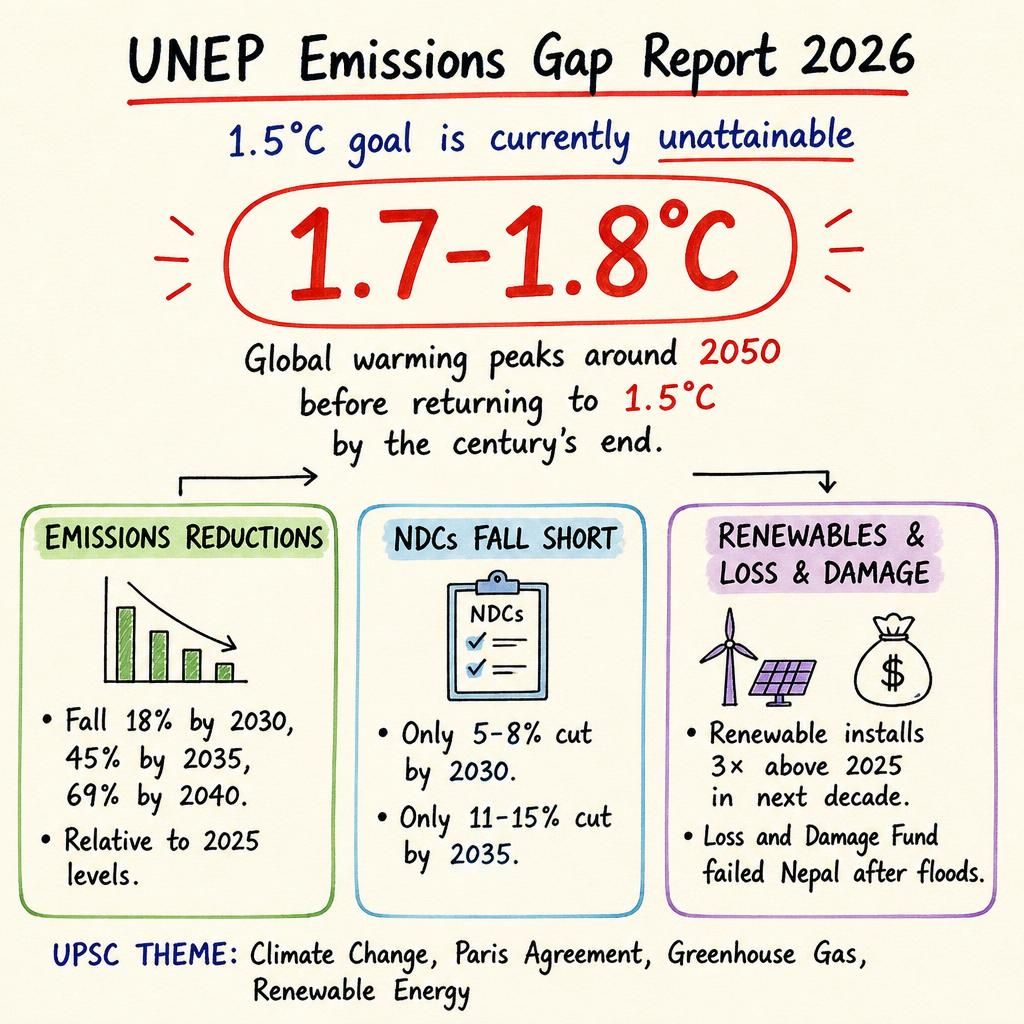
- The UNEP Emissions Gap Report 2026 indicates that the Paris Agreement's goal of limiting global temperature rise to 1.5°C above pre-industrial levels is currently unattainable in the near term.
- The report outlines a scenario where global warming peaks at 1.7-1.8°C around 2050 before returning to 1.5°C by the century's end.
- This pathway necessitates global greenhouse gas (GHG) emissions to fall by 18% by 2030, 45% by 2035, and 69% by 2040, relative to 2025 levels.
- Current Nationally Determined Contributions (NDCs) would only reduce global emissions by 5-8% by 2030 and 11-15% by 2035, significantly short of the required reductions.
- Renewable energy installations, particularly solar and wind, need to surge three times above 2025 levels in the next decade to meet climate targets.
- The Loss and Damage Fund, formalized three years ago, has shown shortcomings, exemplified by its failure to aid Nepal after recent floods.
UNEP Emission Gap Report.jpg
Detailed Insights:
- The Paris Agreement, adopted in 2015, aims to strengthen the global response to climate change by keeping a global temperature rise this century well below 2°C above pre-industrial levels and pursuing efforts to limit it to 1.5°C.
- The UNEP Emissions Gap Report annually assesses the gap between countries' pledges to reduce greenhouse gas emissions and the reductions required to meet the Paris Agreement goals.
- The insufficiency of current NDCs highlights a significant ambition gap, requiring countries to submit more robust climate action plans.
- While technological progress and falling costs support renewable energy expansion, challenges remain in ensuring clean energy storage and shielding the market from geopolitical influences.
- The Loss and Damage Fund, established at COP27 in 2022, is designed to provide financial assistance to vulnerable developing countries for irreversible climate impacts.
- The upcoming Conference of Parties (COP) meetings are crucial for delegates to demonstrate greater resolve and implement stronger measures to align global efforts with the Paris targets.
Key Concepts Involved:
- Paris Agreement: An international treaty adopted in 2015 aiming to limit global warming to well below 2°C, preferably to 1.5°C, compared to pre-industrial levels.
- UNEP Emissions Gap Report: An annual report by the United Nations Environment Programme assessing the difference between projected global greenhouse gas emissions and levels consistent with climate goals.
- Nationally Determined Contributions (NDCs): Climate action plans submitted by countries under the Paris Agreement outlining their efforts to reduce emissions and adapt to climate change.
- Loss and Damage Fund: A fund established at COP27 to provide financial assistance to developing countries most vulnerable to the adverse effects of climate change.

SuperKalam is your personal mentor for UPSC preparation, guiding you at every step of the exam journey.
Download the App


STUDY RESOURCES
CONTACT US
ⓒ Snapstack Technologies Private Limited