GS 2: International RelationsGS 3: Environment & EcologyGS 3: EconomyPrelimsGS 3: Major Crops, Cropping Patterns and Irrigation Systems
Fossil fuel in the farm, and food as fuel — a double bind, Pg16
Indian agriculture faces a 'double bind' from fossil fuel dependence and food-to-fuel diversion, exposing vulnerabilities to global conflicts and El Niño.
Practice MCQs
775 Students attempted
Key Highlights:
- Indian agriculture faces a "double bind" from "fossilisation" (reliance on fossil fuels) and "fuelisation" (diversion of food for biofuels), exacerbated by global conflicts and weather events.
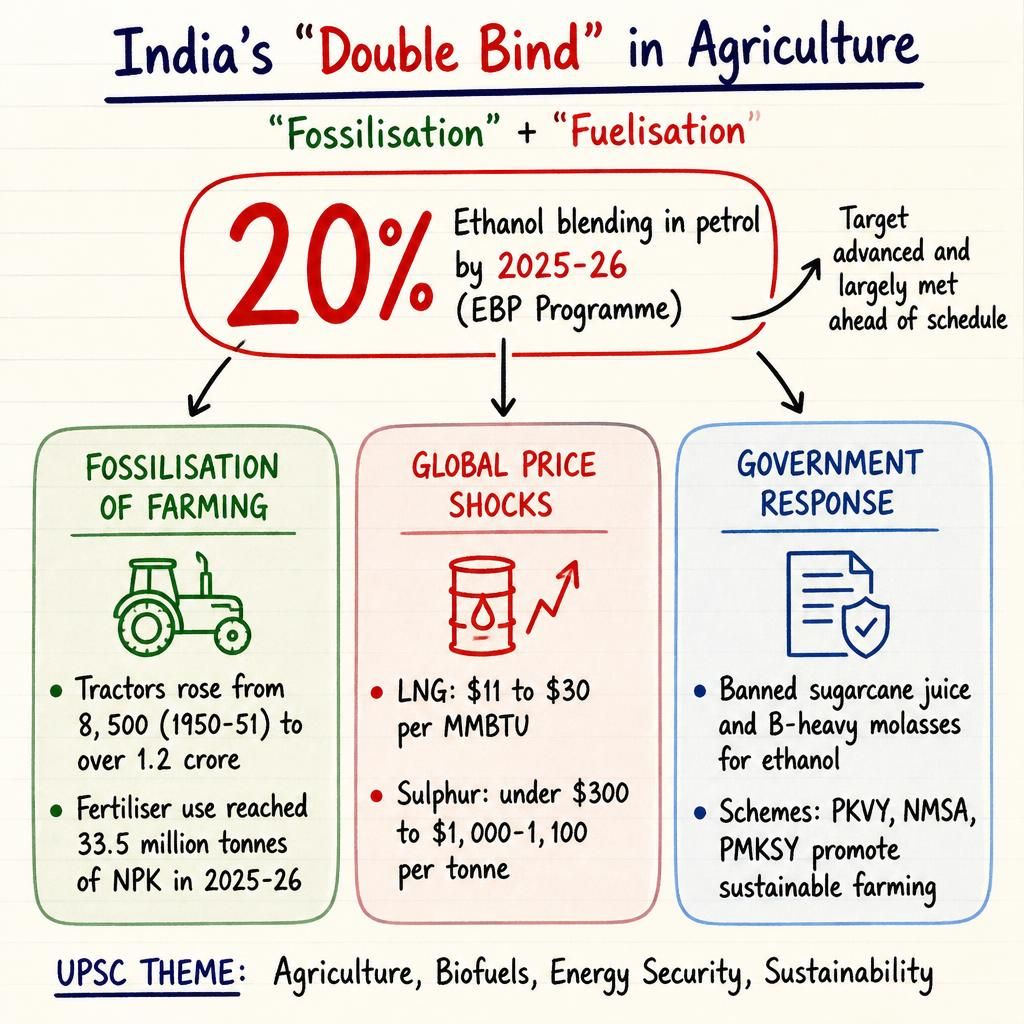
- Tractor usage has surged from 8,500 in 1950-51 to over 1.2 crore currently, with fertiliser consumption reaching 33.5 million tonnes of NPK in 2025-26.
- Global conflicts have driven up prices of liquefied natural gas (LNG) from $11 to $30 per MMBTU and naphtha from $515 to $915 per tonne.
- Sulphur prices, crucial for phosphate fertilisers, have soared from under $300 to $1,000-1,100 per tonne due to geopolitical tensions.
- India has advanced its Ethanol Blended Petrol (EBP) Programme target to achieve 20% ethanol blending in petrol by 2025-26, largely met ahead of schedule.
- The government has banned sugarcane juice and B-heavy molasses for ethanol production to mitigate food-versus-fuel concerns.
Agriculture.jpg
Detailed Insights:
- "Fossilisation" of farming refers to the increasing dependence on fossil fuel-derived inputs like tractors, chemical fertilisers (urea, DAP), and crop protection chemicals.
- In 1950-51, farming relied on bullocks and farmyard manure, contrasting sharply with today's mechanised and chemical-intensive practices.
- The primary feedstocks for urea and other nitrogen fertilisers are fossil fuels, making agriculture vulnerable to global energy price fluctuations.
- Sulphur, a byproduct of oil refining, is indispensable for producing phosphate fertilisers like DAP and SSP.
- "Fuelisation" of food involves diverting food crops such as sugarcane, rice, and maize for biofuel production, driven by high crude oil prices.
- India's National Policy on Biofuels 2018, amended in 2022, expanded eligible feedstocks for ethanol and advanced the blending target.
- The National Policy on Biofuels 2018 also aims for 5% biodiesel blending in diesel by 2030.
- Low Nutrient Use Efficiency (NUE) for nitrogen (30-45%) and phosphorus (15-25%) in India leads to significant wastage and environmental concerns.
- Solutions include shifting to balanced complex fertilisers, using biostimulants, and adopting solar-powered drip irrigation systems.
- Government schemes like Paramparagat Krishi Vikas Yojana (PKVY) and National Mission on Sustainable Agriculture (NMSA) promote sustainable farming practices.
- The Pradhan Mantri Krishi Sinchayee Yojana (PMKSY) supports micro-irrigation to enhance water use efficiency in agriculture.
- While El Niño poses risks, India's diversified agriculture and increased irrigation (56% of gross cropped area) offer resilience compared to past shocks.
Key Concepts Involved:
- Fossilisation of Farming: Agriculture's growing reliance on fossil fuel-derived inputs like machinery, fertilisers, and pesticides.
- Fuelisation of Food: The diversion of food crops for the production of biofuels, creating a potential conflict between food security and energy needs.
- Nutrient Use Efficiency (NUE): The proportion of applied fertiliser nutrients that crops effectively absorb and utilise for growth and yield.
- Ethanol Blending: The practice of mixing ethanol, typically derived from agricultural products, with petrol to reduce fossil fuel consumption and emissions.

SuperKalam is your personal mentor for UPSC preparation, guiding you at every step of the exam journey.
Download the App


STUDY RESOURCES
CONTACT US
ⓒ Snapstack Technologies Private Limited