GS 2: GovernanceGS 3: EconomyPrelimsGS 3: Indian Economy, Planning, Mobilization of Resources, Growth, Development and EmploymentGS 3: Infrastructure: Energy, Ports, Roads, Airports, Railways etc.
Canary in coal mine, Pg8
India's industrial uptick, driven by coal and electricity, masks deeper fiscal challenges from expensive oil imports and shrinking government spending capacity.
Practice MCQs
775 Students attempted
Key Highlights:
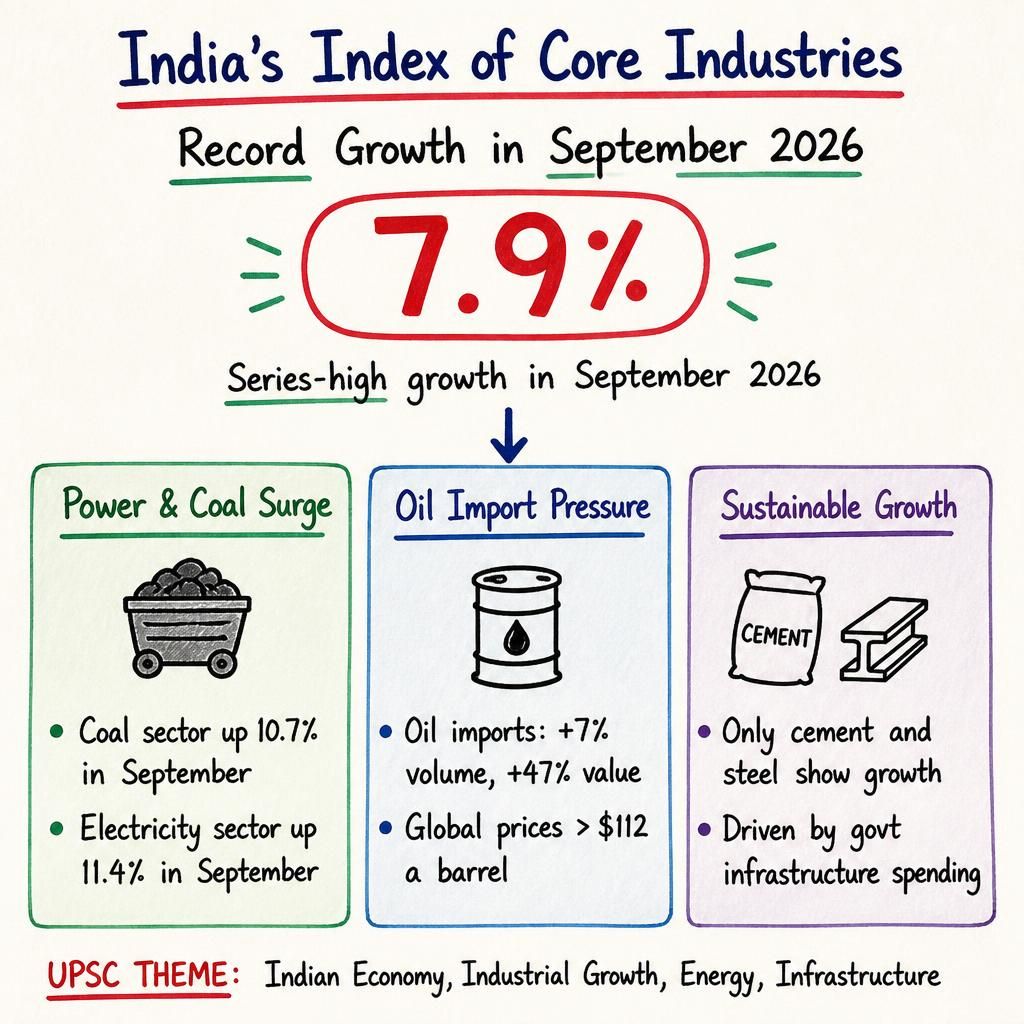
- India's Index of Core Industries recorded a series-high growth of 7.9% in September 2026, marking the second consecutive month of accelerated performance.
- The coal sector saw a sudden surge of 10.7% in September, attributed to a statistical low base and high demand from power plants during a heatwave.
- The electricity sector demonstrated robust growth of 11.4% in September, contributing to double-digit growth over the preceding half-year.
- Crude oil and natural gas sectors have continuously contracted since 2024, while refinery output rose to 10.3% in September, indicating increased processing of expensive imported oil.
- India's oil imports in September increased by 7% in volume but jumped 47% in value due to high global oil prices, which exceeded $112 a barrel following attacks on Saudi Arabia's energy infrastructure.
- The country's Foreign Exchange Reserves are being utilized to defend the rupee amidst rising import costs and shrinking fiscal space.
- Only the cement and steel sectors show sustainable growth, primarily driven by government infrastructure spending.
Index of Core Industries.jpg
Detailed Insights:
- The unexpected growth in the coal sector in September is likely a temporary phenomenon, as the sector had contracted by 1.1% over April-September 2026.
- The surge in electricity demand for coal is expected to moderate due to the El Niño factor, which is projected to result in a milder winter.
- While the steel sector accelerated in September, its growth was insufficient to sustain the coal sector's output levels.
- The uptick in steel production positively impacted the iron ore sector, leading to a return to double-digit growth, which is favorable for the mining component of the Index of Industrial Production.
- The continuous contraction in crude oil and natural gas production highlights India's increasing reliance on imported oil for its refineries.
- High global oil prices, exacerbated by geopolitical events like attacks on Saudi Arabia's energy infrastructure, are significantly impacting India's import bill.
- Despite a reprieve from potential U.S. tariffs on Russian oil, India is now facing premium pricing for crude, further straining its Foreign Exchange Reserves.
- The government's fiscal capacity is diminishing as industrial output is temporarily bolstered, and sustainable growth is limited to sectors reliant on public spending.
Key Concepts Involved:
- Index of Core Industries (ICI): A monthly production volume index measuring the performance of eight core infrastructure industries (Coal, Crude Oil, Natural Gas, Petroleum Refinery Products, Fertilizers, Steel, Cement, and Electricity) in India.
- El Niño: A climate pattern characterized by unusually warm sea-surface temperatures in the central and eastern equatorial Pacific Ocean, often leading to warmer winters and altered rainfall patterns in India.
- Foreign Exchange Reserves: External assets held by a country's central bank in foreign currencies and other internationally accepted reserve assets, used to manage external stability, balance of payments, and rupee volatility.
- Index of Industrial Production (IIP): A composite indicator that measures the short-term changes in the volume of production of a basket of industrial products, with the core industries having a significant weight in its calculation.

SuperKalam is your personal mentor for UPSC preparation, guiding you at every step of the exam journey.
Download the App


STUDY RESOURCES
CONTACT US
ⓒ Snapstack Technologies Private Limited