GS 2: International RelationsGS 3: EconomyPrelimsGS 3: Changes in Industrial Policy and Effects on Industrial GrowthGS 3: Indian Economy, Planning, Mobilization of Resources, Growth, Development and Employment
What are the U.S.’s latest allegations against India?, Pg12
U.S. accuses India of enabling China's tariff evasion, citing $28 billion lost revenue, threatening India's manufacturing growth story.
Practice MCQs
760 Students attempted
Key Highlights:
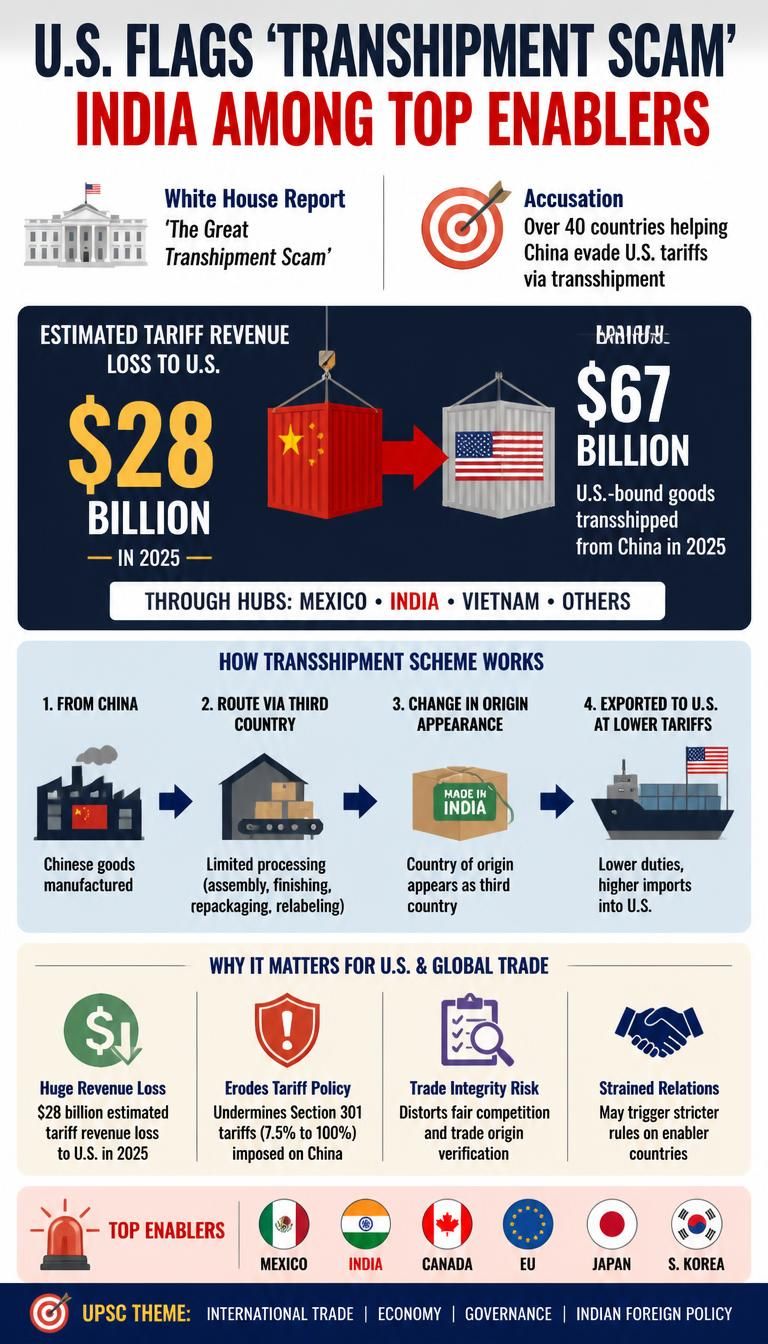
- The U.S. White House recently published a report titled ‘The Great Transhipment Scam’, accusing over 40 countries, including India, of helping China evade U.S. tariffs.
- The report alleges that Chinese goods are routed through third countries, marginally modified, and then exported to the U.S. at lower tariffs, leading to significant revenue loss for the U.S. government.
- The Office of Trade and Economic Analysis estimates approximately $67 billion in U.S.-bound goods were transshipped from China through hubs like Mexico, India, and Vietnam in 2025, resulting in an estimated $28 billion in lost tariff revenue.
- India is identified as one of the top "enablers" of this tariff evasion, alongside Mexico, Canada, the European Union, Japan, and South Korea.
USA-India.jpg
Detailed Insights:
- The U.S. initiated tariffs on Chinese goods in 2018 under Section 301 of the Trade Act of 1974 due to concerns over unfair trade and tech practices.
- These tariffs, ranging from 7.5% to 100% on various goods, aimed to reduce the U.S. trade deficit with China.
- The transshipment scheme involves limited assembly, finishing, repackaging, or relabeling in third countries to alter the apparent national origin of Chinese products.
- The U.S. policy has shifted import sources from China to other countries rather than significantly increasing domestic production.
- This allegation is part of a series of trade disputes between the U.S. and India, which have included issues like tariffs on luxury motorcycles, India's import of Russian oil, and concerns over forced labor.
- The U.S. had previously imposed a 10% tariff on Indian imports for not curbing goods made using forced labor and is considering further tariffs related to Russian oil imports.
- For India, potential penal actions could impact its Make in India initiative, as its manufacturing sector heavily relies on intermediate goods and raw materials imported from China.
- Increased manufacturing costs due to import restrictions could reduce the global competitiveness of Indian products.
Key Concepts Involved:
- Transshipment: The routing of goods through an intermediary country to conceal their true country of origin and obtain more favorable tariff treatment.
- Tariffs: Taxes imposed by a government on imported or exported goods, typically to protect domestic industries or generate revenue.
- Trade Deficit: An economic measure where a country's imports exceed its exports, indicating a negative balance of trade.
- Section 301 of the Trade Act of 1974: A U.S. trade law authorizing the United States Trade Representative (USTR) to investigate and respond to unfair foreign trade practices that harm American commerce.

SuperKalam is your personal mentor for UPSC preparation, guiding you at every step of the exam journey.
Download the App


STUDY RESOURCES
CONTACT US
ⓒ Snapstack Technologies Private Limited