GS 1: Physical GeographyGS 3: Science & TechnologyPrelimsGS 1: Salient Features of World's Physical GeographyGS 3: Achievements of Indians in Science and Technology
‘Indian rock yields oldest directly dated traces of microbial life’, Pg11
Indian rock in Singhbhum Craton yields oldest directly dated 3.5-billion-year-old microbial life traces, offering new insights into Earth's early evolution.
Practice MCQs
760 Students attempted
Key Highlights:
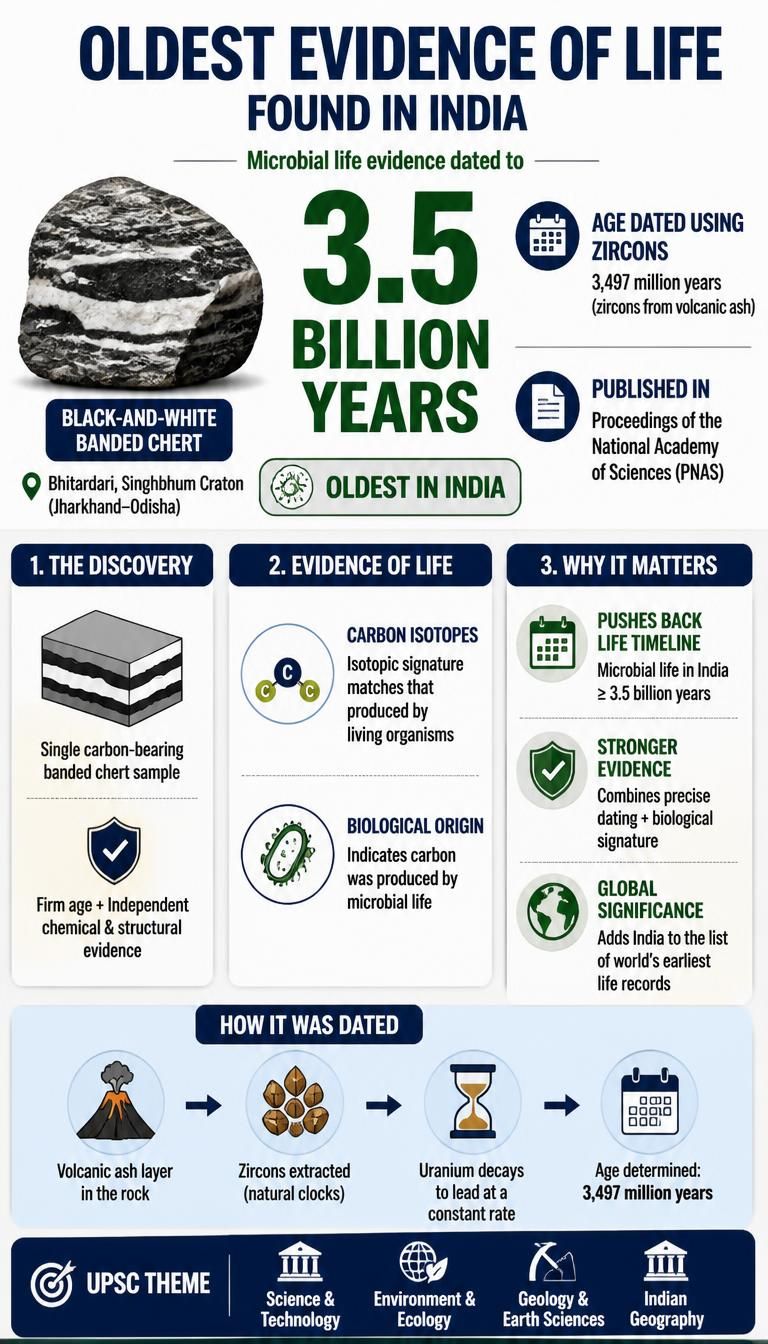
- Researchers have found compelling evidence of microbial life in eastern India dating back at least 3.5 billion years.
- The discovery was made in a single carbon-bearing rock from the Singhbhum Craton, an ancient continental crust block in parts of Jharkhand and Odisha.
- The age of the rock, 3,497 million years, was firmly established using zircons extracted from volcanic ash within the rock.
- Chemical and structural signs, including the balance of carbon isotopes, indicate the carbon was produced by living organisms.
- The findings were published in the peer-reviewed Proceedings of the National Academy of Sciences.
Life Evidence.jpg
Detailed Insights:
- The rock, a "black-and-white" banded chert from Bhitardari, provides a firm age paired with independent chemical and structural evidence of biological origin.
- Chert is a silica-rich rock known for its ability to preserve organic matter over billions of years, though it cannot be directly dated.
- The dating process involved analyzing zircons, which are robust crystals that function as natural clocks by trapping uranium that decays into lead at a consistent rate.
- The specific balance of carbon isotopes found in the material matches that typically captured by living cells, distinguishing it from inorganic contamination.
- This discovery is significant as it places the existence of life approximately one billion years after Earth's formation, suggesting life may emerge readily on habitable worlds.
- While older claims of life traces exist, such as graphite in 3.7-to-3.8-billion-year-old Greenland rocks, many have faced disputes regarding their biological origin.
- The Singhbhum Craton is a crucial geological region in the Indian Shield, known for containing some of India's oldest rocks, recording crust formation over 4 billion years ago.
Scientific/Technical Concepts Involved:
- Singhbhum Craton: An ancient, stable block of continental crust in eastern India, containing some of the oldest rocks in the Indian Shield.
- Zircons: Extremely durable silicate minerals used for radiometric dating due to their ability to incorporate and retain radioactive elements like uranium.
- Chert: A hard, fine-grained sedimentary rock composed primarily of silica, known for its excellent preservation potential of microfossils and organic matter.
- Carbon Isotopes: Different forms of carbon atoms (e.g., Carbon-12 and Carbon-13) whose ratios can indicate biological processes, as living organisms preferentially utilize lighter isotopes.
- Biosignature: Any substance, object, or pattern whose origin specifically requires a biological agent, providing evidence of past or present life.

SuperKalam is your personal mentor for UPSC preparation, guiding you at every step of the exam journey.
Download the App


STUDY RESOURCES
CONTACT US
ⓒ Snapstack Technologies Private Limited