GS 2: GovernanceGS 2: Social JusticeGS 3: EconomyPrelimsGS 3: Indian Economy, Planning, Mobilization of Resources, Growth, Development and Employment
Unemployment Is Not About Just Education, Pg14
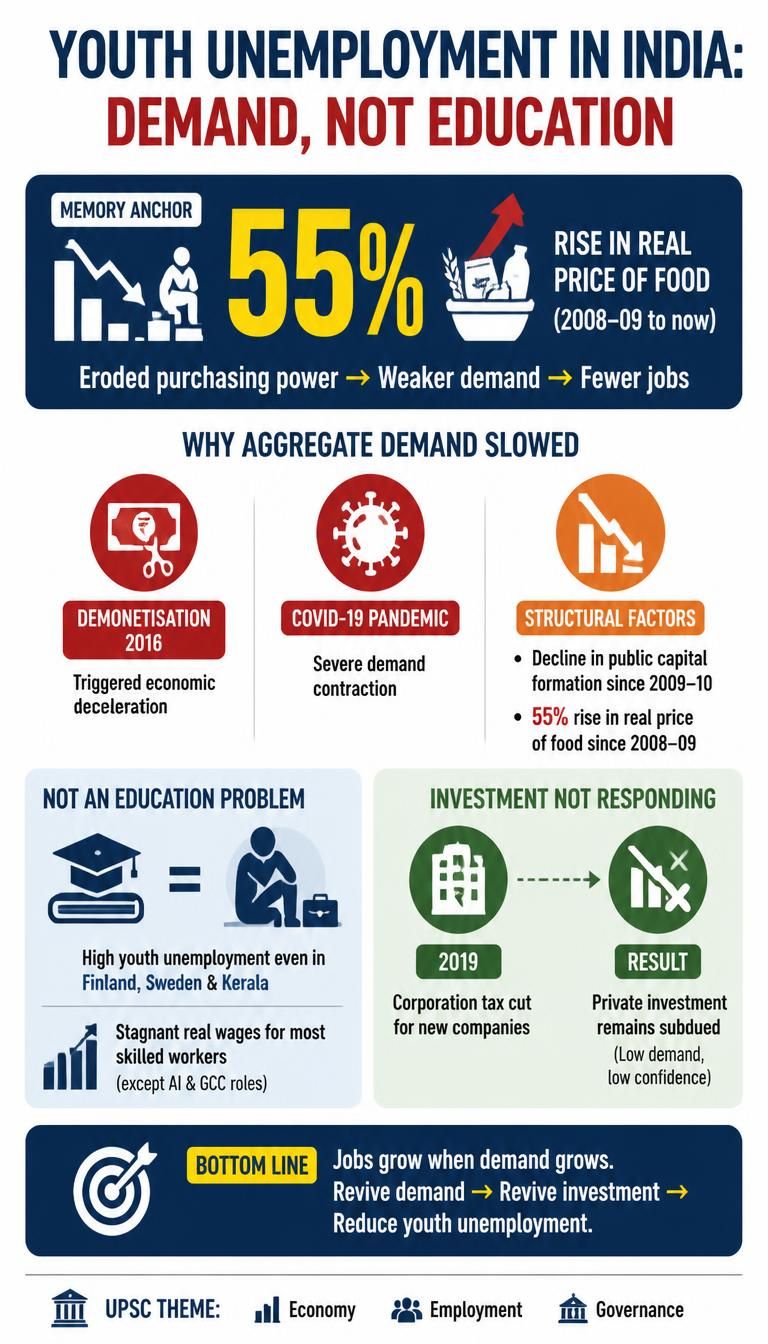
Expert analysis attributes India's unemployment crisis to a decade-long aggregate demand slowdown, triggered by demonetisation and rising food prices, rather than solely education.
Practice MCQs
760 Students attempted
Key Highlights:
- Youth unemployment in India is primarily attributed to a slowdown in aggregate demand rather than solely poor education.
- Countries with superior education systems, such as Finland and Sweden, and Indian states like Kerala, also experience high youth unemployment rates.
- The economic slowdown was triggered by the 2016 Demonetisation, followed by the impact of the COVID-19 pandemic.
- Long-term factors contributing to the slowdown include a decline in public capital formation since 2009-10 and a significant 55% rise in the real price of food since 2008-09.
- Despite the 2019 cut in the corporation tax rate for new companies, private investment has not accelerated.
Youth Unemployment.jpg
Detailed Insights:
- The article challenges the direct correlation between educational quality and unemployment, citing examples where better education does not guarantee lower unemployment.
- Stagnant real wages for most skilled workers, except those in AI-related competencies or Global Capability Centres, suggest that skill scarcity is not the primary issue.
- A comprehensive slowdown in aggregate demand growth across most economic sectors over the last decade has directly reduced the demand for labor.
- The 2016 Demonetisation is identified as a critical short-term factor that initiated a period of economic deceleration.
- The consistent pace of private investment, despite government incentives, indicates a lack of confidence among firms due to subdued market demand.
- The substantial increase in the real price of food has eroded household purchasing power, leading to reduced consumption of other goods and services.
- Stagnant real wages for rural workers and declining real earnings for regular and self-employed individuals have further suppressed overall consumption expenditure.
- Public policy should prioritize boosting aggregate demand and strategically investing in production-allied infrastructure like roads, electricity, and transportation to generate more employment.
Key Concepts Involved:
- Aggregate Demand: The total demand for all goods and services produced in an economy at a given overall price level.
- Capital Formation: The net addition of capital stock to an economy, including investment in physical assets and infrastructure.
- Real Wage: The purchasing power of wages, adjusted for inflation, reflecting the actual goods and services that can be bought.
- Demonetisation: The act of stripping a currency unit of its status as legal tender, as implemented in India in 2016.

SuperKalam is your personal mentor for UPSC preparation, guiding you at every step of the exam journey.
Download the App


STUDY RESOURCES
CONTACT US
ⓒ Snapstack Technologies Private Limited