GS 2: GovernanceGS 3: Environment & EcologyGS 3: EconomyPrelimsGS 3: Infrastructure: Energy, Ports, Roads, Airports, Railways etc.
About E20: Why choice, pricing matter, Pg14
Public discontent over E20 fuel's mileage prompts calls for government to offer consumer choice and differential pricing for successful adoption.
Practice MCQs
760 Students attempted
Key Highlights:
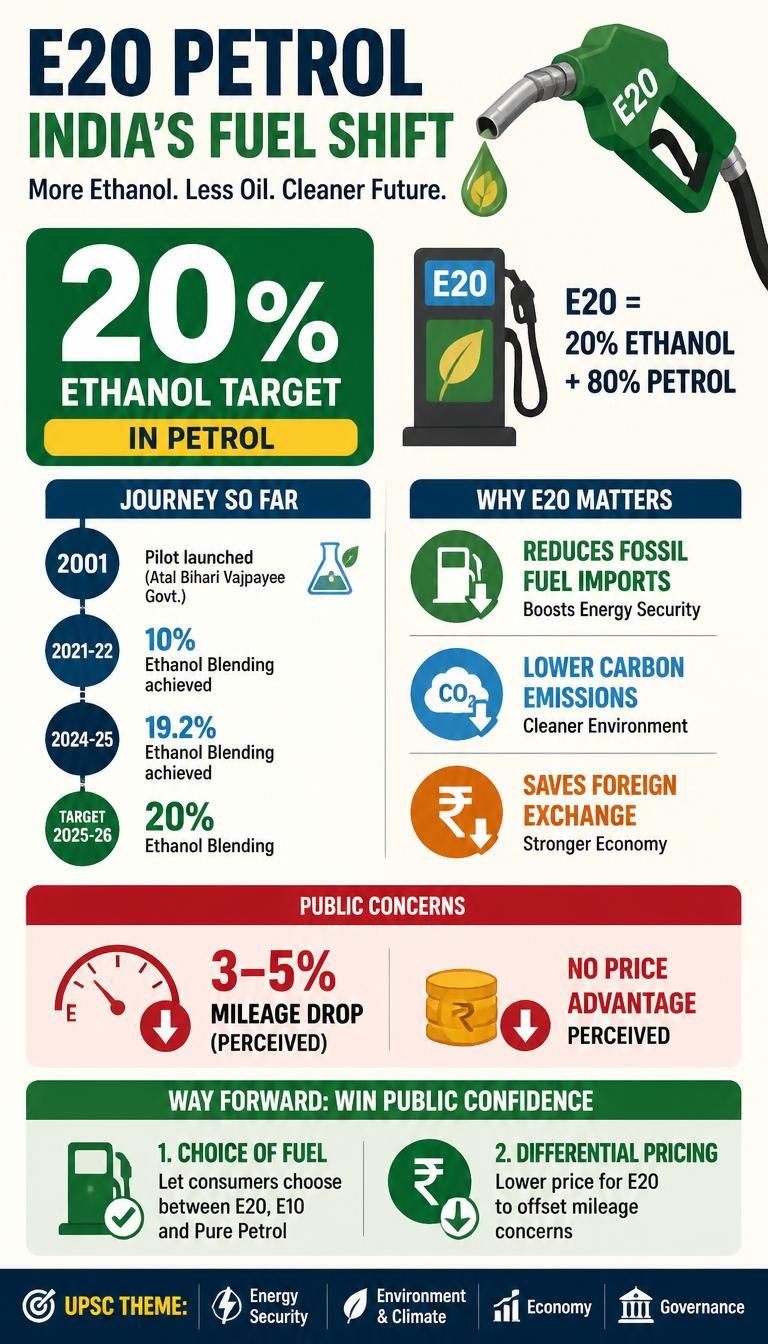
- E20 (petrol blended with 20% ethanol) is facing public discontent in India due to concerns over mileage and lack of price benefits.
- The Ethanol Blending Programme (EBP) was initiated with a pilot in 2001 under the Atal Bihari Vajpayee government.
- The program gained significant momentum after 2014, reaching 10% blending in 2021-22 and 19.2% in 2024-25, targeting 20%.
- The government advocates E20 for reducing fossil fuel use, lowering carbon emissions, and saving foreign exchange.
- Proposed solutions to address public concerns include offering consumers a choice of fuel and implementing differential pricing for E20.
E20.jpg
Detailed Insights:
- The Ethanol Blending Programme (EBP) aims to reduce India's reliance on crude oil imports and enhance energy security.
- The EBP also contributes to environmental benefits by producing lower carbon emissions compared to pure petrol.
- Consumer resistance to E20 is primarily due to a perceived 3-5% reduction in vehicle mileage without a corresponding price advantage.
- The article suggests that offering a choice between different ethanol blends and pure petrol, along with lower pricing for E20, could incentivize adoption.
- This approach is compared to the income tax regime, where taxpayers have the option to choose between old and new tax structures.
- E20 helps the government keep petrol prices stable, especially when global crude oil prices are high, such as above $100 a barrel.
- Producing ethanol can be costlier than pure petrol when global crude oil prices are low, for instance, at $70 a barrel or less.
Key Concepts Involved:
- Ethanol Blending Programme (EBP): A government initiative to mix ethanol with petrol to reduce crude oil imports and carbon emissions.
- E20 Fuel: A motor fuel composed of 20% ethanol and 80% petrol.
- Differential Pricing: Charging different prices for the same product based on factors like consumer choice or product variant.
Previous8/8

SuperKalam is your personal mentor for UPSC preparation, guiding you at every step of the exam journey.
Download the App


STUDY RESOURCES
CONTACT US
ⓒ Snapstack Technologies Private Limited