GS 3: Science & TechnologyGS 2: International RelationsGS 3: EconomyPrelimsGS 2: Bilateral, Regional and Global Groupings and Agreements
China, Indonesia agree to boost defence ties; work closer on minerals and energy, Pg2
China and Indonesia strengthen defence, mineral, and energy cooperation amidst South China Sea tensions, with Jakarta balancing ties between Beijing and Washington.
Practice MCQs
760 Students attempted
Key Highlights:
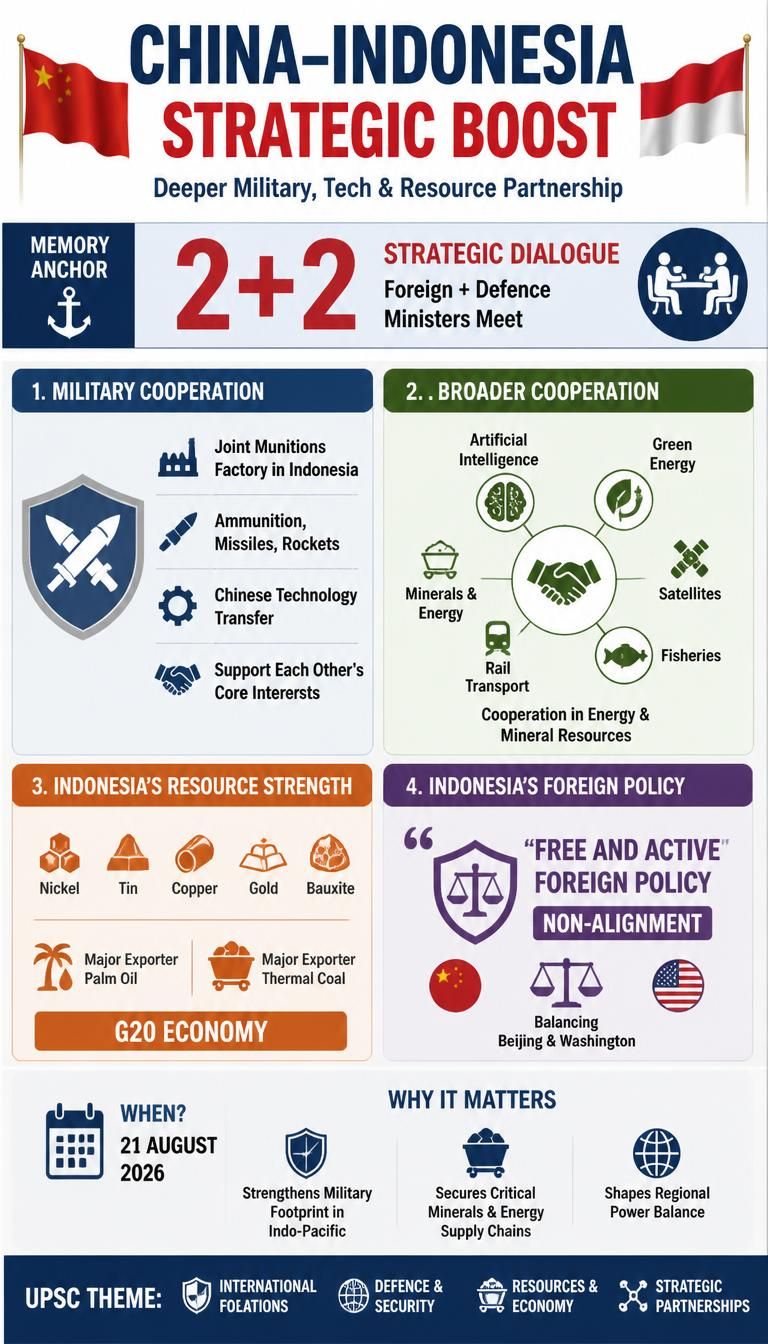
- China and Indonesia agreed to boost military ties and cooperate closely on minerals, energy, and technology.
- The agreement was reached during a visit by Chinese Foreign Minister Wang Yi and Defence Minister Dong Jun to Jakarta on August 21, 2026.
- Indonesia aims to balance its relationships with both Beijing and Washington amidst economic and geopolitical tensions.
- Indonesian President Prabowo Subianto emphasized the country's "free and active" foreign policy of non-alignment.
China-Indonesia.jpg
Detailed Insights:
- The cooperation areas include artificial intelligence, defense, rail transport, green energy, satellites, and fisheries.
- Both nations pledged to support each other's core interests and enhance collaboration in energy and mineral resources.
- Indonesia, a G20 economy, is rich in nickel, tin, copper, gold, bauxite, and is a major exporter of palm oil and thermal coal.
- Discussions included a joint munitions factory in Indonesia for ammunition, missiles, and rockets, with potential Chinese technology transfers.
- The meetings involved a Comprehensive Strategic Dialogue and a "2+2" meeting between the foreign and defense ministers of both countries.
- Chinese Foreign Minister Wang Yi highlighted the complex international situation, criticizing "unilateralism" and "hegemonism."
Key Concepts Involved:
- Free and active foreign policy: Indonesia's principle of non-alignment, seeking to maintain relations with all countries without taking sides in major power rivalries.
- Non-alignment: A foreign policy approach where a state is not formally allied with or against any major power bloc.
- Unilateralism: A doctrine or agenda that supports one-sided action, often disregarding other parties.
- Hegemonism: The dominance of one group or state over others.

SuperKalam is your personal mentor for UPSC preparation, guiding you at every step of the exam journey.
Download the App


STUDY RESOURCES
CONTACT US
ⓒ Snapstack Technologies Private Limited