GS 2: GovernanceGS 2: PolityGS 2: Social JusticePrelimsGS 2: Development Processes and Role of NGOs, SHGs and Other Stakeholders
Why Did the SC Reject Methanol Rules?, Pg8
Supreme Court strikes down Maharashtra's methanol rules, citing disproportionality and lack of nexus with preventing hooch tragedies, impacting industrial users.
Practice MCQs
760 Students attempted
Key Highlights:
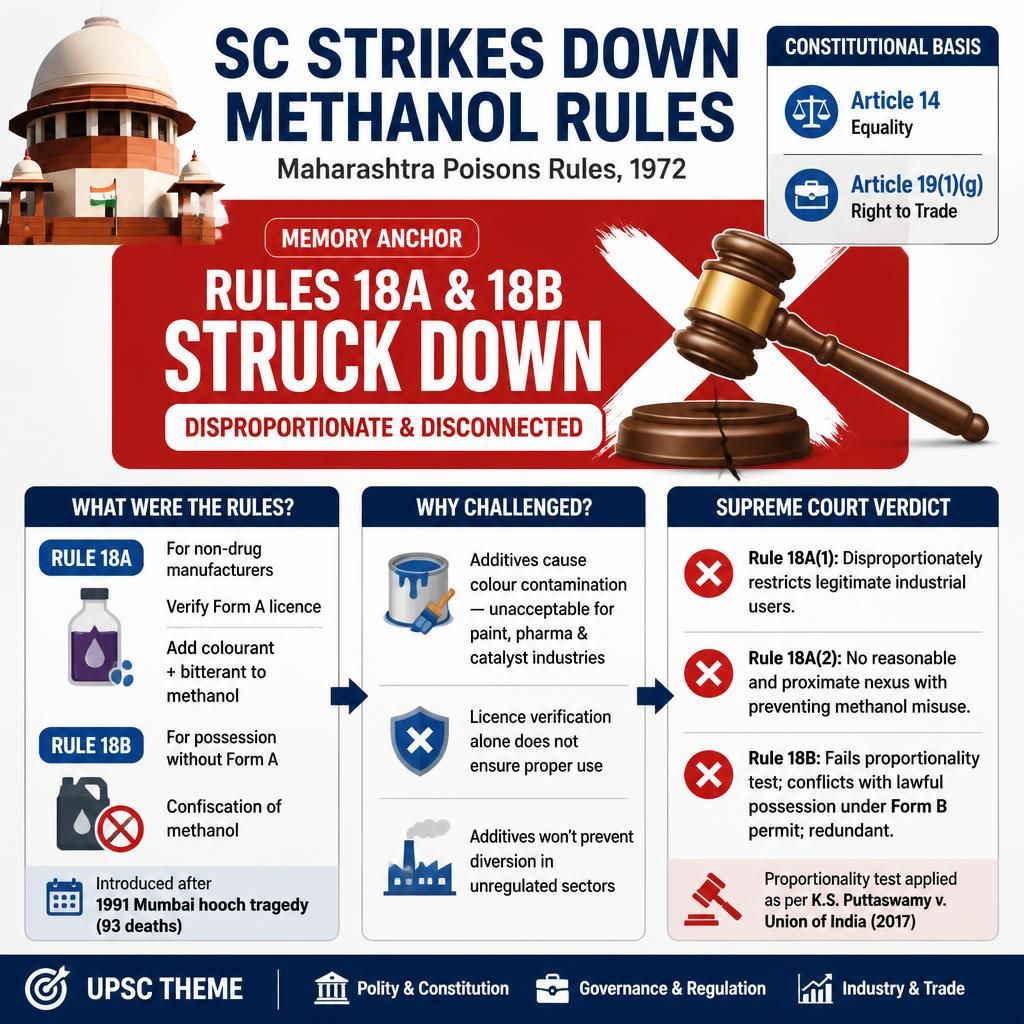
- On September 18, the Supreme Court struck down Rules 18A and 18B of the Maharashtra Poisons Rules, 1972.
- These rules mandated denaturing methanol with a colourant and bitterant before sale to non-drug manufacturers.
- The Court ruled that the measures were disproportionate and lacked a sufficient connection to the problem they aimed to address.
- The decision cited violations of Article 14 (equality) and Article 19(1)(g) (right to trade) of the Indian Constitution.
- The rules were initially introduced following a 1991 hooch tragedy in Mumbai that resulted in 93 deaths.
Methanol Rules.jpg
Detailed Insights:
- Methanol, or methyl alcohol, is a highly toxic substance also widely used as an industrial raw material in products like formaldehyde, paints, and resins.
- The Maharashtra Poisons Rules, 1972 were amended in 2011 to introduce stricter controls on methanol after the 1991 hooch tragedy.
- Rule 18A required verification of a purchaser’s Form A licence and mandated the addition of colourant and bitterant to methanol for non-drug manufacturers.
- Rule 18B provided for the confiscation of methanol possessed without a Form A licence.
- Methanol-based product manufacturers argued that colour contamination and additives would render their products unacceptable for paint, pharmaceutical, and catalyst industries.
- The Supreme Court found Rule 18A(1) disproportionately restricted legitimate industrial users, as merely verifying a licence did not ensure proper use.
- Rule 18A(2) was deemed to lack a reasonable and proximate nexus with preventing methanol misuse, as additives would not prevent diversion in unregulated sectors.
- Rule 18B failed the proportionality test as it could conflict with lawful possession under a Form B permit, effectively making it redundant.
- The Court applied the proportionality framework established in K.S. Puttaswamy v. Union of India (2017) to assess the validity of the rules.
- The Supreme Court issued guidelines for states, emphasizing inter-departmental cooperation and strengthening existing methanol regulations.
- These guidelines included regular review of licences, proper stock and consumption records, dedicated and sealed transport for methanol, and increased de-addiction facilities.
Key Concepts Involved:
- Methanol: A highly toxic alcohol used industrially, but dangerous if consumed, often found in illicit liquor.
- Hooch Tragedy: Incidents of mass poisoning and death caused by the consumption of illicit liquor adulterated with toxic substances like methanol.
- Proportionality Test: A legal principle used by courts to determine if a restriction on a fundamental right is appropriate, necessary, and not excessive for its intended aim.
- Article 14 of the Indian Constitution: Guarantees equality before the law and equal protection of the laws, prohibiting arbitrary state action.
- Article 19(1)(g) of the Indian Constitution: Protects the fundamental right to practice any profession, or to carry on any occupation, trade or business.
- Poisons Act, 1919: Central legislation empowering state governments to make rules regulating the possession and sale of poisons.

SuperKalam is your personal mentor for UPSC preparation, guiding you at every step of the exam journey.
Download the App


STUDY RESOURCES
CONTACT US
ⓒ Snapstack Technologies Private Limited