GS 3: Science & TechnologyPrelimsGS 3: Indigenization of Technology and New Technology DevelopmentGS 3: Space Technology
How will Gaganyaan’s crew module deploy its parachutes?, Pg8
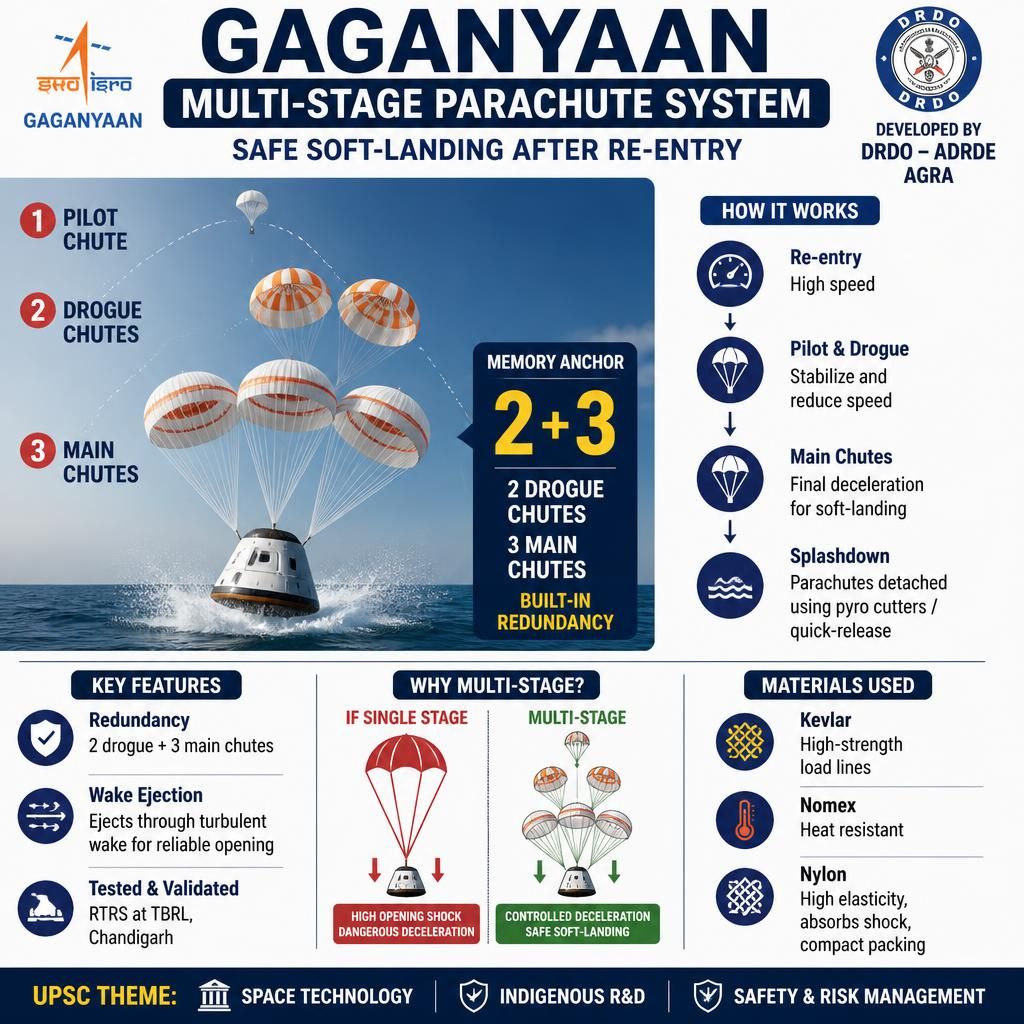
Gaganyaan's crew module employs a multi-stage, redundant parachute system using pilot, drogue, and main chutes for safe re-entry and soft-landing.
Practice MCQs
760 Students attempted
Key Highlights:
- The Gaganyaan crew module will utilize a multi-stage parachute system for a safe soft-landing after re-entry.
- The system comprises pilot, drogue, and main parachutes, deployed sequentially to manage deceleration and opening shock.
- The Defence Research & Development Organisation (DRDO) laboratory, ADRDE in Agra, is developing the parachute system for Gaganyaan.
- The crew module's recovery system incorporates redundancy with two drogue chutes and three main chutes to ensure safety even if one main parachute fails.
- Parachutes are deployed below the speed of sound and detached after splashdown using pyro cutters or mechanical quick-release devices.
Gaganyaan.jpg
Detailed Insights:
- Spacecraft re-entering Earth's atmosphere primarily use atmospheric drag to reduce velocity, with parachutes providing the final deceleration for a gentle touchdown.
- Multi-staging of parachutes is crucial to prevent high opening shock and dangerous deceleration for the crew, by gradually increasing the parachute diameter.
- The parachute system is designed to eject through the turbulent wake created by the crew module's blunt shape, ensuring rapid and effective deployment.
- Testing platforms like the rail track rocket sled (RTRS) at Terminal Ballistic Research Lab, Chandigarh, are used to validate parachute performance at appropriate velocities.
- Advanced synthetic polymers such as Kevlar for high-load lines, Nomex for heat resistance, and Nylon for canopy broadcloths are used in aerospace parachutes.
- The elasticity of Nylon helps absorb initial dynamic shock loads during inflation and allows for compact packing.
- After landing, immediate detachment of parachutes is essential to prevent the module from being dragged on land or capsizing in water, which could injure astronauts.
Scientific/Technical Concepts Involved:
- Atmospheric Drag: The resistive force exerted by the atmosphere on an object moving through it, used for initial deceleration of spacecraft.
- Multi-staging: The sequential deployment of parachutes of increasing size to control deceleration and reduce opening shock.
- Pilot Chute: A small parachute deployed first to pull out larger drogue or main parachutes.
- Drogue Chute: A medium-sized parachute deployed early in descent to stabilize the module and reduce initial velocity.
- Main Chute: The largest parachute deployed in the final phase to achieve the required low velocity for a soft-landing.

SuperKalam is your personal mentor for UPSC preparation, guiding you at every step of the exam journey.
Download the App


STUDY RESOURCES
CONTACT US
ⓒ Snapstack Technologies Private Limited