GS 3: Internal SecurityGS 2: International RelationsPrelimsGS 4: Ethical Issues in International Relations and FundingGS 2: Bilateral, Regional and Global Groupings and Agreements
Houthis are putting Mecca pact to the test, Pg10
Houthi attacks on Saudi Arabia expose the Mecca Joint Defence Agreement's ineffectiveness, highlighting its lack of ratification and members' divergent strategic interests.
Practice MCQs
760 Students attempted
Key Highlights:
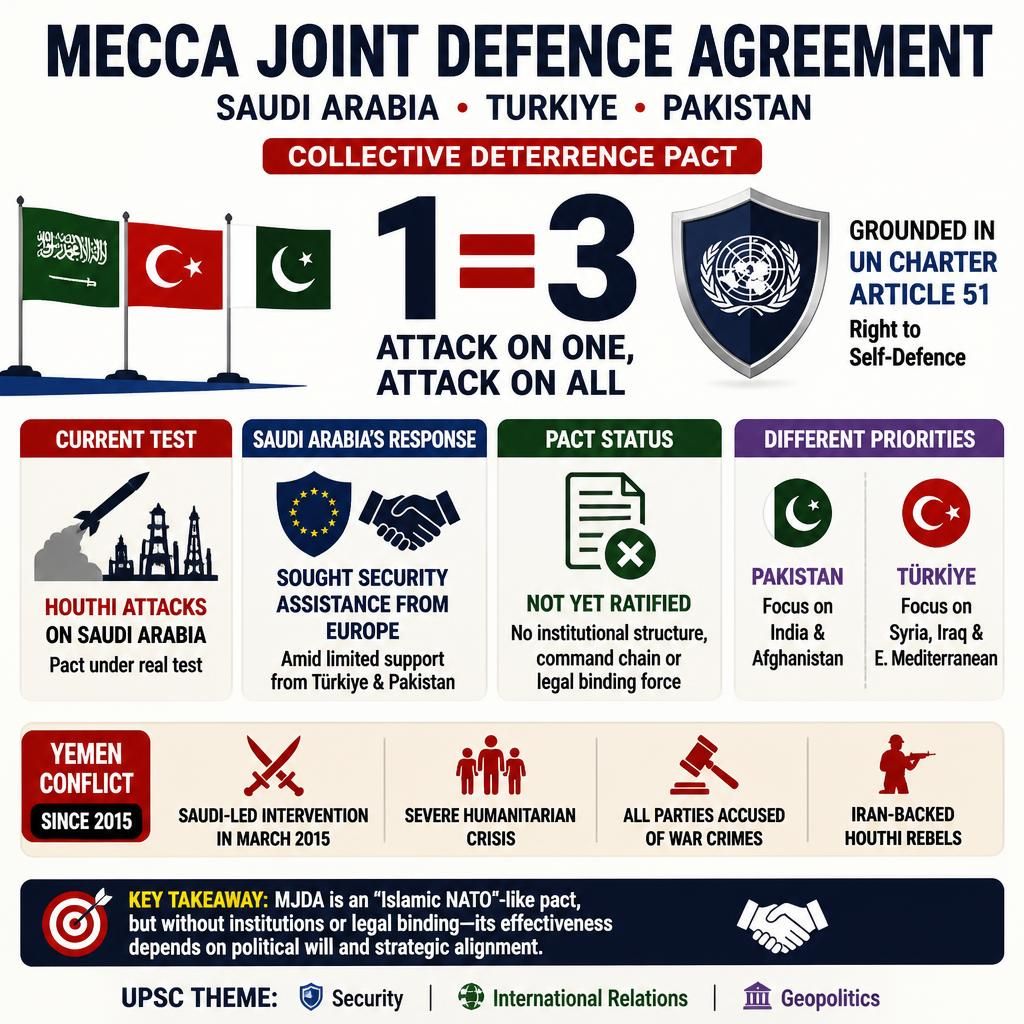
- The Mecca Joint Defence Agreement (MJDA) is a trilateral pact between Saudi Arabia, Turkey, and Pakistan for collective deterrence.
- It states that an armed attack against any member would be considered an attack against all, grounded in UN Charter Article 51.
- The pact is currently being tested by ongoing Houthi attacks against Saudi Arabia.
- Saudi Arabia has sought security assistance from Europe due to a lack of military support from Turkey and Pakistan.
Mecca Defense Pact.jpg
Detailed Insights:
- The MJDA was signed on August 7, drawing comparisons to an "Islamic NATO" due to its collective self-defence principles.
- Unlike NATO, the MJDA currently lacks an institutional structure, established command arrangements, and bureaucracy.
- Saudi Arabia intervened in Yemen in March 2015 to support the internationally recognized government against Iran-backed Houthi rebels.
- The Yemen conflict has led to a severe humanitarian crisis, with all parties accused of potential war crimes, including the Saudi-led coalition.
- The MJDA lacks official ratification and its mutual defence terms are not yet legally binding for member states.
- Saudi Arabia has sought security assistance from Europe after a cold response from the United States.
- Turkey and Pakistan have distinct strategic interests, with Pakistan focused on India and Afghanistan, and Turkey on Syria, Iraq, and the Eastern Mediterranean.
- The European Union is unlikely to provide direct military intervention to Saudi Arabia due to reported violations of International Humanitarian Law in Yemen.
Key Concepts Involved:
- Mecca Joint Defence Agreement (MJDA): A trilateral pact for collective deterrence and self-defence between Saudi Arabia, Turkey, and Pakistan.
- UN Charter Article 51: Recognizes the inherent right of states to individual and collective self-defence against armed attack.
- Collective Self-Defence: A principle where an armed attack against one state is considered an attack against all members of an alliance.
- International Humanitarian Law (IHL): A set of rules seeking to limit the effects of armed conflict, protecting persons not participating in hostilities.

SuperKalam is your personal mentor for UPSC preparation, guiding you at every step of the exam journey.
Download the App


STUDY RESOURCES
CONTACT US
ⓒ Snapstack Technologies Private Limited